
Botswana Ancient Rift Reawakening Inside African Craton
An ancient 180-million-year-old crack inside the Kalahari Craton in Botswana is reawakening, challenging long-held assumptions about continental stability.

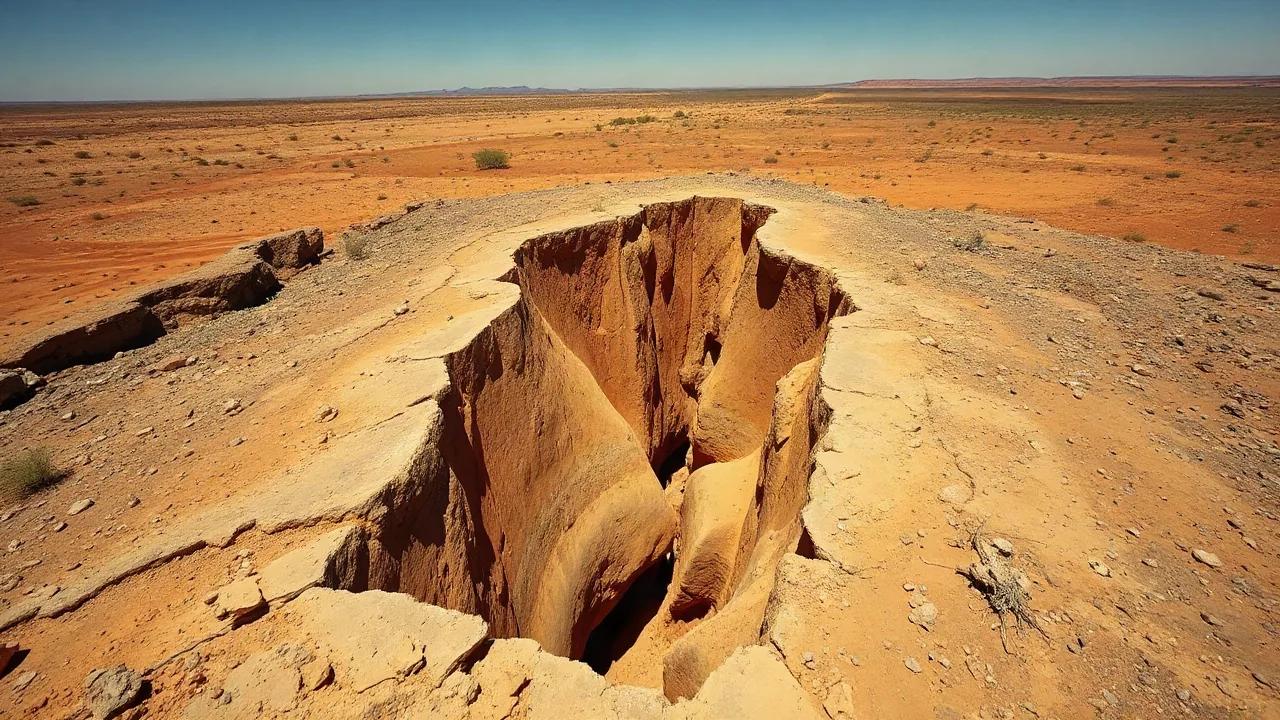
A geological study published in the journal Tectonics reveals that an ancient 180-million-year-old crack is reopening inside the Kalahari Craton in eastern Botswana. Cratons are the ancient cores of continents, and this region is built from blocks of crust up to 3.7 billion years old. Geologists have traditionally considered such ancient cores too cold, thick, and rigid to tear apart, but researchers from the Botswana International University of Science and Technology (BIUST) and the Lamont-Doherty Earth Observatory found that the craton is indeed being pulled apart by a reawakening rift.
The discovery follows an investigation into a magnitude 6.5 earthquake that shook southern Africa in April 2017 from the middle of the craton. Researchers found that the active rift reaches nearly 200 miles into the craton itself, extending far beyond the Okavango Rift Zone of northern Botswana identified in the 1970s. To understand how the rift is breaking into the craton, the team focused on the Khurutshe Fault, which cuts a 50-mile-long scarp across the Kalahari landscape about 50 miles south of the 2017 earthquake site. Fieldwork involving trenches, groundwater boreholes, and electrical resistivity tomography revealed that the fault moved during the Jurassic period roughly 180 million years ago and is moving again today, offsetting young Kalahari sands laid down mostly within the last 2.6 million years.
Reactivating Ancient Geological Seams
The study highlights how ancient geological seams can reactivate to fracture even the oldest continental cores. Structural geologist and co-author Folarin Kolawole noted the unexpected nature of the activity. “The earthquake happened in the middle of the craton, a region where no one expected to have an active fault slipping, let alone an active plate boundary developing,” he said. Lead author Boniface Kgosidintsi added, “Whether rifts do propagate through cratons has been a really big question in geoscience.”
The researchers concluded that the rift first opened during a period of continent-wide stretching in the Jurassic before failing and going dormant until the East African Rift System began pulling on it again. The findings also suggest that faulting began before volcanic activity reached the area during the Jurassic, indicating that magma alone did not weaken the craton. Instead, the rift exploited existing weak spots where the craton's oldest pieces fused together billions of years ago. These new insights suggest the region south of the Okavango Rift, previously thought to be a single stable microplate called the San Plate, may be slowly breaking into two smaller plates named the North San Plate and the South San Plate.