
Astronomers Detect Radio Galaxy With Four Distinct Jet Eruptions
An international team of astronomers has identified a distant radio galaxy, PKS 0405-385, exhibiting four distinct episodes of jet activity. This groundbreaking discovery provides new insights into the complex feeding and outburst cycles of supermassive black holes.

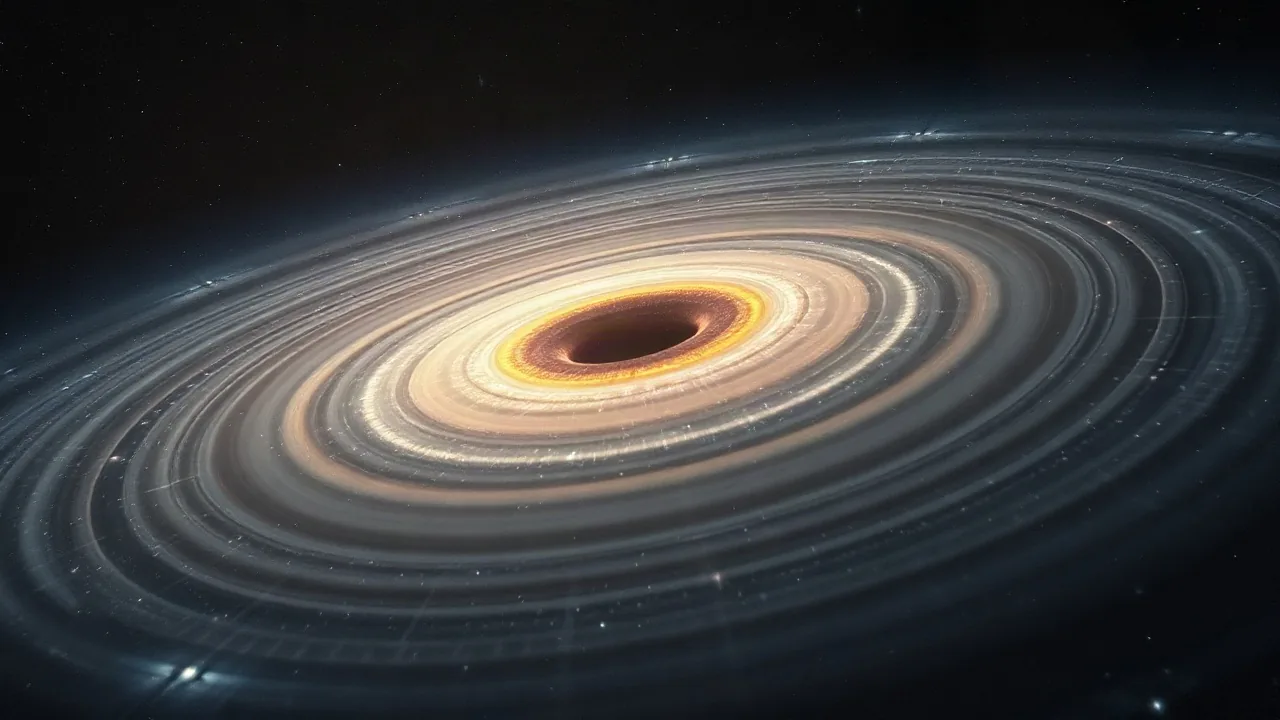
An international team of astronomers has discovered a distant radio galaxy, designated PKS 0405-385, displaying compelling evidence of four separate jet outbursts originating from its central supermassive black hole. The findings, published in the journal Astronomy & Astrophysics, offer a rare glimpse into the dynamic and cyclical nature of active galactic nuclei, challenging previous models of black hole feeding mechanisms. This radio galaxy is located approximately 770 million light-years away in the constellation Dorado.
These powerful jets, streams of charged particles ejected at nearly the speed of light, are a hallmark of active galactic nuclei. While single or double jet outbursts have been observed before, the detection of four distinct episodes in PKS 0405-385 suggests a more complex and potentially recurring pattern of activity. The research team utilized data from the Australia Telescope Compact Array (ATCA) and the MeerKAT radio telescope array in South Africa to analyze the radio emissions from the galaxy.
"We were surprised to find such clear evidence of multiple, distinct outbursts," said lead researcher Dr. Michelle Collins of the University of Bristol. "This galaxy is essentially showing us its history of feeding and erupting over a prolonged period. It’s like finding a geological record, but for black hole activity." The observations revealed concentric rings of radio emission, each corresponding to a past jet outburst, with the most recent activity still visible.
Unraveling Black Hole Feeding Cycles
The cyclical nature of these jet outbursts is crucial for understanding how supermassive black holes grow and influence their host galaxies. When a black hole accretes matter, it can trigger powerful outflows, including relativistic jets. These jets can heat the surrounding intergalactic gas, regulating star formation within the galaxy. The discovery of four separate outbursts in PKS 0405-385 implies that the feeding of the supermassive black hole is not continuous but occurs in bursts, leading to periodic activation of jet production.
This finding could help resolve a long-standing debate in astrophysics regarding the duty cycle of active galactic nuclei. Some models propose that black holes are continuously fed, leading to persistent jet activity, while others suggest intermittent feeding and episodic outbursts. The detailed structure observed in PKS 0405-385 strongly supports the latter. Dr. Ben Pope, an astrophysicist at the University of New South Wales and co-author of the study, explained that the spacing and intensity of the radio rings provide clues about the timescale and energy of each eruption event. "Each ring represents a 'fossil' of a past event, allowing us to reconstruct the history of the central engine," he stated.
Further observations with more sensitive radio telescopes are planned to refine the dating of these events and to search for similar multi-outburst galaxies. Understanding the precise mechanisms that trigger and quench these powerful jets is a key goal for astronomers studying the evolution of galaxies and the role of supermassive black holes in the cosmos. The study opens new avenues for investigating the interplay between black hole accretion and jet feedback, a fundamental process shaping the universe.