
Webb Telescope Captures Record Radio Signal From Early Universe
The James Webb Space Telescope has detected the most distant Fast Radio Burst (FRB) ever observed, originating from the early universe. This discovery offers new insights into the cosmic dawn.

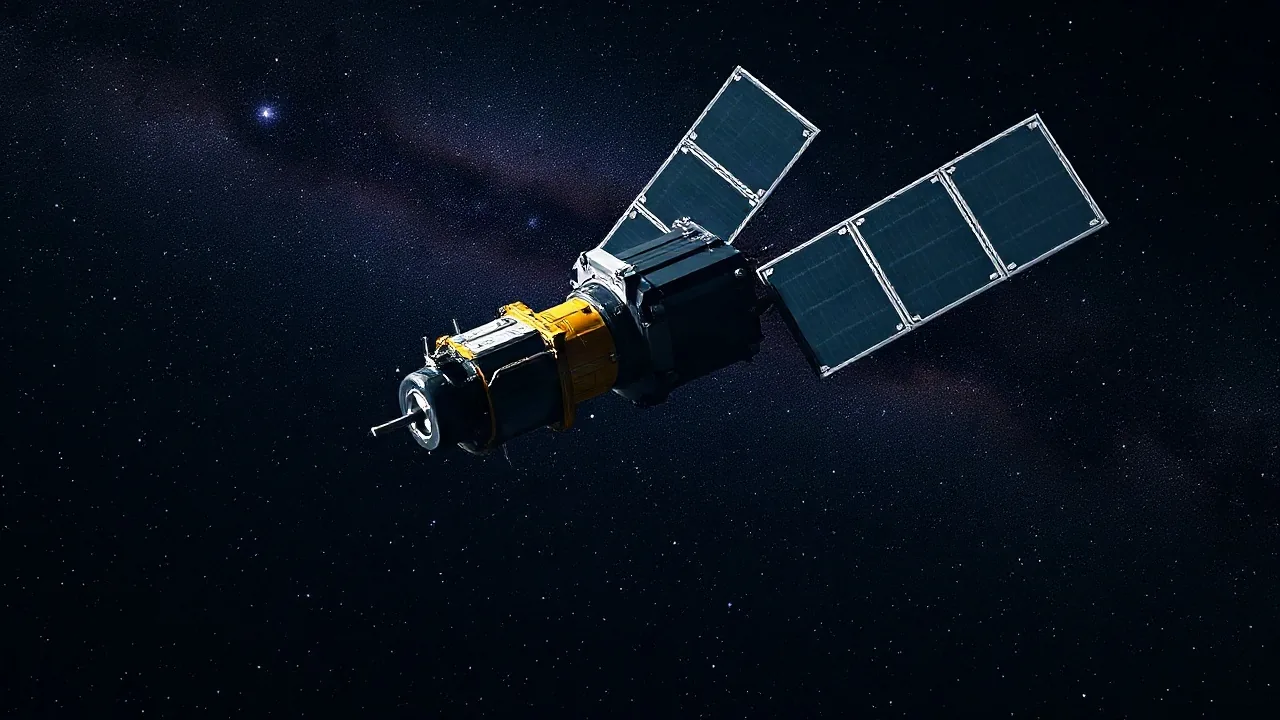
Astronomers using the James Webb Space Telescope (JWST) have detected the most distant Fast Radio Burst (FRB) ever recorded, tracing the powerful cosmic signal back to an era when the universe was still in its infancy. The signal, designated FRB 20220610A, originated from a galaxy approximately 12 billion light-years away, a finding that pushes the boundaries of our understanding of these enigmatic cosmic phenomena. This detection marks a significant advancement in the study of FRBs, which are intense, millisecond-long bursts of radio waves originating from deep space.
The discovery was announced by a team of international researchers who utilized the unparalleled observational capabilities of the JWST. By analyzing the light emitted by the host galaxy of FRB 20220610A, scientists were able to pinpoint its immense distance. The signal's origin in the early universe, a period characterized by the formation of the first stars and galaxies, suggests that FRBs may have been more common in the cosmos's youth. This provides a unique opportunity to study the conditions of the universe shortly after the Big Bang.
Fast Radio Bursts are among the most puzzling phenomena in astrophysics. While their exact origin remains unknown, theories range from highly magnetized neutron stars (magnetars) to more exotic explanations. Some researchers believe that the rate of FRBs may have been higher in the early universe, when star formation was more vigorous. The detection of this distant FRB by the Webb Space Telescope lends significant support to this hypothesis.
Cosmic Dawn Insights
The ability of the JWST to observe in infrared light allowed astronomers to peer through the dust and gas that obscure distant objects, providing a clear view of the host galaxy. "This is the most distant FRB detected to date," said Dr. Ryan Chornock, an astronomer at Ohio State University and part of the research team. "It allows us to probe the universe at a time when the first stars and galaxies were just beginning to form, offering a glimpse into the cosmic dawn." The specific properties of the host galaxy, including its star formation rate and metallicity, are still being analyzed, but preliminary data suggests it is a dwarf galaxy with a high rate of star formation.
Previous detections of FRBs have been limited to galaxies much closer to Earth, typically within a few billion light-years. This record-breaking distance opens up a new observational window into the universe's past. By studying the characteristics of this ancient FRB and its host galaxy, scientists hope to gain crucial insights into the evolution of galaxies, the distribution of matter in the early universe, and the physical processes that generate these powerful radio emissions. The radio signal itself carries imprints of the matter it has traversed over billions of years, allowing astronomers to study the intergalactic medium during that epoch.
The implications of this discovery extend beyond understanding FRBs themselves. It demonstrates the power of the JWST to explore the universe's earliest epochs and detect faint signals from cosmic dawn. As more such distant FRBs are identified, astronomers will be able to build a more comprehensive picture of the universe's evolution and the conditions that prevailed when the first light emerged. The study of ancient universe phenomena like this FRB is crucial for testing cosmological models and understanding our place in the cosmos. The team plans further observations to refine the measurements and investigate potential correlations between FRB activity and the cosmic environments of the early universe.