
Roman Telescope Launch Promises New Universe Insights
NASA's Nancy Grace Roman Space Telescope is set for launch on August 30, 2026. This advanced observatory aims to map billions of galaxies and explore cosmic mysteries like dark matter and dark energy.

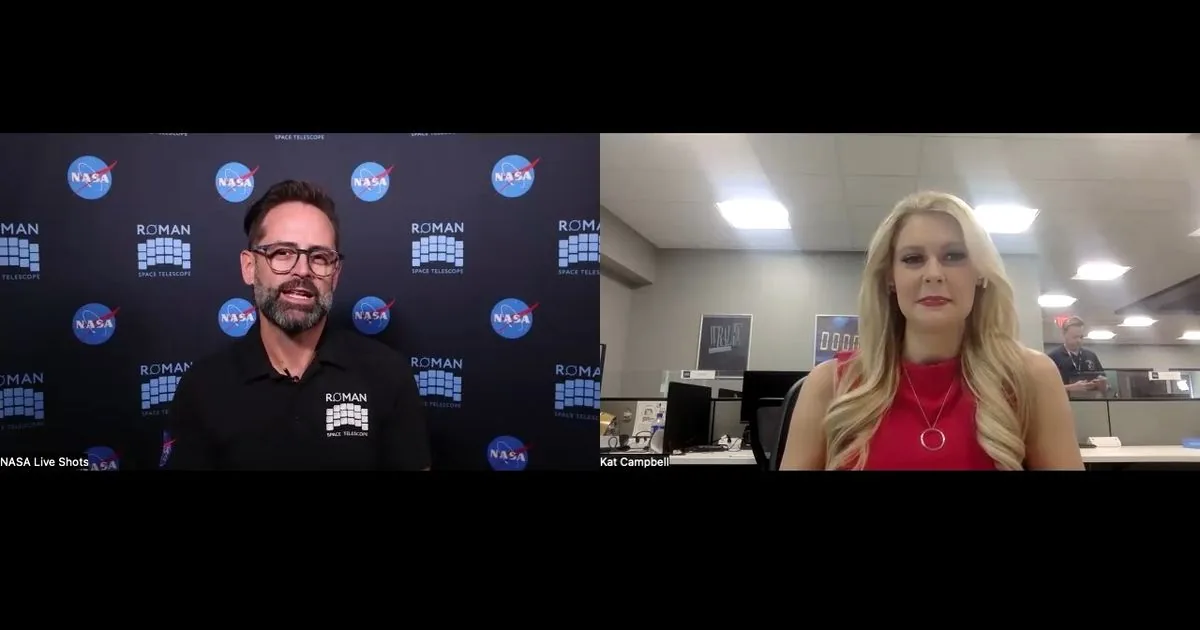
The Nancy Grace Roman Space Telescope, a powerful new instrument poised to redefine humanity's understanding of the cosmos, is scheduled for launch on Sunday, August 30, 2026. The observatory will lift off from NASA’s Kennedy Space Center in Florida aboard a SpaceX Falcon Heavy rocket, with a target liftoff time of 7:26 a.m. EDT, provided weather conditions are favorable. For Lucas Paganini, program executive for the Roman mission, this launch represents the culmination of years of dedicated effort and the dawn of a transformative era in astronomical research. "This is the best tool we have ever developed to study the universe," Paganini stated, emphasizing the telescope's unprecedented capabilities.
Designed for vast cosmic surveys, the Roman telescope will capture incredibly detailed images across enormous swathes of space, offering a field of view at least 100 times larger than that of the Hubble Space Telescope. NASA officials likened the primary camera's scale to 32 individual 4K televisions displaying a single, cohesive image. This remarkable instrument is anticipated to generate approximately 1.4 terabytes of scientific data daily. The mission's objectives include mapping billions of galaxies and stars, potentially discovering thousands of exoplanets, and providing crucial insights into the nature of dark matter and dark energy, as well as the intricate processes of galaxy formation and evolution.
Unraveling Cosmic Composition
A central focus for the Roman telescope will be addressing one of astronomy's most profound questions: the fundamental composition of the universe. Current scientific consensus indicates that ordinary matter—everything observable, from stars and planets to living beings—constitutes a mere fraction of the universe's total mass-energy. The overwhelming majority is believed to be composed of enigmatic dark matter and dark energy, substances that do not interact with light and whose properties remain largely mysterious. "We actually don't quite know what the universe is made of," Paganini acknowledged. The high-resolution data and broad survey capabilities of the Roman telescope are expected to yield novel clues, potentially challenging and refining existing cosmological models.
The telescope honors Nancy Grace Roman, a pioneering figure in space-based astronomy and NASA's first chief astronomer. Roman recognized early on that many of the universe's most significant questions could only be answered by placing observational instruments above Earth's atmospheric interference. "She was a trailblazer," Paganini remarked, noting her instrumental role in paving the way for iconic space observatories like the Hubble Space Telescope. Her vision underscores the enduring importance of pushing the boundaries of space exploration to achieve greater scientific understanding.
Following its planned August 30, 2026, launch, the Roman telescope will undergo a rigorous commissioning period lasting approximately three months. During this phase, engineers will meticulously verify that all its sophisticated instruments and optical systems are functioning optimally. Once science operations commence, the vast datasets collected by the telescope will be made publicly accessible. "You don't have to be with NASA in order to take a look at the data, analyze it," Paganini explained, underscoring the mission's commitment to open science. This accessibility ensures that researchers and students worldwide, including those at universities and institutions across the United States, can actively participate in analyzing the incoming data and contributing to groundbreaking discoveries about the cosmos. After years of meticulous planning and development, the quest to answer some of humanity's most fundamental questions is on the cusp of a new, data-rich chapter.