
3 Major Solar Flares Boost Northern Lights Chances Across US
Three powerful solar flares erupted from the sun this week, creating an increased possibility of viewing the aurora borealis across the United States. The flares could also impact technology on Earth.

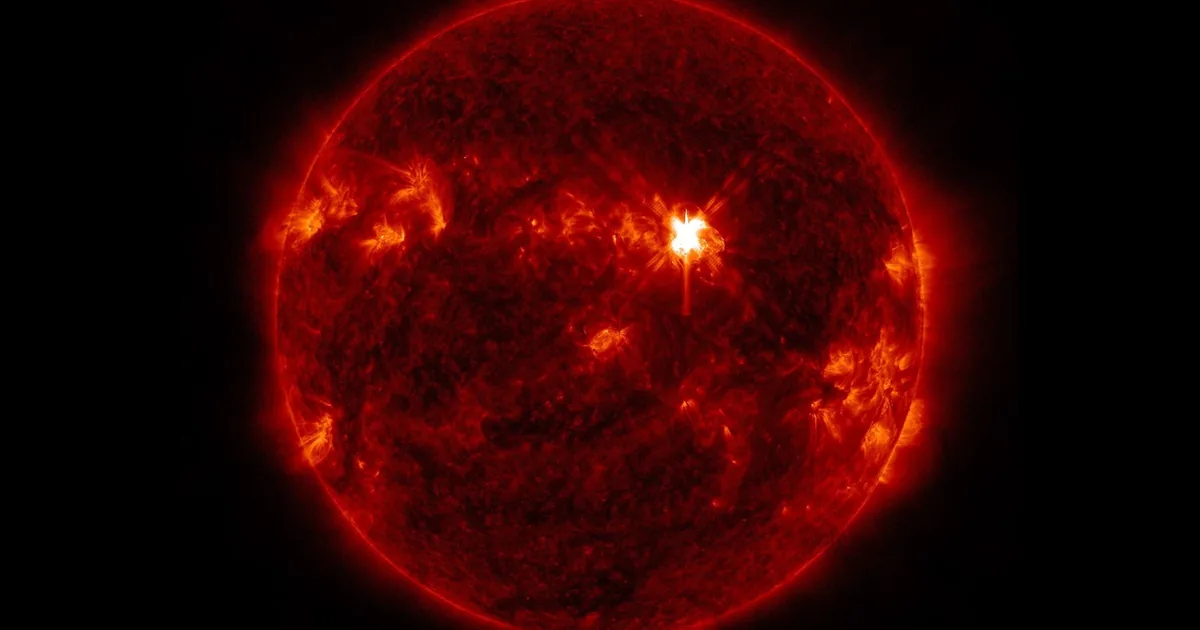
Three significant solar flares erupted from the sun this week, heading towards Earth and raising the likelihood of seeing the aurora borealis, commonly known as the northern lights, across the United States. Scientists at the National Weather Service's Space Weather Prediction Center noted that the trio of flares, expelled within a 24-hour period, are expected to merge before reaching our planet.
Solar flares are intense bursts of electromagnetic radiation, including X-rays and ultraviolet light, originating from the sun's surface, according to NASA. These powerful events are frequently linked to coronal mass ejections (CMEs), which are large expulsions of plasma and magnetic field from the sun's corona. If directed toward Earth, CMEs can significantly disrupt technological systems.
Potential Impacts and Aurora Visibility
While the precise intensity of the combined flares remains uncertain, forecasters predict a geomagnetic storm classification between 'strong' and 'severe' on a scale of 1 to 5. The National Weather Service issued an advisory, stating a 'fair level of confidence' in an Earth arrival. The most powerful of the three flares, classified as an X1.0 event—the strongest category—peaked early Wednesday morning, according to NASA, which released an image of the bright eruption against the sun's silhouette.
These solar phenomena pose potential risks to Earth's infrastructure. NASA has previously warned that solar flares and geomagnetic storms can interfere with telecommunications, including radio broadcasts, and satellite operations. They can also affect electrical power grids, navigation systems, and pose safety concerns for astronauts and spacecraft in orbit.
However, the enhanced solar activity also presents an exciting opportunity for skywatchers. The increased geomagnetic activity associated with these flares often leads to more vibrant and widespread displays of the aurora borealis. Regions in the northern United States, and potentially further south than usual, may have a chance to witness the natural light show in the coming nights.