
South Dakota Mine Explores Universe Secrets: Dark Matter & Antimatter
A former gold mine in South Dakota is now a cutting-edge research facility, delving into the universe's mysteries like dark matter and antimatter. Scientists are using the deep underground environment to conduct experiments seeking fundamental physics answers.

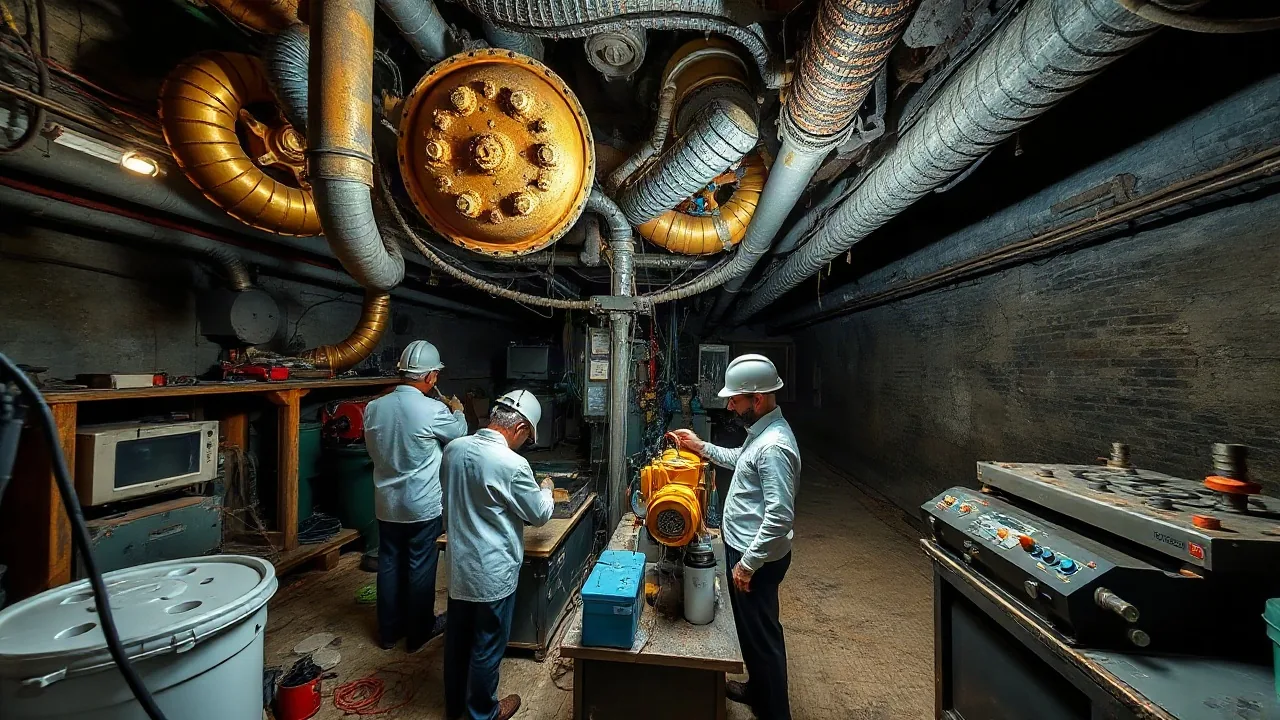
Lead, South Dakota – Beneath the rolling hills of the Black Hills, a former gold mine has been transformed into a scientific frontier, where researchers are listening for the faint whispers of the universe's most elusive secrets. The Sanford Underground Research Facility (SURF), located nearly a mile below the surface in the historic Homestake Mine, is currently at the forefront of the quest to understand dark matter and antimatter.
For over a century, the Homestake Mine was synonymous with gold extraction, producing over 40 million ounces of the precious metal. However, its closure in 2001 marked the beginning of a new era. The immense depth and the natural shielding provided by over 7,400 feet of rock above the experimental sites make it an unparalleled location for detecting faint particle signals that would otherwise be drowned out by cosmic rays and background radiation at the Earth's surface. This unique environment is crucial for experiments like LUX-ZEPLIN (LZ), designed to detect weakly interacting massive particles (WIMPs), a leading candidate for dark matter.
Deep Science from a Deep Place
The search for dark matter, which is believed to make up about 85% of the universe's mass but does not emit, absorb, or reflect light, is a primary focus at SURF. Experiments like LZ aim to directly observe the interaction of dark matter particles with ordinary matter. "The sheer amount of overburden is what makes this site so special," said Dr. Emily Carter, a lead physicist on the LZ experiment. "It effectively acts as a shield, allowing us to see signals that are incredibly rare, signals that could finally reveal the nature of dark matter."
Beyond dark matter, SURF is also home to experiments investigating neutrinos and the fundamental properties of antimatter. The Large Area Telescope (LAT) on the Fermi Gamma-ray Space Telescope has provided data that, when combined with ground-based observations from facilities like SURF, helps scientists piece together cosmic events. Understanding antimatter is a key piece of the cosmological puzzle, as the Big Bang should have created equal amounts of matter and antimatter, yet the universe is overwhelmingly composed of matter.
The transition from a bustling gold mining operation to a sophisticated scientific laboratory represents a significant shift in human endeavor. The infrastructure of the old mine – its shafts, tunnels, and electrical systems – has been repurposed and upgraded to support highly sensitive scientific instruments. Teams of geologists, engineers, and particle physicists collaborate to maintain and operate these complex experiments in the challenging underground environment.
The scientific community anticipates that discoveries made at SURF could revolutionize our understanding of physics and cosmology. By probing the universe from the depths of the Earth, researchers hope to answer some of humanity's most profound questions: what is the universe made of, and how did it evolve? The continued operation and expansion of SURF promise to be a cornerstone in these ongoing investigations.