
November Supermoon and Mars-Jupiter Conjunction Light Up 2026 Sky
November 2026 will feature a stunning supermoon alongside a rare conjunction of Mars and Jupiter, offering a spectacular celestial display for skywatchers.

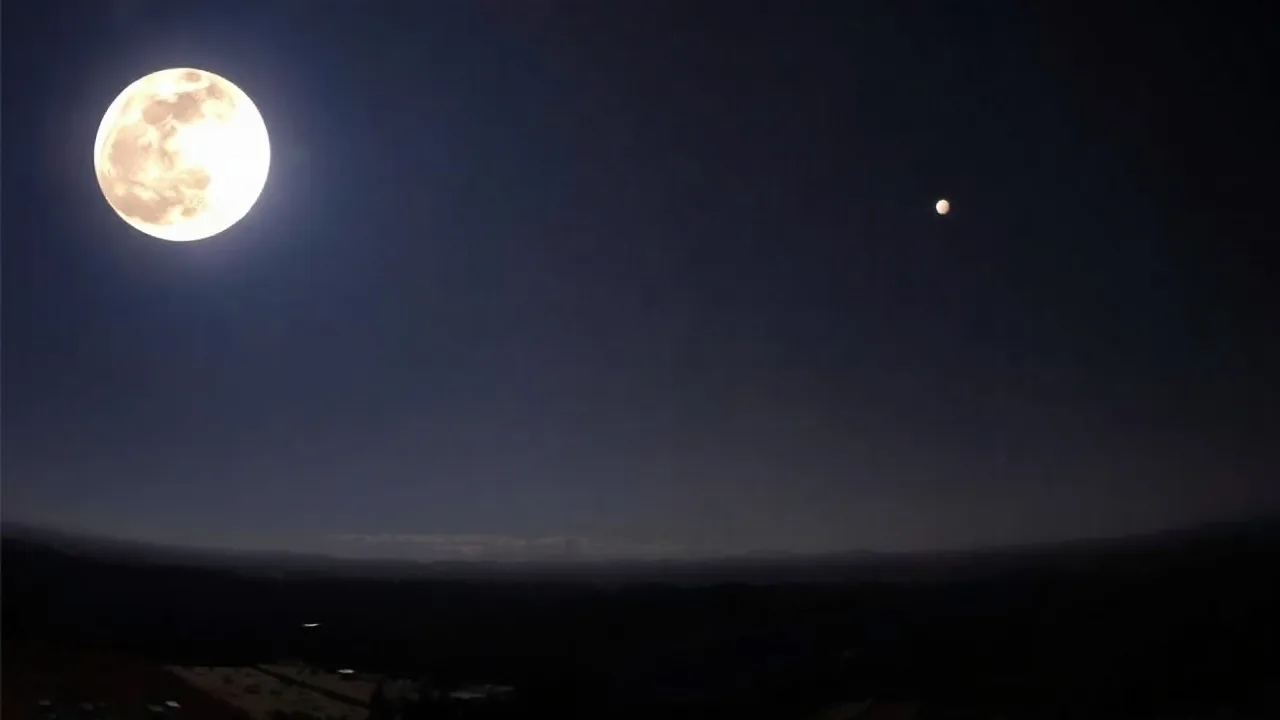
The night sky in November 2026 is set to dazzle observers with a significant astronomical event: a supermoon will rise, coinciding with a rare planetary meetup of Mars and Jupiter. This celestial spectacle promises to be a highlight of the year for amateur astronomers and casual stargazers alike, offering a brilliant display shortly after sunset.
The full moon in November, often called the Beaver Moon, will appear larger and brighter than usual as it reaches its perigee, the closest point to Earth in its orbit. This year, the timing of the full moon is particularly noteworthy due to the simultaneous alignment of two prominent planets. Mars, the Red Planet, and Jupiter, the solar system's largest planet, will appear exceptionally close together in the sky for much of the month.
Planetary Dance and Lunar Spectacle
Skywatchers can anticipate witnessing the Mars-Jupiter conjunction throughout November. While they won't physically collide, their apparent proximity in our sky will create a striking visual. This alignment is a product of their respective orbits around the Sun, with Earth's perspective from November 2026 allowing us to see them in close alignment. The precise timing of the closest approach will occur on November 28th, making that evening a prime opportunity for observation.
The supermoon, expected on November 27th, will further enhance the celestial drama. A supermoon occurs when a full moon coincides with its perigee, making it appear up to 14% larger and 30% brighter than a typical full moon. The combination of the prominent planets and the luminous supermoon offers a unique astronomical treat.
These events provide a fantastic opportunity for astronomy enthusiasts to engage with the cosmos. Understanding these alignments requires a grasp of orbital mechanics. Planets appear to move across our sky due to their orbits around the Sun and the Earth's own journey. When we observe two planets seemingly close, it's a matter of their positions relative to Earth at that specific moment.
For those eager to catch the show, clear skies and minimal light pollution will be key. The planets and the moon will be visible to the naked eye, though binoculars or a telescope will offer a more detailed view of their features. The early evening hours, shortly after sunset, will be the optimal time to look towards the eastern horizon for the rising moon and the planetary pair.
This conjunction and supermoon are not just visually appealing; they are reminders of the dynamic and ever-changing nature of our solar system. Events like these have fascinated humans for millennia, inspiring mythology, navigation, and scientific inquiry. Observing them in 2026 connects us to that long tradition of celestial observation.