
Oldest Mars Meteorite Fragment Found in Sahara Dates to 4.1 Billion Years
A Martian meteorite discovered in the Sahara Desert, designated Teghaza-001, has been dated to at least 4.1 billion years old, offering crucial insights into the early solar system.

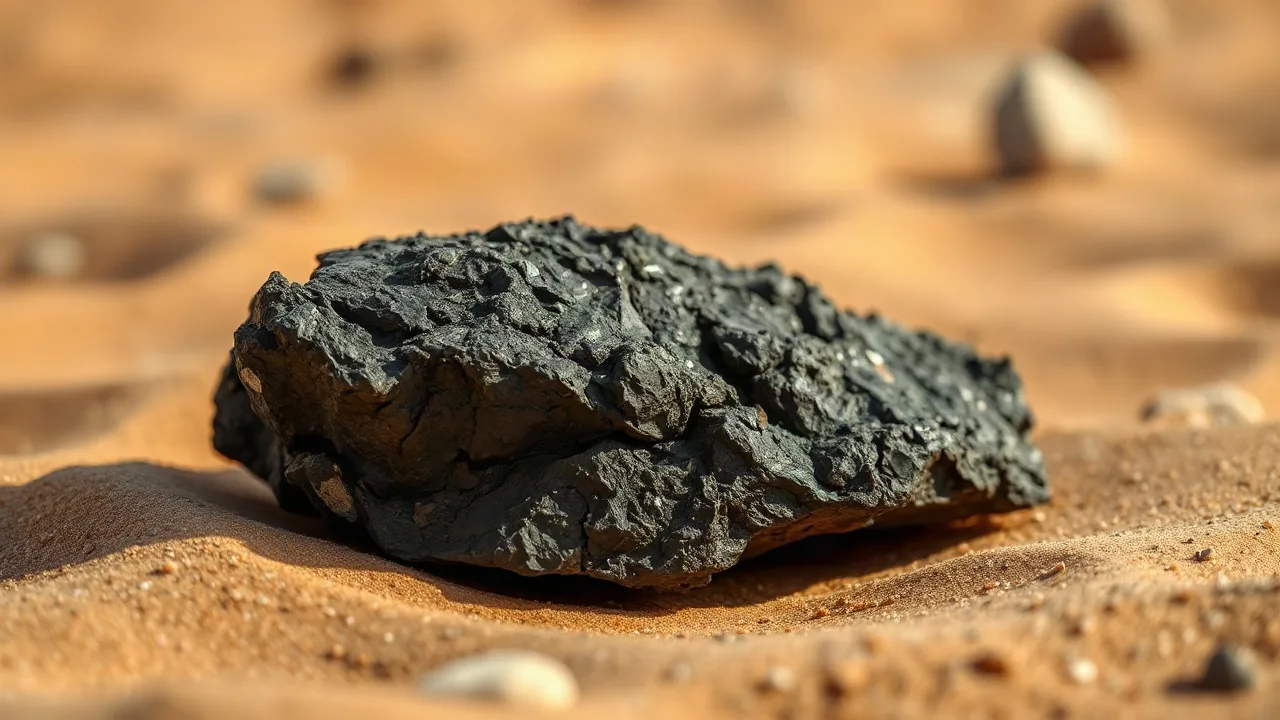
An ancient Martian meteorite, identified as Teghaza-001, has been unearthed in the Sahara Desert, with scientists determining its age to be at least 4.1 billion years old. This remarkable discovery provides a rare glimpse into the foundational era of the solar system and the initial evolution of the Red Planet. The fragment is among the oldest known pieces of Mars ever recovered.
The meteorite was found in the vast Sahara Desert by meteorite hunters and has since undergone extensive analysis by researchers. Its mineral composition and isotopic signatures strongly indicate an origin from Mars. The age of Teghaza-001 places it among the earliest known Martian rocks, potentially predating many significant geological events on the planet.
Early Solar System Insights
Scientists are particularly interested in Teghaza-001 because its extreme age allows for an unprecedented study of the conditions on Mars and in the inner solar system during its infancy. Understanding the early Martian environment is critical for comprehending how planets form and evolve, and whether life could have emerged on other worlds. The composition of such ancient rocks can reveal details about the planet's initial atmosphere, its geological activity, and the presence of water billions of years ago.
Dr. Anya Sharma, a planetary geologist at the University of California, Berkeley, who was not involved in the initial dating, commented on the significance. "Discoveries like Teghaza-001 are invaluable," Dr. Sharma stated. "They act as time capsules, offering direct evidence of planetary processes that occurred when our solar system was still in its formative stages. Studying these ancient fragments can help us refine our models of planet formation and potentially answer questions about the habitability of early Mars."
The dating of meteorites is a complex process that often involves analyzing radioactive isotopes within the rock. By measuring the ratios of parent isotopes to their decay products, scientists can calculate how much time has passed since the rock solidified. The age of 4.1 billion years for Teghaza-001 suggests it originated from an era when Mars was potentially much more geologically active and may have possessed conditions more favorable for life than previously thought for that period.
The implications of this finding extend beyond Martian science. Studying the early conditions of Mars, a planet that shares many similarities with Earth, can provide comparative data for understanding our own planet's history. Researchers hope that further analysis of Teghaza-001 will uncover more about the early chemical environment of Mars, including the availability of elements and compounds essential for life.
The research team is planning further studies, including detailed microstructural analysis and isotopic composition studies, to glean even more information from this ancient Martian artifact. This Martian meteorite discovery underscores the importance of meteorite research in expanding our knowledge of the solar system's history and the potential for extraterrestrial life.