
SpaceX Falcon 9 Dominates Commercial Launch Market
SpaceX's reusable Falcon 9 rocket continues to lead the commercial space industry, setting new records for orbital launches and satellite deployment. The company's focus on rocket reusability has fundamentally reshaped how the aerospace sector approaches spaceflight economics.

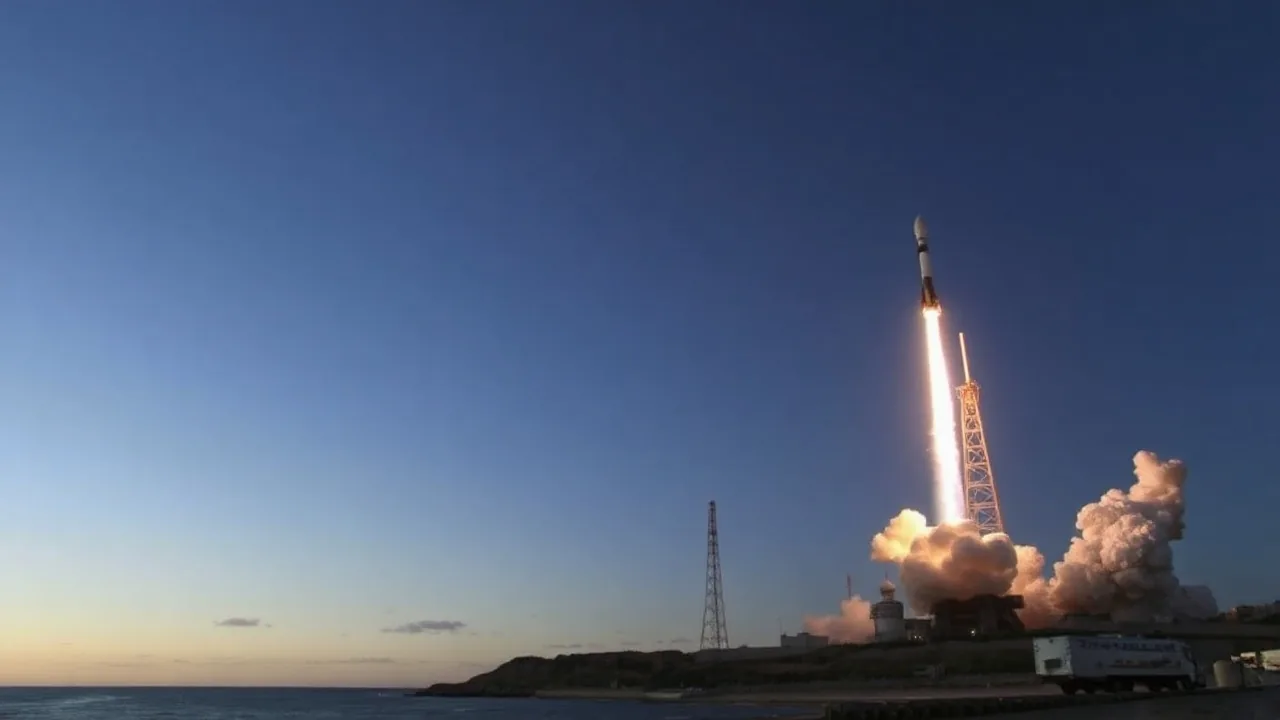
SpaceX launched its 300th Falcon 9 mission in late 2024, cementing the rocket's position as the most frequently flown orbital launcher in human history. The milestone underscores how thoroughly the Sunnyvale, California-based company has disrupted the commercial launch sector since the Falcon 9's maiden flight in 2010.
Each successful mission delivers satellites for telecommunications networks, Earth observation operators, and government agencies. The rocket's ability to land its first-stage booster and refleet it within days has slashed operational costs and accelerated launch cadence across the entire industry.
How Reusability Reshaped Commercial Launch Economics
Traditional expendable rockets cost between $50 million and $150 million per launch because each booster was discarded after a single flight. SpaceX demonstrated that reusable rockets could cut per-launch expenses dramatically by recovering and refurbishing boosters.
The Falcon 9's first stage has now completed over 250 successful booster landings and reflights. SpaceX's record booster, B1051, has been launched 22 times. This operational tempo would be impossible with expendable hardware.
"Reusability is the only way to dramatically reduce launch costs," said SpaceX founder Elon Musk during the company's third quarter 2024 update. The strategy has forced competitors like United Launch Alliance, Arianespace, and emerging Chinese providers to accelerate their own reusable rocket programs.
Reduced launch costs have opened new market segments. Constellation operators like Amazon and OneWeb now deploy thousands of satellites for global broadband. Government space exploration missions benefit from more affordable rides to orbit.
Falcon 9's Role in NASA and Defense Department Operations
SpaceX holds long-term contracts with NASA to resupply the International Space Station and with the U.S. Space Force to deploy national security payloads. The Falcon 9 has become integral to American civil and military spaceflight operations.
NASA selected SpaceX as one of two providers for its Commercial Crew Program, which flies astronauts to and from the ISS. The Crew Dragon capsule, mounted atop Falcon 9, has completed multiple crewed missions for the space agency since 2020.
For the Department of Defense, SpaceX Falcon 9 launches carry classified intelligence, surveillance, and reconnaissance satellites. These missions require the same reliability standards as civil crewed flights, and Falcon 9's track record demonstrates consistent performance.
The Space Force has used Falcon 9 to deploy Space Force satellites across multiple orbits. These launches support military communications, GPS augmentation, and strategic early warning systems.
Competition and Industry Transformation
The Falcon 9's success has forced the broader space industry to innovate. Blue Origin's New Glenn, Relativity Space's 3D-printed Terran R, and Axiom Space's proposed heavy-lift vehicle are all being developed partly in response to SpaceX's demonstrated efficiency.
International competitors have also reacted. China's Long March 9 is in development as a reusable heavy-lift rocket. The European Space Agency's Ariane 6, which began operational flights in 2024, will eventually retire in favor of a fully reusable Ariane Next system.
Smaller launch providers focusing on specific niches have also emerged. Relativity Space and Rocket Lab operate in lighter payload classes, while SpaceX's Starship super-heavy vehicle sits at the opposite end of the spectrum, designed to lift more mass than any active rocket.
Despite this competition, Falcon 9 maintains its market share through a combination of proven reliability, fast turnaround times, and competitive pricing. In 2024, SpaceX completed over 60 Falcon 9 launches, more than any other operator globally.
Technological refinements continue. SpaceX regularly upgrades the Falcon 9's engines, avionics, and structural components. These incremental improvements maintain performance margins and extend booster service life.
The commercial launch market now represents a multi-billion-dollar sector. Smallsat constellation deployments, national government missions, and international payloads all depend on rocket technology providers who can deliver frequently and affordably. Falcon 9's dominance reflects SpaceX's ability to execute at scale while managing operational complexity.
As the space industry matures, aerospace companies and space agencies recognize that frequent, affordable access to orbit drives innovation. The Falcon 9 has become the baseline standard against which all other commercial launch providers are measured.