
SpaceX Starship Reaches Orbit in Landmark Test Flight
SpaceX successfully launched its Starship rocket on an unprecedented test flight Monday, reaching orbit for the first time and marking a major milestone for the company's ambitious space program.

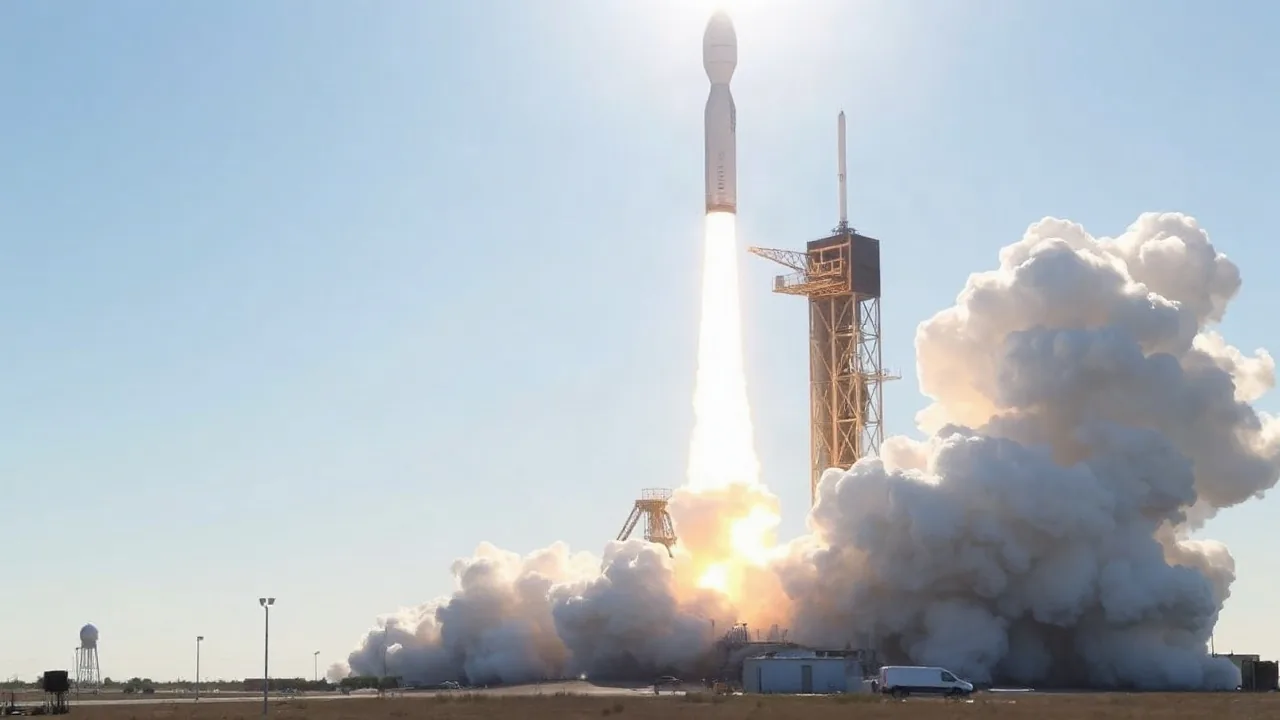
SpaceX achieved a historic milestone on Monday, September 28, 2026, successfully launching its massive Starship rocket into orbit for the very first time. The unprecedented test flight, originating from the company's Starbase facility in Boca Chica, Texas, represents a significant leap forward in the development of the reusable super heavy-lift launch vehicle.
The successful orbital insertion marks the culmination of years of development and multiple test flights. Previous attempts have focused on achieving key milestones such as stage separation, engine burns, and atmospheric re-entry, but reaching orbit itself was the ultimate objective for this latest mission. The Starship spacecraft, designed for deep space exploration, lunar missions, and eventually Mars colonization, carried a payload of Starlink V3 satellites, the next generation of SpaceX's satellite internet constellation.
Starship's Orbital Ambitions
The primary goal of this test flight was to validate Starship's capabilities in the extreme environment of space, including its life support systems, orbital maneuvering thrusters, and its ability to deploy payloads. The success of this mission is crucial for SpaceX's long-term vision, which includes a robust network of Starlink satellites and ambitious crewed missions to the Moon and Mars. Elon Musk, the founder and chief technology officer of SpaceX, has repeatedly stated that Starship is key to making humanity a multi-planetary species.
During the flight, mission control confirmed successful stage separation, with the Super Heavy booster returning to Earth for a planned splashdown in the Gulf of Mexico. The Starship upper stage then continued its journey, firing its Raptor engines to achieve orbital velocity. Data streamed back from the rocket indicated that all systems performed within expected parameters. "This is a critical step towards enabling a future where space travel is routine and accessible," a SpaceX spokesperson stated following the successful orbital insertion.
This launch is particularly significant as it represents the first time SpaceX has targeted an orbital trajectory with its full Starship stack. Previous missions had focused on sub-orbital flights or specific orbital tests of individual components. The company has been iterating rapidly on the design and capabilities of Starship, drawing on lessons learned from each test. The development of SpaceX's Starship program is closely watched by space agencies and private companies worldwide, as its potential to lower launch costs and increase payload capacity could revolutionize space access.
The successful deployment of the Starlink V3 satellites is also a notable achievement. These advanced satellites are designed to offer higher bandwidth and lower latency, improving the performance of SpaceX's global internet service. The ability to launch these satellites directly into orbit on the Starship platform demonstrates the vehicle's versatility and its capacity to support commercial satellite deployment alongside its more ambitious interplanetary goals.
While this test flight is a resounding success, SpaceX acknowledges that significant challenges remain. The next phases of development will focus on demonstrating Starship's re-entry capabilities, its ability to perform a controlled landing, and eventually, its full reusability. The ultimate aim is to achieve rapid turnaround between flights, drastically reducing the cost of space missions.
The implications of a fully operational Starship extend far beyond satellite launches. It is envisioned as the primary vehicle for NASA's Artemis program missions to the Moon, providing a crucial transportation system for astronauts and cargo. Furthermore, SpaceX plans to use Starship for its own ambitious private lunar missions and, critically, to establish a permanent human settlement on Mars in the coming decades. This orbital test flight is a powerful testament to that vision, bringing the dream of interplanetary travel one giant leap closer to reality.