
SpaceX Starship Achieves Major Test Milestones in 2024
SpaceX's Starship program has reached critical development phases with successful booster catches and orbital flight tests, accelerating timelines for lunar missions and Mars exploration.

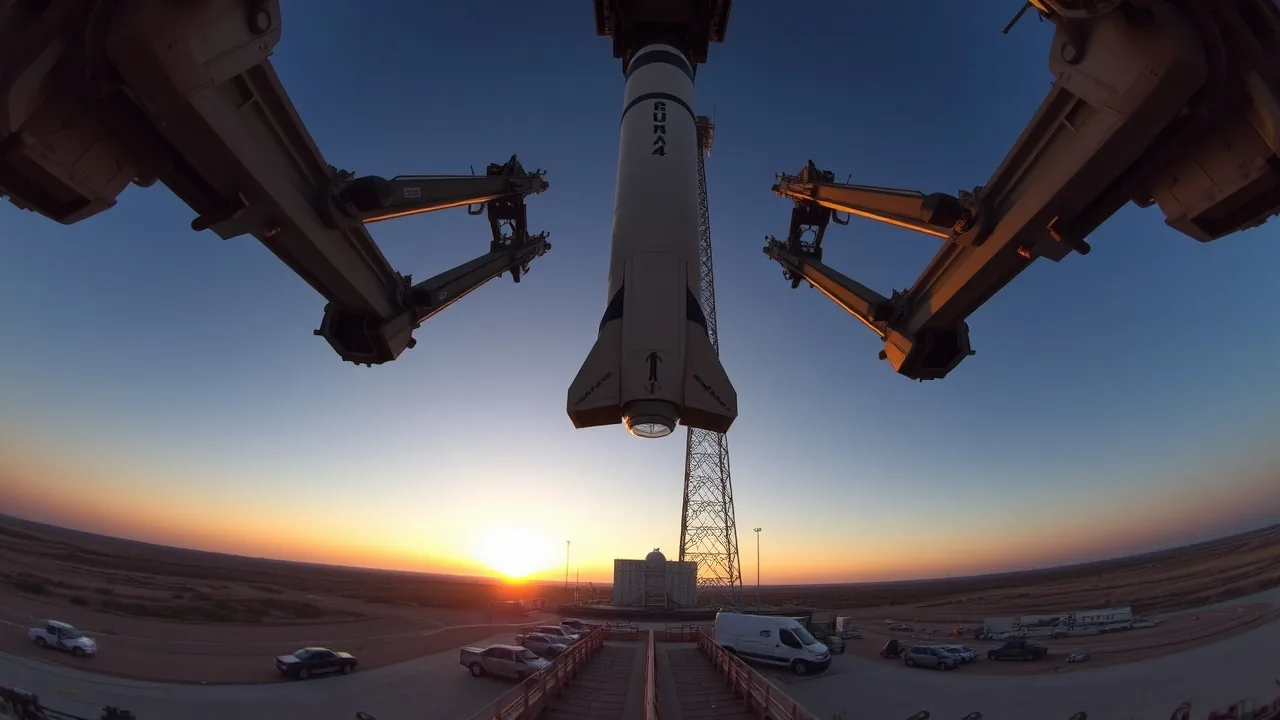
SpaceX successfully caught a Starship booster with the launch tower's mechanical arms during the fifth integrated flight test on October 13, 2024, marking a watershed moment for the company's most ambitious rocket program. The Super Heavy booster descended from suborbital altitudes and was captured by the "chopstick" arms at the Starbase facility in Boca Chica, Texas, demonstrating reusable rocket technology at an unprecedented scale.
The Starship program represents SpaceX's effort to build a fully reusable super-heavy lift launch system capable of carrying 100 metric tons to orbit. Unlike expendable rockets that splash down in the ocean after one use, Starship's integrated design aims to reduce launch costs and increase flight frequency, fundamentally changing how humanity accesses space.
"With this catch, we're one step closer to achieving rapid, reliable spaceflight," Elon Musk said on X (formerly Twitter) following the October test. The booster catch required precise coordination between flight software, ground control systems, and launch tower equipment, all executing in a matter of seconds during the descent.
Technical Achievements and Test Progression
SpaceX has conducted five integrated flight tests of the Starship stack since April 2023. Each test has pushed further into the rocket's flight envelope, with successive missions validating critical systems and subsystems required for eventual operational flights.
Key milestones from the test campaign include:
- First integrated flight test (IFT-1) in April 2023: Demonstrated initial stack separation and launch vehicle control
- IFT-2 in November 2023: Achieved booster-stage engine shutdown sequencing
- IFT-3 in March 2024: Executed the first controlled booster landing attempt
- IFT-4 in June 2024: Demonstrated booster catch capability and Starship re-entry heating validation
- IFT-5 in October 2024: Successfully completed booster catch and extended Starship flight duration
Each test generates terabytes of telemetry data that engineers analyze to refine guidance algorithms, propellant management systems, and structural performance models. SpaceX typically incorporates findings from one test into the next vehicle within 6 to 12 weeks, a cadence that far exceeds traditional aerospace development cycles.
Implications for Lunar and Mars Exploration
NASA has selected Starship as the human lander variant for the Artemis III mission, currently targeted for 2026 or later. The agency awarded SpaceX a contract worth up to $2.9 billion in 2021 to develop the lunar variant, which must demonstrate autonomous precision landing, ascent, and crew transfer capabilities.
Interplanetary missions to Mars require payload capacity and in-space refueling architecture that only Starship's 100-ton lift capability can feasibly support. SpaceX has outlined plans to use multiple Starship launches to conduct propellant transfers in low Earth orbit, enabling trans-Mars trajectories with both crewed and cargo variants.
The company's long-term architecture foresees establishing a self-sustaining settlement on Mars by the 2050s, a goal that depends entirely on Starship becoming a routine, low-cost launch vehicle. Current expendable rockets cost between $60,000 and $150,000 per kilogram to orbit; Starship's full reusability could reduce that figure by an order of magnitude if development succeeds.
"Starship is the enabling technology for multi-planetary civilization," Musk stated in a 2023 shareholder letter. "Without it, we remain a single-planet species."
The Broader Aerospace Landscape
Starship's progress directly influences how competitors and government agencies approach rocket technology development. Blue Origin's New Glenn and United Launch Alliance's Vulcan vehicles, while advancing space exploration in their own right, follow more conventional launch vehicle architectures with limited or no reusability.
NASA's Space Launch System (SLS), which costs roughly $2 billion per flight and is expendable, has become a point of comparison in congressional debates about federal aerospace spending. Starship's cost trajectory and reusability have energized discussions about the sustainability of government-funded human spaceflight programs.
Commercial satellite operators have also taken notice. Starship's promised cargo capacity and low marginal launch cost could reshape the economics of megaconstellations, high-bandwidth internet networks, and on-orbit manufacturing. Axiom Space, which develops commercial space stations, has expressed interest in using Starship for habitat module delivery.
The future of space infrastructure increasingly depends on whether SpaceX can transition Starship from test vehicle to operational spacelift platform. The technical challenges remain substantial. Achieving the high flight rate required for cost targets, qualifying systems for crewed missions, and developing reliable in-space refueling all require solutions that exist in preliminary form but not yet at flight-proven maturity.
SpaceX's track record with Falcon 9 and Falcon Heavy, both of which achieved routine booster recovery and reuse, suggests the company has the engineering discipline to solve these problems. The October 2024 booster catch represented not the end goal but a critical waypoint on a much longer path toward the rapid, routine spaceflight that Starship's design promises to enable.