
TESS Satellite Captures Most Detailed All-Sky Exoplanet Map
NASA's TESS mission has unveiled its most comprehensive map of the night sky, detailing thousands of exoplanet candidates. The data gathered over eight years offers unprecedented insights into planetary systems beyond our own.

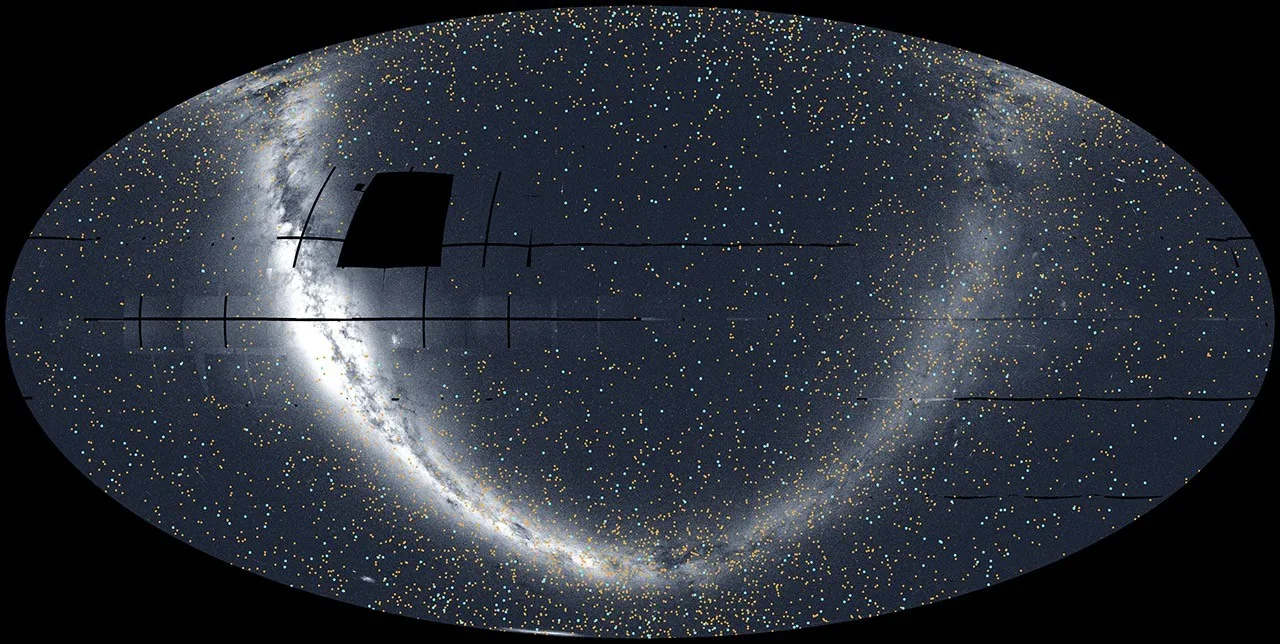
NASA's Transiting Exoplanet Survey Satellite (TESS) has delivered its most extensive mosaic of the cosmos to date, consolidating years of observations into a single, dazzling panorama. This comprehensive celestial map, featuring nearly 6,000 distinct points representing confirmed or candidate exoplanets, marks a significant milestone in humanity's ongoing quest to discover worlds beyond our solar system. The data encompasses observations conducted through September 2025, concluding TESS's second extended mission.
"Over the last eight years, TESS has become a fire hose of exoplanet science," stated Rebekah Hounsell, an associate project scientist for TESS at the University of Maryland Baltimore County and NASA's Goddard Space Flight Center. "It’s helped us find planets of all different sizes, from tiny Mercury-like ones to those larger than Jupiter. Some of them are even in the habitable zone, where liquid water might be possible on the surface, an important factor in our search for life beyond Earth."
The TESS spacecraft employs a strategic method for sky observation. It dedicates approximately one month to meticulously surveying a specific segment of the sky, known as a sector. During these prolonged observation periods, TESS utilizes its four sophisticated cameras to monitor the light output of tens of thousands of stars. By detecting minute fluctuations in stellar brightness, scientists can infer the presence of orbiting planets, which cause these predictable dips in light as they transit, or pass in front of, their host stars. This innovative approach has revolutionized the study of extrasolar planets.
Expanding the Boundaries of Planetary Discovery
The recently released all-sky mosaic is a testament to the mission's enduring success. It is meticulously assembled from 96 individual sectors observed between April 2018, the start of TESS's scientific operations, and September 2025. This vast dataset represents a significant leap forward in our understanding of planetary formation and diversity across the galaxy. Each point of light in the mosaic signifies a potential new world, a step closer to answering fundamental questions about our place in the universe and the potential for life elsewhere. The diversity of planet sizes detected, from terrestrial worlds akin to Mercury to gas giants larger than Jupiter, underscores the wide range of planetary systems that exist.
The significance of finding planets within the habitable zone cannot be overstated. This region around a star is defined as the orbital distance where temperatures could allow liquid water to exist on a planet's surface. The presence of liquid water is widely considered a key prerequisite for life as we know it, making these discoveries particularly exciting for astrobiologists. TESS's ongoing contributions provide invaluable data for follow-up studies with other powerful telescopes, such as the James Webb Space Telescope, to analyze the atmospheres of these distant worlds and search for biosignatures.
The TESS mission's success highlights the power of dedicated, long-term observation campaigns in pushing the frontiers of scientific knowledge. The nearly 6,000 identified exoplanet candidates offer a rich target list for future research, promising to further illuminate the sheer abundance and variety of planets orbiting stars beyond our Sun. The ongoing analysis of this extensive dataset will continue to refine our understanding of galactic planetary populations for years to come, solidifying TESS's legacy in the field of exoplanet discovery.