
Trump to Award Artemis II Crew Congressional Space Medals
President Trump will present the Congressional Space Medal of Honor to the four Artemis II astronauts on August 28th for their record-breaking lunar journey. The crew ventured farther from Earth than any humans in history.

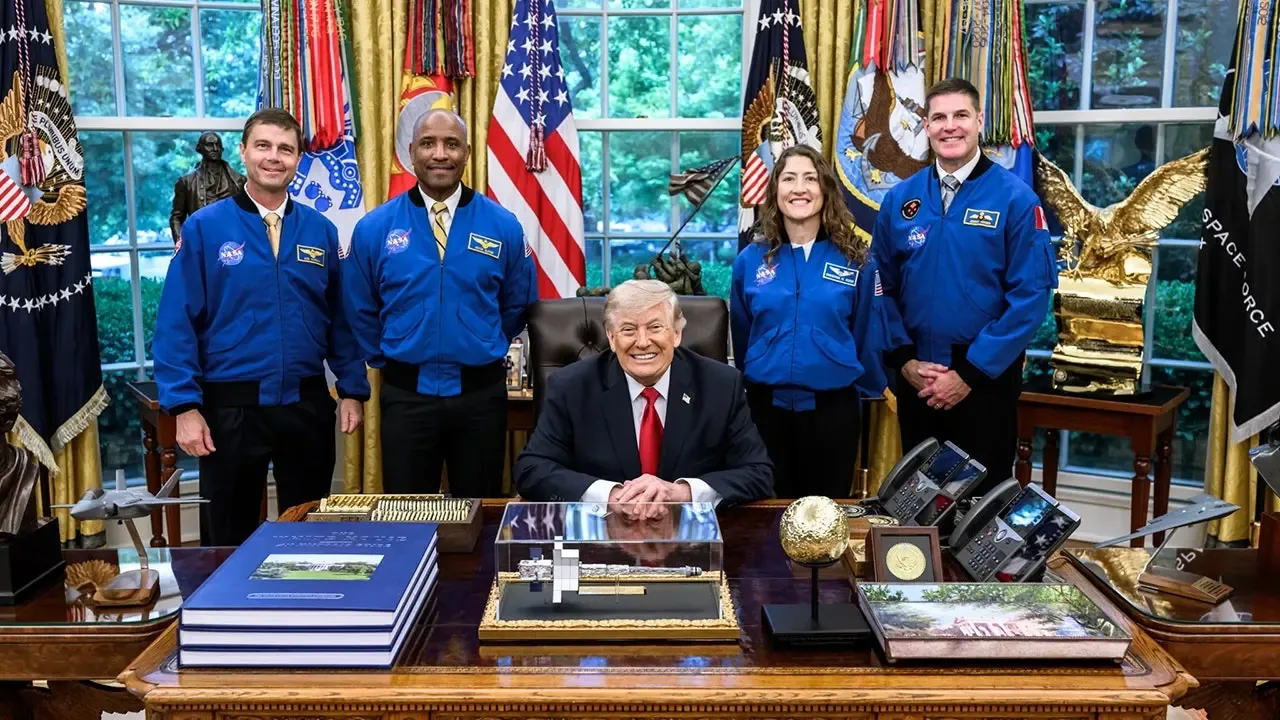
President Donald Trump is scheduled to honor the four astronauts of the Artemis II mission with the Congressional Space Medal of Honor on August 28th. The ceremony will take place at NASA's Johnson Space Center in Houston, recognizing the crew for their historic journey that took them farther from Earth than any humans before. The astronauts set a new human spaceflight distance record during their nearly 10-day mission aboard the Orion spacecraft earlier this year.
The Artemis II crew, comprised of NASA astronauts Reid Wiseman, Victor Glover, and Christina Koch, alongside Canadian Space Agency astronaut Jeremy Hansen, achieved this milestone in April. During their mission, the spacecraft reached a maximum distance of 252,756 miles from Earth, surpassing the previous record set by the Apollo 13 mission in 1970. In total, the astronauts traveled 695,081 miles, marking the first crewed mission to orbit the moon in over 50 years.
The mission began on April 1, 2026, with the launch of NASA's Space Launch System rocket from Kennedy Space Center in Florida. Following tests of the Orion spacecraft's systems in space, the crew proceeded towards the moon, passing within 4,067 miles of its surface on April 6. Throughout the voyage, the astronauts captured over 7,000 images, documenting stunning views of Earthrise, lunar craters, ancient lava flows, and even a solar eclipse as seen from the Orion capsule. They also reported observing meteoroid impacts on the moon's dark side.
A Legacy of Space Exploration and Future Ambitions
The return journey concluded on April 10, 2026, with the Orion spacecraft splashing down in the Pacific Ocean off the coast of California after traveling at speeds approaching 25,000 mph. NASA Administrator Jared Isaacman commended the crew for undertaking significant risks to test the spacecraft and its systems, which are critical for future deep-space endeavors. The Congressional Space Medal of Honor, which the astronauts will receive, has a storied history dating back to the Apollo era. It was authorized by Congress in 1969 to recognize the exceptional courage, dedication, and sacrifice of astronauts venturing into the challenging environment of space.
Under federal law, the president can award this prestigious medal on behalf of Congress to individuals who demonstrate exceptionally meritorious service and contributions to humanity. The medal is awarded to a select group of astronauts, with only 30 recipients on its official roster prior to the Artemis II crew, including legendary figures like Neil Armstrong and John Glenn. The four Artemis II astronauts will bring the total number of recipients to 34, underscoring the significance of their recent achievement.
The Artemis II mission served as a vital precursor to NASA's broader lunar ambitions, specifically paving the way for the return of astronauts to the moon's surface. The crew's work in testing Orion's life-support systems and manually piloting the spacecraft gathered crucial data for upcoming missions. NASA is planning further lunar exploration, with missions like Artemis III targeting commercial lander operations in low Earth orbit in 2027, and Artemis IV aiming for the program's first crewed lunar landing in 2028. Ultimately, the Artemis program aims to establish a sustained human presence on the moon and build the foundation for future human missions to Mars. NASA Administrator Isaacman highlighted the mission's impact, stating, "Under President Trump’s leadership, Artemis II captivated the world, inspired a generation, and gave us the confidence to press on as America returns to the Moon to build a base and to stay."