
Venus and Jupiter Shine in June 2026 Celestial Display
Jupiter and Venus engaged in a stunning close planetary conjunction on June 9, 2026, visible across the globe. Astrophotographers captured breathtaking images of the celestial event.

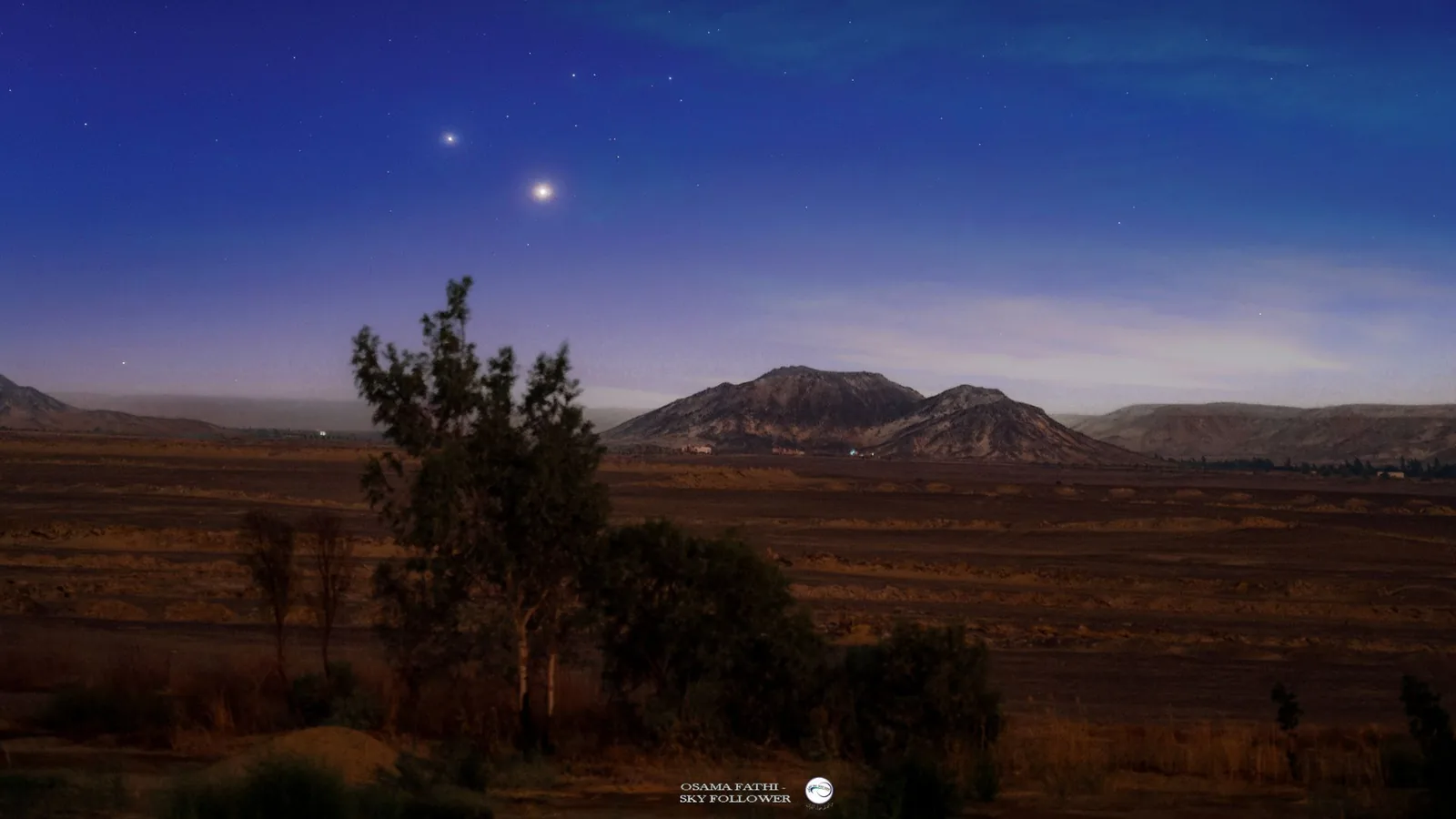
Jupiter and Venus offered a spectacular celestial performance on June 9, 2026, appearing unusually close in the western twilight sky as Mercury also made an appearance. The two brightest planets have been a mesmerizing fixture in the sunset for weeks, slowly converging before reaching their closest point. This dramatic cosmic alignment peaked on June 9, with Jupiter and Venus shining less than two degrees apart in the constellation Gemini. The event drew the attention of astrophotographers worldwide, who captured stunning images of the planetary approach.
Among the notable captures was Josh Dury's photograph from Wiltshire, U.K., taken on June 8. His image features Venus and Jupiter positioned near the prehistoric Avebury stone circles, with the bright stars Castor and Pollux visible to their right. Dury remarked on the striking similarity in angle between the ancient stones and the planets, suggesting a metaphorical connection. "These two stones almost appear to mirror the angle of the planets," Dury stated in an email. "Almost like a couple gazing up to the wonders of the universe."
In Shenzhen, China, astrophotographer Cheng Xin documented the planetary duo. Their image showcases Venus and Jupiter bright enough to fit comfortably within the field of view of a pair of 10x50 binoculars, illustrating their apparent proximity from Earth's perspective.
Riste Spiroski, based in Skopje, the capital of North Macedonia, also captured the planets over city rooftops. Spiroski noted the subtle hint of Jupiter's four Galilean moons in his photograph. "While Venus and Jupiter are separated by hundreds of millions of kilometres in space, tonight they appeared close together from our perspective on Earth, creating one of the year's most beautiful celestial sights," Spiroski shared via email. "I was particularly drawn to the contrast between the couple focused on their phone and the rare astronomical event above them, this contrast inspired the story behind this series." This observation highlights the human element often present in appreciating astronomical events.
A Global Phenomenon Captured
The planetary conjunction was a global spectacle, with photographers submitting images from diverse locations. Yasser Al-Zayyat photographed the planets above the Kuwait City skyline on June 9, with modern skyscrapers providing a stark contrast to the ancient celestial display.
Further south, Osama Fathi captured the event on June 6 over the volcanic landscape of Egypt's Black Desert. Fathi utilized a Nikon Z6 camera with a 24 mm lens to capture the scene. He employed a specialized technique for astrophotography, capturing the terrestrial foreground during the twilight 'blue hour' and stacking multiple short exposures for the sky. This method allowed for the faint background stars to be revealed without overexposing the brilliant planets. "The terrestrial foreground was captured during the twilight 'blue hour,' while the star-studded sky was built by stacking multiple short exposures to reveal the faint background stars without blowing out the bright planets," Fathi explained in his communication. The photographic process underscores the dedication and technical skill involved in modern astrophotography.
This recurring alignment of Venus and Jupiter serves as a reminder of the dynamic nature of our solar system and the ongoing celestial ballet visible from Earth. Such conjunctions have captivated observers for millennia, inspiring art, mythology, and scientific inquiry. The ability for everyday individuals to capture and share these moments with high-quality equipment in 2026 highlights the democratization of astronomy and stargazing. The event provided a breathtaking visual for skywatchers and a valuable dataset for planetary scientists studying atmospheric conditions and orbital mechanics.