
Voyager 1 Signal Delay Nears Two Days as Probe Exceeds 22-Hour Travel Time
NASA's Voyager 1, now 16 billion miles from Earth, faces a nearly two-day communication delay. This milestone approaches as the probe nears a full light-day distance from our planet.

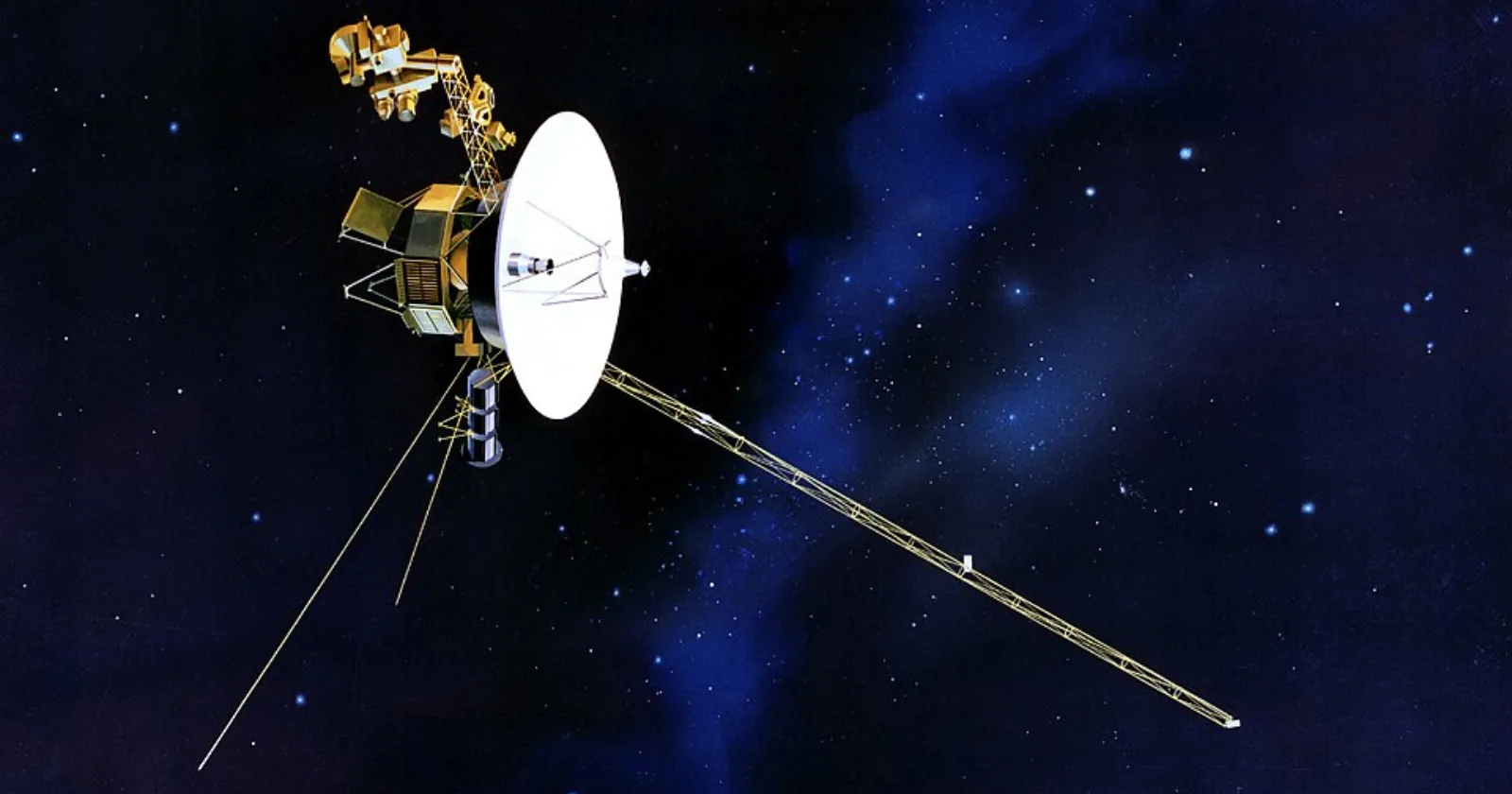
NASA's venerable Voyager 1 spacecraft is so distant from Earth that a radio command now takes over 22 hours to reach it, meaning engineers must wait nearly two full days for a response. Launched in September 1977, the probe is currently approximately 16 billion miles away, hurtling away from the Sun at about 38,000 miles per hour. By November 2026, Voyager 1 is set to become the first human-made object to traverse a distance of one light-day from Earth, a boundary where a signal requires a full 24 hours for a one-way trip.
This immense separation translates to a significant communication lag. Suzy Dodd, the Voyager project manager at NASA’s Jet Propulsion Laboratory (JPL), illustrated the protracted exchange: “If I send a command and say, ‘good morning, Voyager 1,’ at 8 a.m. on a Monday morning, I’m going to get Voyager 1’s response back to me on Wednesday morning at approximately 8 a.m.” This extensive round-trip time recently proved critical during a five-month operational challenge.
In November 2023, Voyager 1 unexpectedly ceased transmitting coherent scientific and engineering data. The JPL team spent months diagnosing and resolving the issue, which was ultimately traced to a single faulty memory chip within one of the spacecraft’s three onboard computers. Unable to repair the chip directly, engineers devised a workaround: they partitioned the affected software into smaller segments and redistributed them across different memory locations. Linda Spilker, the Voyager 1 project scientist at JPL, described the painstaking process of implementing this fix. “With Voyager 1, it takes 22 1/2 hours to get the signal up and 22 1/2 hours to get the signal back, so we’d get the commands ready, send them up, and then like two days later, you’d get the answer if it had worked or not,” she told NBC News.
A Delicate Digital Operation in Deep Space
The challenge of fixing such old hardware, for which no functioning ground simulators exist, required an old-fashioned, meticulous approach. Spilker explained the team's verification method: “There were three different people looking through line by line of the patch of the code we were going to send up, looking for anything that they had missed,” she said, referring to it as “sort of an eyes-only check of the software that we sent up.” This carefully reviewed patch was transmitted to the spacecraft on April 18, 2024. The team received confirmation that the modification was successful on April 20, two days later, validating the two-day communication cycle for a successful command.
While the November 2026 milestone of reaching the one-light-day mark is largely symbolic, it underscores the changing operational reality. Once the signal round-trip duration surpasses 48 hours, every command and its subsequent response will be measured in days rather than hours. The existing data transmission rate is already a trickle, with Dodd noting to CNN that the probes transmit at around 160 bits per second. Voyager 1 and its twin, Voyager 2, were designed with significant autonomy to handle unexpected situations. “If they get something going wrong,” Dodd explained, “they can put themselves in a safe state so that they can wait until we’re able to talk to the spacecraft and figure out what the problem is and resolve that issue.” The Earth-based team effectively operates on standby, addressing issues that the spacecraft cannot resolve independently.
Voyager 2, following its own distinct trajectory, is not projected to reach the one-light-day milestone until 2035. However, by that time, neither probe is expected to be actively transmitting. Both spacecraft are undergoing a gradual shutdown of their scientific instruments to conserve their increasingly limited power supply. According to NASA's latest instrument status update, Voyager 1 currently has two science instruments operational: the magnetometer and the plasma wave subsystem. Voyager 2 maintains three active instruments: the cosmic ray subsystem, the magnetometer, and the plasma wave subsystem. This controlled power conservation is crucial for extending the operational life of these pioneering interstellar probes.