
Webb Telescope Reveals Strongest Evidence for 'Black Hole Stars'
NASA's James Webb Space Telescope has identified compelling evidence for a new class of celestial objects called 'black hole stars' (BH*). The telescope's detailed analysis of a distant object, GLIMPSE-17775, supports the model of a supermassive black hole surrounded by a dense gas cocoon.

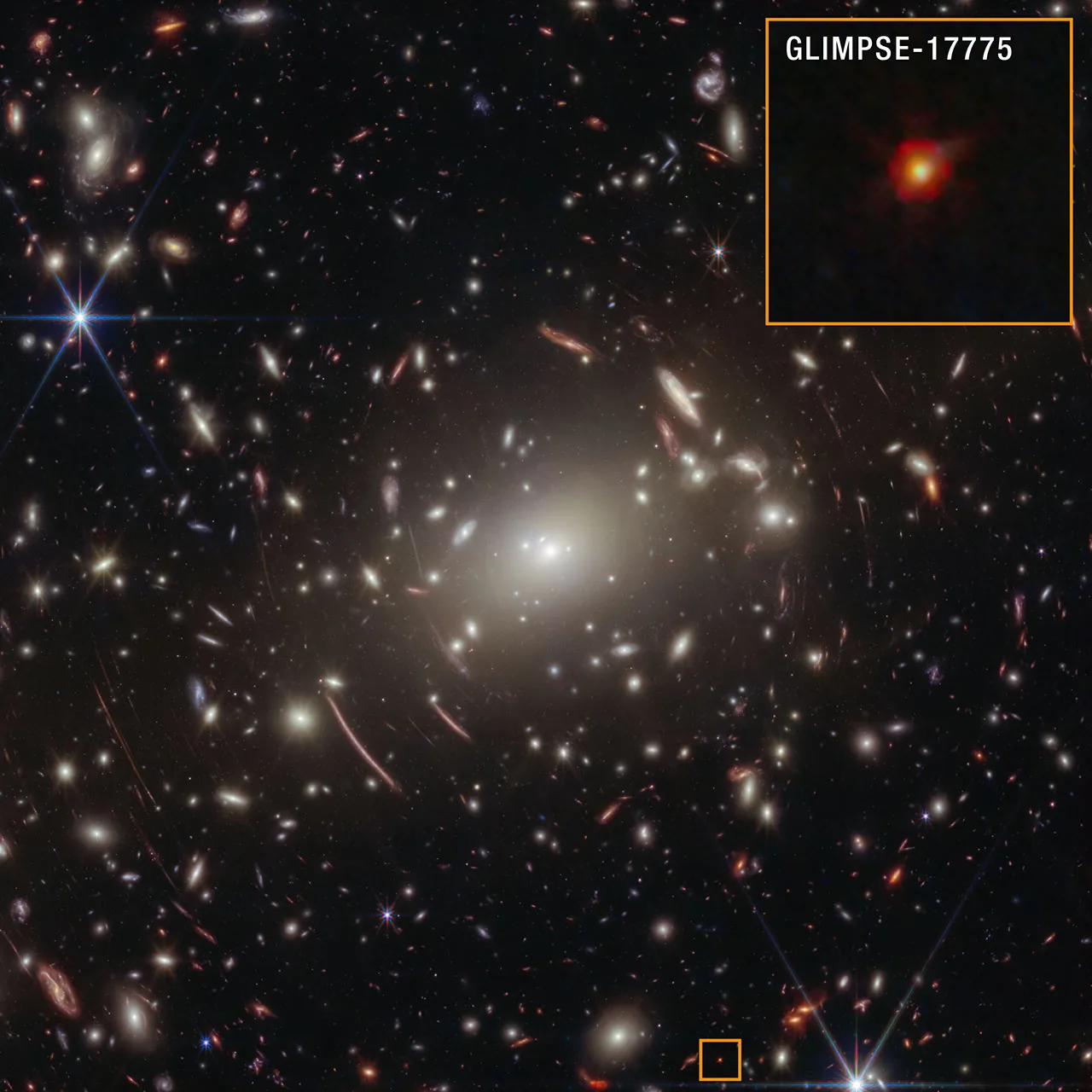
Astronomers using NASA's James Webb Space Telescope (JWST) have uncovered the most compelling evidence to date for a theoretical celestial object known as a 'black hole star' (BH*). The groundbreaking discovery centers on a distant object identified as GLIMPSE-17775, a 'little red dot' observed in the early universe. The detailed spectroscopic analysis of this object by JWST provides multiple lines of evidence strongly supporting the BH* model, which posits that these objects are supermassive black holes enveloped in a dense cocoon of partially ionized gas.
The research, led by Vasily Kokorev at the University of Texas at Austin, focused on the spectrum of GLIMPSE-17775. This object, first spotted by Webb in 2022, is located approximately 1.8 billion years after the Big Bang and is gravitationally lensed, meaning its light is magnified by a massive foreground galaxy cluster, Abell S1063. The magnification amplified the effect of Webb's observation, making the 30-hour spectrum equivalent to 80 hours of telescope time. This resulted in the deepest and most detailed spectrum ever obtained of a 'little red dot,' revealing over 40 spectral lines.
"When we saw the spectrum for the first time, it was like having all the pieces of a puzzle scattered on the floor," said Kokorev, lead author of the study published in The Astrophysical Journal. "We picked up each piece of the puzzle, measured the lines, and started combining the different pieces into a mosaic. Maybe a few pieces looked like nothing at first, but then a couple of them came together, and we realized that there was something there."
Unraveling the 'Little Red Dots'
The enigmatic 'little red dots' emerged as a surprising discovery shortly after JWST began its science operations, appearing as abundant red objects from the very early universe, roughly 600 million years after the Big Bang. Scientists have been exploring various explanations for their existence, with the BH* scenario being a leading contender. The rich dataset from GLIMPSE-17775 offers the most comprehensive test of these models to date, as previous objects lacked the full suite of supporting evidence.
The spectroscopic data from JWST revealed crucial details that align with the BH* model. For instance, the observed spectral lines of elements like hydrogen, oxygen, and helium did not conform to a simple rotating gas cloud. Instead, the data indicated an electron scattering broadening effect, a strong signature of a dense gas cocoon surrounding the source. Furthermore, the intensity and ratios of certain lines, particularly the "iron forest" of 16 iron lines and specific oxygen lines, point to a high-energy source, such as a rapidly accreting black hole, as the power source.
The analysis also identified fluorescence and absorption of helium, both of which independently suggest the presence of a dense medium obscuring a powerful central engine. A key advantage of the BH* scenario is that it naturally explains why most 'little red dots' appear faint in X-rays; any such emissions would likely be absorbed by the dense gas cocoon. This also helps resolve a previous challenge in cosmological models, as it means the black hole masses do not need to be exceptionally large to explain the observed broad emission lines.
The research team also incorporated data from NASA's Hubble Space Telescope, specifically from the Frontier Fields and BUFFALO programs. This ancillary data helped explain a weaker-than-usual Balmer break in GLIMPSE-17775's spectrum, a feature typically seen in other 'little red dots.' The combined Webb and Hubble observations suggest that a large host galaxy is enveloping GLIMPSE-17775, a scale not previously observed for such objects but consistent with the dense gas cocoon model. This offers a more complete picture, integrating the 'little red dot' observation within the existing framework of cosmic evolution.
"Everything fits, nothing is broken, and I think that makes the puzzle that is our universe even better," Kokorev stated. "Looking ahead, I’m eager to dive deeper and learn about what is powering the central engines of little red dots. While we think it’s a black hole, there are some other interesting theories being proposed, which is exciting. Maybe in a year or two, we’ll have the final answer to what powers these sources." The James Webb Space Telescope continues to push the boundaries of astronomical understanding, solving long-standing mysteries about the early universe and the nature of celestial objects.