
AI Agents Orchestrate Complex Tasks in 2026
Advanced AI agents are now autonomously managing multistep workflows, from data analysis to customer support. The shift is reshaping how businesses automate operations.

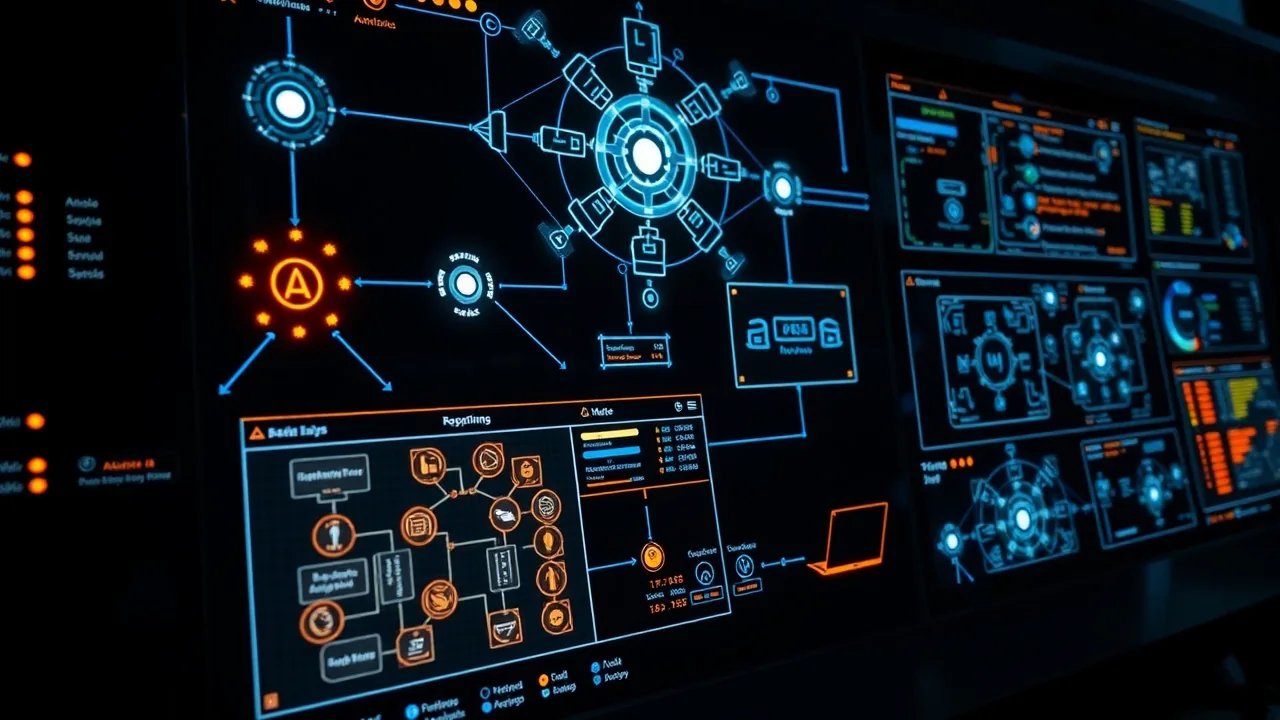
On May 15, 2026, OpenAI released an updated framework for agentic AI systems capable of breaking down sprawling business problems into executable subtasks without constant human supervision. This milestone reflects a broader industry shift: AI agents have moved beyond chatbots and single-function tools into orchestrators of genuinely complex workflows.
The capabilities now in play would have seemed impossible just 18 months ago. Modern agents can chain together API calls, validate outputs, retry failed steps, and adapt their approach mid-execution. They reason about their own limitations and escalate decisions to humans when confidence drops below a threshold.
"We're seeing deployment of agents that run 10 to 15 sequential steps with branching logic," said Dr. Yuki Tanaka, AI research director at Sequoia Capital, in a May 2026 interview. "The reliability has crossed an inflection point. Most corporate pilots are now succeeding rather than failing."
How Agents Learn to Dream and Plan
The technical leap hinges on something researchers call "agentic reasoning." Unlike traditional machine learning models that map inputs directly to outputs, modern agents simulate multiple future paths, evaluate them, and select the highest-confidence route. In some cases, they even generate synthetic training data by running simulations of tasks they haven't yet attempted.
This simulation capability bears a metaphorical resemblance to dreaming. The agent explores hypothetical scenarios in a low-cost internal space before committing resources to real-world action. Anthropic's Claude 3.2 and Google's Gemini 2.0 both expose this via "chain-of-thought" outputs, where users can watch the agent's deliberation unfold.
The practical result is remarkable efficiency. A typical enterprise document-processing task that once required three manual steps, two handoffs, and error-checking now runs unattended. Agents handle edge cases by triggering specialized sub-agents rather than failing or asking for help.
- Recursive decomposition: breaking large tasks into smaller, verifiable subtasks
- Dynamic routing: sending work to the best available sub-agent or human based on task type
- Fallback logic: gracefully degrading when confidence thresholds aren't met
- Memory management: retaining context across hundreds of steps without hallucination
Business Impact and Productivity Gains
Automation has always promised efficiency. What's changed in 2026 is the scope of what can be automated. Previously, tools were narrowly scoped: a chatbot answered FAQs, an RPA bot filled in forms. Agents, by contrast, own entire workflows.
McKinsey's March 2026 report on enterprise AI adoption found that companies deploying agentic systems saw a median 35 percent reduction in time-to-completion for white-collar tasks. Finance teams reported agents processing month-end reconciliations in hours instead of days. Customer support organizations replaced ticket triage with multi-step agents that resolved issues without escalation 68 percent of the time.
The cost economics are shifting too. An enterprise AI agent that manages procurement, from requisition through vendor selection and contract negotiation, costs roughly 50,000 dollars to train and deploy but eliminates 1.5 FTEs. Payback occurs within the first financial year.
However, the future of AI adoption isn't purely optimistic. Early deployments reveal friction points: agents occasionally misinterpret ambiguous instructions, can't reliably handle out-of-distribution scenarios, and sometimes persist in wrong approaches when human oversight would catch the error in seconds.
Regulatory bodies are beginning to scrutinize agentic systems. The SEC issued guidance in April 2026 clarifying that AI agents making trading decisions must maintain full audit trails and human approval checkpoints. Similarly, the FDA expects agentic diagnostic tools in healthcare to operate under explicit human-in-the-loop protocols until further validation is complete.
The Road Ahead
The consensus among technologists is that complex tasks will increasingly be agent-native by 2027. Most major cloud providers (AWS, Google Cloud, Microsoft Azure) now offer agentic frameworks as first-class services. The barrier to building multi-agent systems has dropped from months of specialist engineering to weeks using low-code platforms.
The next frontier is multi-agent coordination. A single agent managing a procurement workflow is useful; an ecosystem where procurement agents, finance agents, legal agents, and vendor management agents interact autonomously to negotiate optimal contracts is transformative. Preliminary projects at Fortune 500 companies are underway, with mixed results.
Talent remains a bottleneck. The demand for engineers who can design, monitor, and improve agentic systems far exceeds supply. Salaries for AI engineers with agent experience have risen 22 percent since January 2026, according to Levels.fyi data.
The shift from artificial intelligence as a tool that humans query to AI as an autonomous operator that humans oversee is cultural as well as technical. Organizations are learning to delegate, to set boundaries and success criteria, and to trust systems that sometimes surprise them. By mid-2026, that transition is well underway but far from settled.