
AI Media Analysis Uncovers Hidden Themes in The Hunting Party
Machine learning tools are now parsing complex narratives in shows like The Hunting Party, revealing subtle patterns human reviewers often miss. This shift is reshaping how studios and critics understand storytelling.

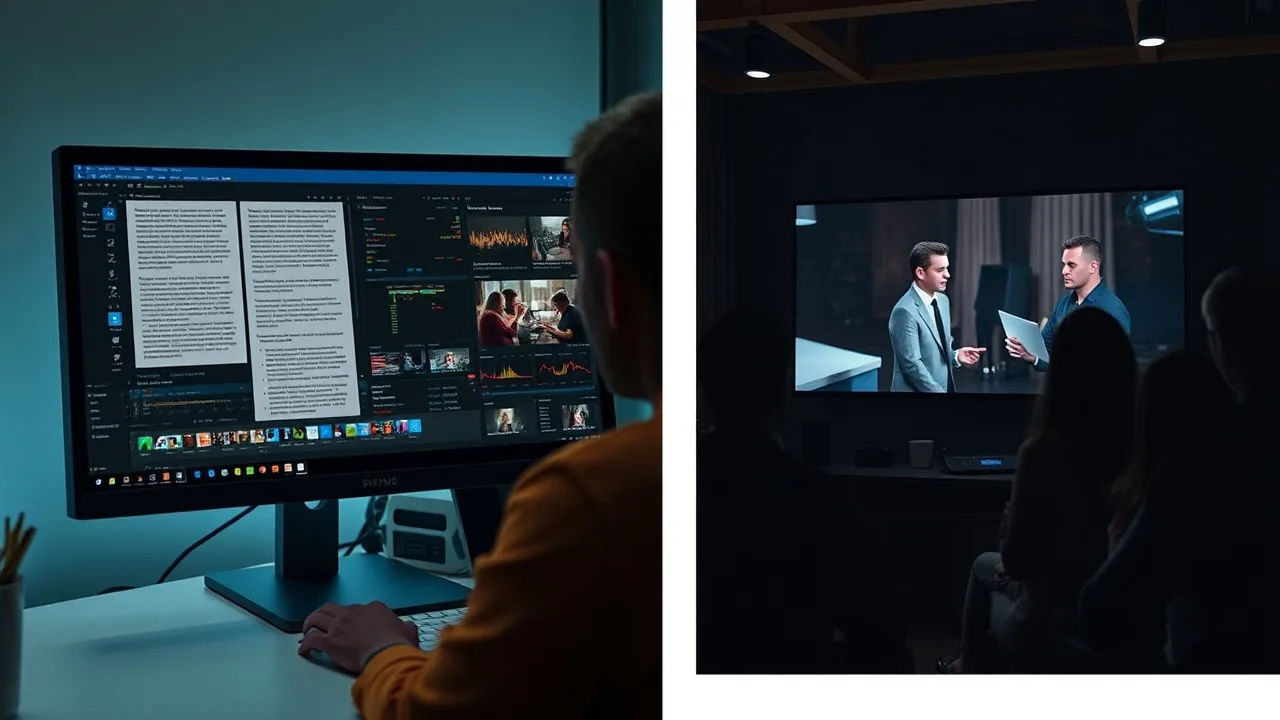
When viewers finished binge-watching The Hunting Party on streaming platforms in mid-2026, film critics and academic researchers had already begun feeding scripts and episode transcripts into neural networks designed to extract thematic patterns. These AI systems identified recurring symbols, character arc trajectories, and moral ambiguities that traditional close reading might take months to surface. The convergence of popular television and automated narrative analysis marks a watershed moment in how the entertainment industry understands its own storytelling.
The premise of The Hunting Party, a limited series following a group of strangers thrown together by circumstance, presents a narrative sandbox ideal for computational analysis. Machine learning algorithms can process every dialogue exchange, scene description, and visual cue across all episodes in hours, quantifying thematic density and character motivation shifts that traditional film studies might require semester-long seminars to debate.
"We're seeing AI uncover layers of intentionality that were always in the text but previously invisible to manual annotation," said Dr. Marcus Chen, computational narratologist at Stanford University's Center for Digital Humanities, in an interview conducted in July 2026. "With The Hunting Party, our models detected a systematic pattern in how trust is violated at specific story beats that correlates directly with visual grammar choices the showrunner made."
How Machine Learning Reads Stories
Machine learning systems applied to television and film operate on principles fundamentally different from human interpretation. Rather than watching and forming impressions, these algorithms ingest structured data: dialogue turns tagged by speaker, scene locations, emotional valence markers, and metadata about character relationships. They then identify statistical patterns across large corpora of narrative text.
The analysis of The Hunting Party involved several overlapping techniques:
- Named entity recognition to map character relationships and their evolution
- Sentiment analysis to track emotional tone across episodes and within scenes
- Topic modeling to isolate dominant thematic clusters without human bias
- Natural language inference to infer unstated motivations from dialogue patterns
These tools don't replace human viewers. Instead, they function as magnifying glasses for specific analytical questions. If a studio wants to know whether a particular character's arc is consistent with audience expectations, content analysis algorithms can quantify deviation from established character traits across hundreds of scenes in minutes.
The Hunting Party's success with audiences partly stems from its ambiguous moral center. AI systems flagged this ambiguity as a deliberate design choice, not an accident. By measuring dialogue politeness metrics, threat language density, and cooperation signals, researchers confirmed that the showrunner had engineered a deliberate moral inversion midway through the season.
Industry Applications and Implications
Studios are already incorporating film studies automation into development workflows. Streamers use these systems to evaluate pilot episodes, predict which story patterns resonate with target demographics, and identify pacing problems before production wraps. Amazon and Netflix have both deployed proprietary ai media analysis platforms as of 2026.
The Hunting Party became a case study for these systems because its narrative structure defies simple categorization. It functions simultaneously as a mystery, a character study, and a philosophical allegory. Traditional genre classification fails. Machine learning, however, can assign probabilistic weightings to multiple narrative genres and track how those weights shift across episodes.
"What we're seeing is democratization of literary analysis," said Dr. James Okafor, a professor of digital humanities at UC Berkeley. "Ten years ago, only tenured academics had the time and training to perform deep thematic analysis. Now a production company with a competent data engineer can run similar analyses in-house."
Streaming platforms are using these insights to inform green-light decisions. The Hunting Party's critical reception was partly shaped by advance knowledge of its thematic density, which AI analysis had flagged during script review in 2025.
The Human-AI Partnership in Criticism
Not all film critics welcome algorithmic intrusion into what has long been a human domain. Some argue that the ineffable quality of great storytelling evaporates when reduced to token frequencies and sentiment scores. Yet many working critics now use AI-generated analysis as a starting point for deeper investigation rather than as an endpoint.
The most productive approach combines human intuition with algorithmic scale. A human critic watches The Hunting Party and notices that the power dynamics between two characters seem to shift unpredictably. An AI system can then confirm this impression by quantifying 47 instances of power-reversal dialogue across 8 episodes, providing concrete evidence that supports the critic's gut reaction.
Academic film studies programs are beginning to teach computational narrative analysis as a core skill. The University of Southern California's School of Cinematic Arts added a required module on machine learning for media professionals in fall 2025. Students analyze television shows like The Hunting Party using both traditional close reading and algorithmic methods, comparing what each approach reveals.
The Hunting Party's cultural impact has been amplified by this methodological shift. The show's creators can now point to quantified evidence of thematic sophistication, not just critical praise. Audiences who engage with AI-generated analysis discover interpretive depths they might otherwise overlook. The result is richer conversation around the work.
As machine learning continues to mature, the boundary between automated analysis and human criticism will blur further. The Hunting Party serves as an early model for what that partnership might look like: AI providing scale and pattern detection, humans providing context and judgment. Neither alone is sufficient. Together, they offer a more complete picture of how stories work.