
Webb Telescope Spots New 'Black Hole Stars' Powered by Cosmic Predators
The James Webb Space Telescope has identified a novel cosmic phenomenon: "black hole stars." These celestial bodies are powered by the immense energy radiating from black holes, not traditional fusion.

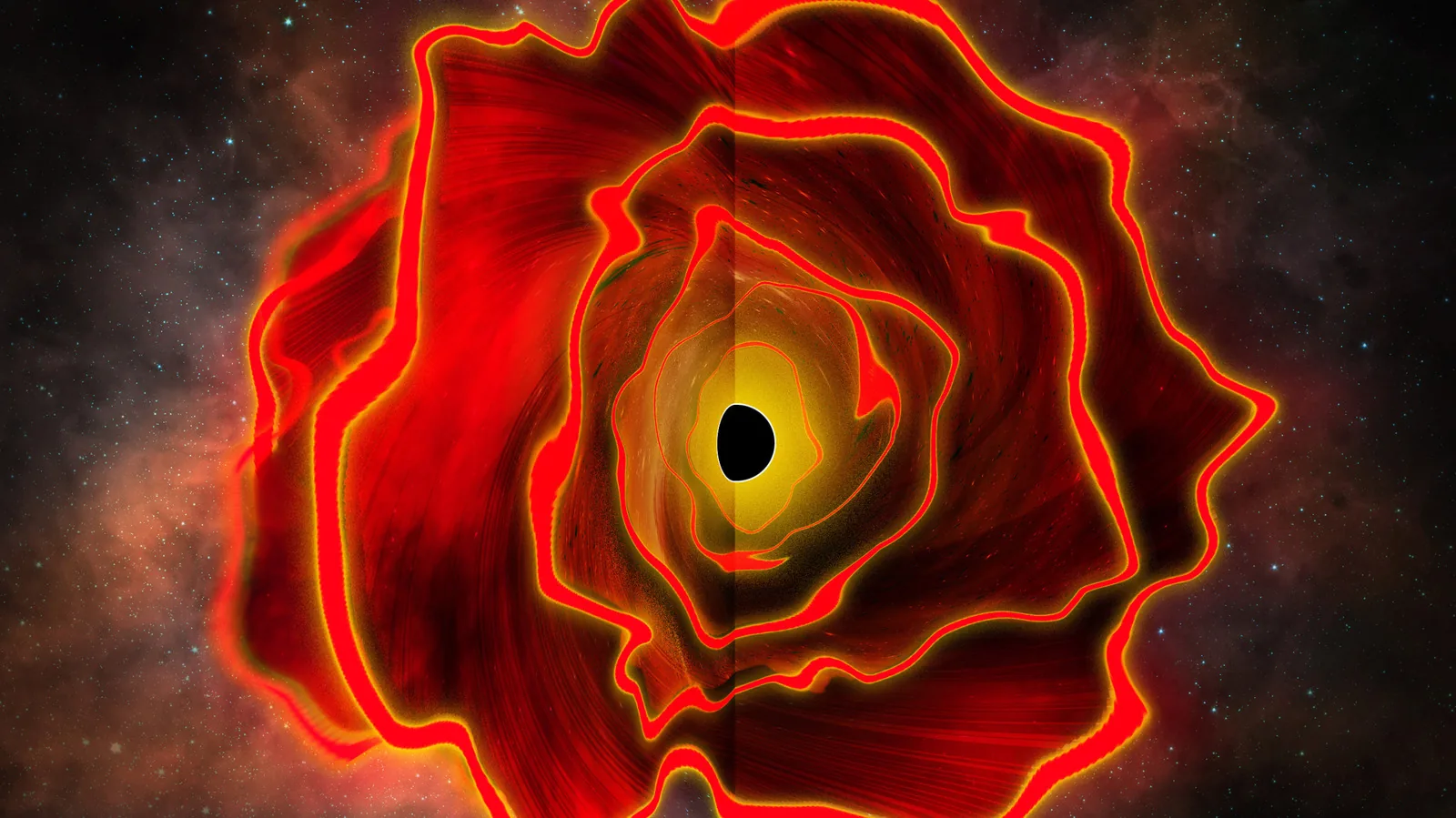
Astronomers using the potent capabilities of the James Webb Space Telescope (JWST) have identified an entirely new class of cosmic object, tentatively dubbed "black hole stars." These are not conventional stars fueled by nuclear fusion. Instead, these incredibly luminous entities are powered by the colossal energy output of black holes shrouded in dense gas clouds. This discovery challenges existing models of stellar evolution and black hole activity.
The groundbreaking observation occurred while scientists were conducting a deep-field survey aimed at identifying the most distant galaxies. They succeeded in locating Mom-Z14, now the farthest known galaxy. However, within JWST's images of the early universe, a peculiar, intensely bright red dot stood out. Researchers noted that such "little red dots" have appeared in numerous JWST deep-space images, previously unexplained phenomena. The specific object in this instance was exceptionally luminous, prompting an investigation into its nature.
After extensive computer simulations, the research team proposed a model that could explain the object's extreme brightness. The theory suggests a supermassive black hole, approximately 100,000 times the mass of our Sun, enveloped by a substantial gas cloud. This differs from the well-known accretion disks, which are flat structures of matter spiraling into a black hole. In a "black hole star," the entire black hole and its accretion disk are encased within a diffuse gas envelope. The immense energy emitted by the black hole blasts through this gas, causing it to glow with extraordinary intensity, outshining its host galaxy.
Early Universe Phenomena
A significant characteristic of these newly identified objects is their age. All observed "black hole stars" have been detected in images of the early universe, when the cosmos was less than a billion years old. Light travels at a finite speed, meaning telescopes peering into the distant universe are effectively looking back in time. The fact that these objects are only seen in this ancient epoch suggests they may be transient phenomena or that their formation mechanism is tied to the conditions of the nascent universe.
The prevailing hypothesis is that these "black hole stars" represent an early stage in the evolution of supermassive black holes. As a black hole accretes vast amounts of gas, it may temporarily adopt this shrouded, highly luminous state. Eventually, the black hole is theorized to consume its gaseous envelope, shedding its luminous shell and becoming less observable. This suggests that the black hole itself is the engine, with the surrounding gas acting as both fuel and a visible manifestation of its power.
This discovery opens new avenues for understanding the formation and growth of supermassive black holes, which are central to most large galaxies. The energy radiated by these objects could have played a significant role in shaping the early universe. Further observations with JWST and other advanced telescopes will be crucial to confirm the nature of these "black hole stars" and to search for more examples across cosmic time. The potential for entirely new astronomical objects underscores the ongoing revolution in our understanding of the cosmos, driven by unprecedented observational tools like the Webb Telescope.