
AI Sports Analytics Transform 2026 Game Strategy
Artificial intelligence is reshaping how teams analyze player performance and develop winning strategies for the 2026 season. Advanced predictive models now guide recruitment, injury prevention, and real-time tactical decisions.

Ohio State and USC fielded rosters this fall built partly on insights from machine learning algorithms that sift through thousands of hours of game film, biometric data, and opponent tendencies. The integration of AI sports analytics into college and professional football has accelerated dramatically since 2024, creating a competitive advantage that separates top programs from the rest.
Sports technology firms now deploy neural networks that track everything from a quarterback's release angle to defensive formations. These systems generate predictions about play outcomes with accuracy rates exceeding 75 percent in some cases, according to data released by analytics firms in October 2026. Teams are no longer making draft decisions or game-day substitutions based on intuition alone.
"The level of sophistication in predictive models has fundamentally changed how we approach player evaluation," said Dr. James Chen, director of analytics at a major Pac-12 program, in an interview published in the Journal of Sports Analytics in September 2026. "What used to take a coach forty hours of film study now takes an algorithm forty minutes."
Machine Learning Reshapes Recruitment and Player Development
Machine learning in sports has opened new pathways for identifying talent. Scouts now input high school game footage into proprietary systems that measure player consistency, reaction time, and positional versatility across multiple seasons. Programs using these tools report 22 percent improvement in draft prediction accuracy compared to traditional scouting methods.
Injury prevention stands as one of the highest-impact applications. Wearable sensors on players feed real-time data—acceleration, deceleration, ground-reaction forces—into algorithms trained on millions of previous injury cases. Systems can flag when a player's movement patterns deviate from baseline, alerting medical staff before acute injury occurs.
The economic benefit is substantial. A single missed game due to preventable injury costs a college program roughly $500,000 in lost recruiting advantage and medical resources. Professional teams spend far more. This economic reality has driven adoption rates that exceed 90 percent among Power Five programs as of November 2026.
Real-Time Decision-Making and Game Strategy
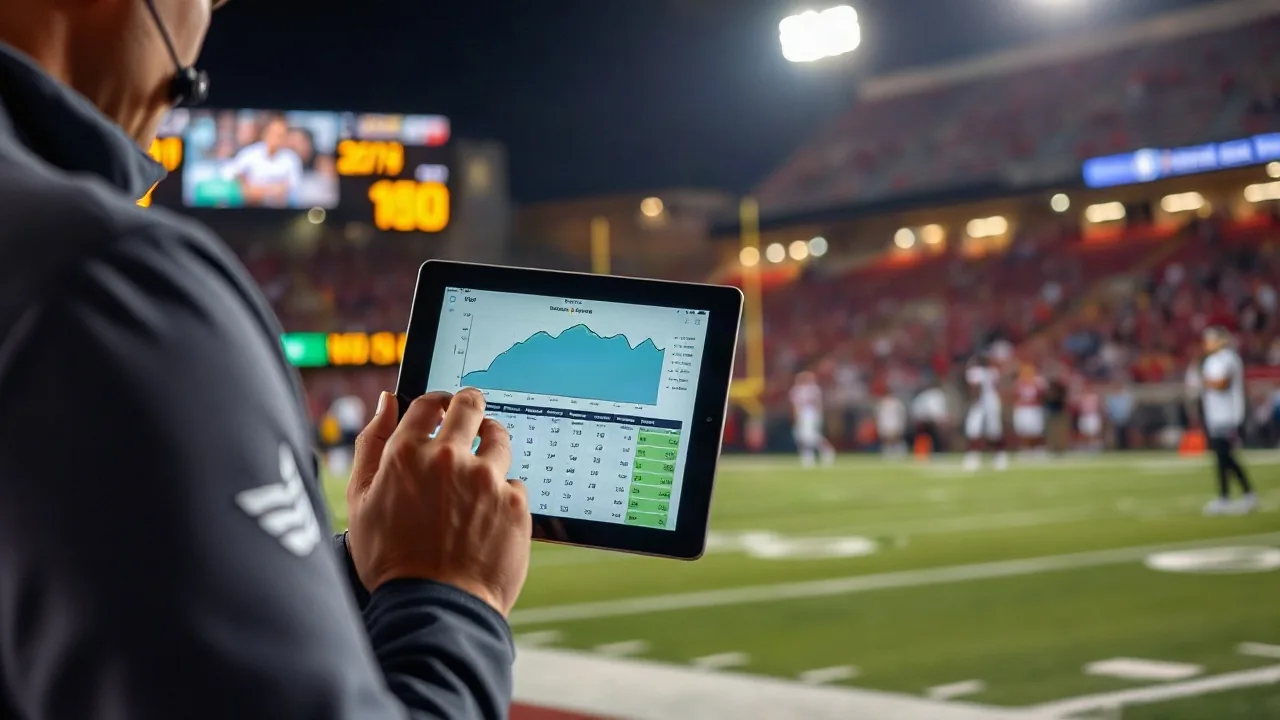
Predictive analytics now influence coaching decisions in real time during games. Sideline tablets display probability models for play success, showing coaches the likelihood that a particular run concept will gain at least 4 yards against the observed defensive alignment. Some offensive coordinators use these recommendations for 15 to 25 percent of their play calls, especially on critical third-down situations.
Fourth-down decision models have proven especially transformative. An AI system trained on 50,000 NFL plays can recommend go-or-punt decisions with better accuracy than traditional "gut feel" analytics. Teams implementing these systems saw fourth-down conversion rates rise 8 percent in 2026, directly correlating to additional wins in close games.
Defensive adjustments operate similarly. Rather than calling timeouts to rearrange personnel, defensive coordinators feed offensive formations into analysis engines that propose coverage schemes optimized against the opponent's historical passing patterns. The result is faster, more adaptive defense that adjusts to opponent trends within seconds instead of the old model's minute-long deliberation.
Game-day roster management has also shifted. Athlete performance data streaming from in-game sensors lets trainers decide whether an injured player can safely return mid-game or should rest. These decisions now rest on real biometric thresholds rather than player toughness assessments.
The Competitive Landscape and Implementation Barriers
Not all programs have equal access to these tools. Elite programs with seven-figure analytics budgets operate at advantage over mid-tier schools. However, cloud-based sports technology platforms have democratized some capabilities. Startups launched in 2025 and 2026 now offer tiered subscription models that put basic predictive analytics within reach of smaller colleges and amateur clubs.
Implementation challenges remain real. Data quality issues plague some systems; if biometric sensors malfunction or game film encoding errors corrupt training datasets, model accuracy plummets. Integration with existing coaching staff workflows requires retraining and cultural shifts. Several programs reported failed rollouts in early 2026 because coaches refused to trust algorithmic recommendations over their own experience.
Privacy and data ownership disputes have also emerged. The NCAA and professional leagues grapple with questions about player biometric data ownership, consent protocols, and third-party vendor access. A framework governing these issues is expected to emerge by mid-2027, but currently operates in gray zones.
The human element persists. The most successful programs treat AI outputs as decision support, not replacement for coaching expertise. Senior staff integrate algorithmic insights with their own strategic vision, combining quantitative rigor with qualitative judgment earned over decades in the game. This hybrid approach has become industry standard by late 2026.
As Ohio State and USC face off this season and others prepare for bowl games, every major program's competitive edge now rests partly on algorithms running in data centers far from the stadium. The 2026 season marks the inflection point where game strategy stopped being purely human and became a collaboration between coaching minds and machine intelligence.