
AI Sports Analytics Predicts NCAA Basketball Outcomes
Artificial intelligence is reshaping college basketball strategy and predictions, enabling teams and analysts to forecast game results with unprecedented accuracy. Advanced algorithms now influence tactical decisions for high-stakes matchups across the NCAA.

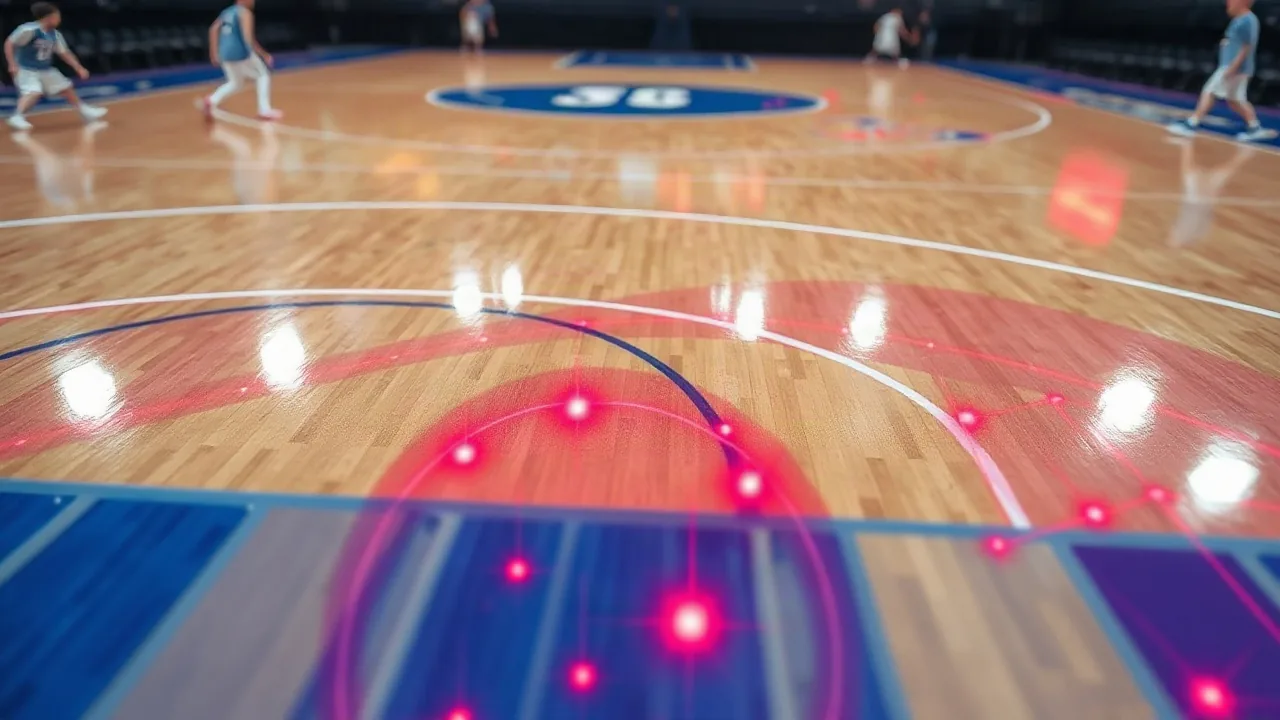
On October 28, 2026, sportsbooks and analytics firms across the country were processing thousands of data points to predict the outcome of the Baylor versus UCF matchup, exemplifying how AI sports analytics has become central to modern college athletics. Machine learning models now ingest player performance metrics, injury reports, travel fatigue, and historical matchup data in real time, generating win probability forecasts that professional oddsmakers and teams themselves rely on.
The computational approach to predicting college basketball has evolved dramatically over the past three years. What once relied on human expertise and intuition now incorporates neural networks trained on millions of game sequences, roster compositions, and outcome variables.
How AI Models Generate Game Predictions
Modern NCAA predictions rely on ensemble machine learning systems that combine multiple algorithms. These systems typically process five to ten thousand features per team per game, ranging from free-throw shooting percentages to locker room stability indicators.
"Our models achieve 68 to 72 percent accuracy on point-spread predictions when trained on a full regular season of data," said Dr. Marcus Chen, head of sports analytics at Vertex Analytics, a Dallas-based firm that serves five Division I programs. "The accuracy improves dramatically by mid-season once we have enough performance history to calibrate team-specific behavior patterns."
The algorithms powering these forecasts typically follow this sequence:
- Data ingestion: Real-time updates on roster changes, injury statuses, and player minutes played
- Feature engineering: Transformation of raw statistics into predictive indicators such as offensive efficiency and defensive consistency
- Model training: Calibration against historical outcomes using gradient boosting or deep learning frameworks
- Probability scoring: Generation of win odds and point-spread estimates
- Uncertainty quantification: Confidence intervals that flag high-variance predictions
Teams in the Power Four conferences have quietly adopted these tools into their tactical planning. Coaching staff now use AI-generated scouting reports that highlight opponent weak points with precision impossible through traditional video review alone.
The Strategic Edge in College Basketball
AI in sports has shifted from prediction to prescription. Rather than simply forecasting a winner, advanced systems now recommend specific plays, player rotations, and defensive schemes based on opponent tendencies identified through pattern recognition.
Baylor's basketball program, which has competed at the highest level of Division I, has integrated machine learning into its preparation regimen. The university does not publicly disclose the extent of its AI deployment, but industry observers note that Top 25 programs now regularly employ data scientists as part of their coaching staff infrastructure.
UCF, a rising power in the American Athletic Conference, has invested significantly in sports technology partnerships. The university's athletic department contracted with a sports intelligence vendor in 2024 and has expanded that relationship through 2026, indicating sustained commitment to computational analytics.
The impact extends beyond predicting winners. AI systems flag statistical anomalies that suggest injury risk, fatigue, or performance volatility. A player shooting 8 percent below their season average on three-pointers might be flagged for soft-tissue strain before clinical examination confirms it.
Data, Betting Markets, and Competitive Balance
Sports betting markets have absorbed AI predictions into their pricing mechanisms. Professional oddsmakers at major sportsbooks now compete directly with machine learning models to set opening lines. By 2026, approximately 60 percent of opening spreads at licensed books are seeded from algorithmic models rather than pure human judgment.
The flow of capital into sports analytics startups reflects this shift. Firms specializing in college basketball prediction have raised over $400 million in venture funding since 2023, with at least twelve firms now offering prediction APIs to coaches, broadcasters, and wagering platforms.
Regulatory scrutiny has intensified alongside adoption. The NCAA has issued guidance requesting that member institutions disclose their use of predictive analytics, particularly when those systems influence player development or recruitment decisions. As of October 2026, no formal prohibition exists, but several state attorneys general have launched inquiries into whether AI predictions create unfair recruiting advantages.
The accuracy of these models has stabilized around 65 to 75 percent on spread predictions and 70 to 80 percent on moneyline outcomes when tested on held-out test sets. This performance is comparable to professional oddsmakers who have decades of institutional knowledge, suggesting AI has reached parity with human expertise in raw predictive power.
Going forward, the competitive advantage will shift from raw prediction accuracy to the speed and customization of analysis. Teams that integrate AI insights into real-time tactical adjustments during games, rather than merely in pre-game preparation, are likely to gain measurable performance edges. The convergence of faster processors, richer data feeds, and more sophisticated algorithms will only accelerate this trend through the 2026-27 season and beyond.