
Chimpanzees Exhibit Altruism for Social Bonds, Study Finds
A new study reveals chimpanzees are willing to forgo immediate rewards, like food, if it means strengthening social bonds with other chimps. This behavior suggests a complex understanding of social economics in primates.

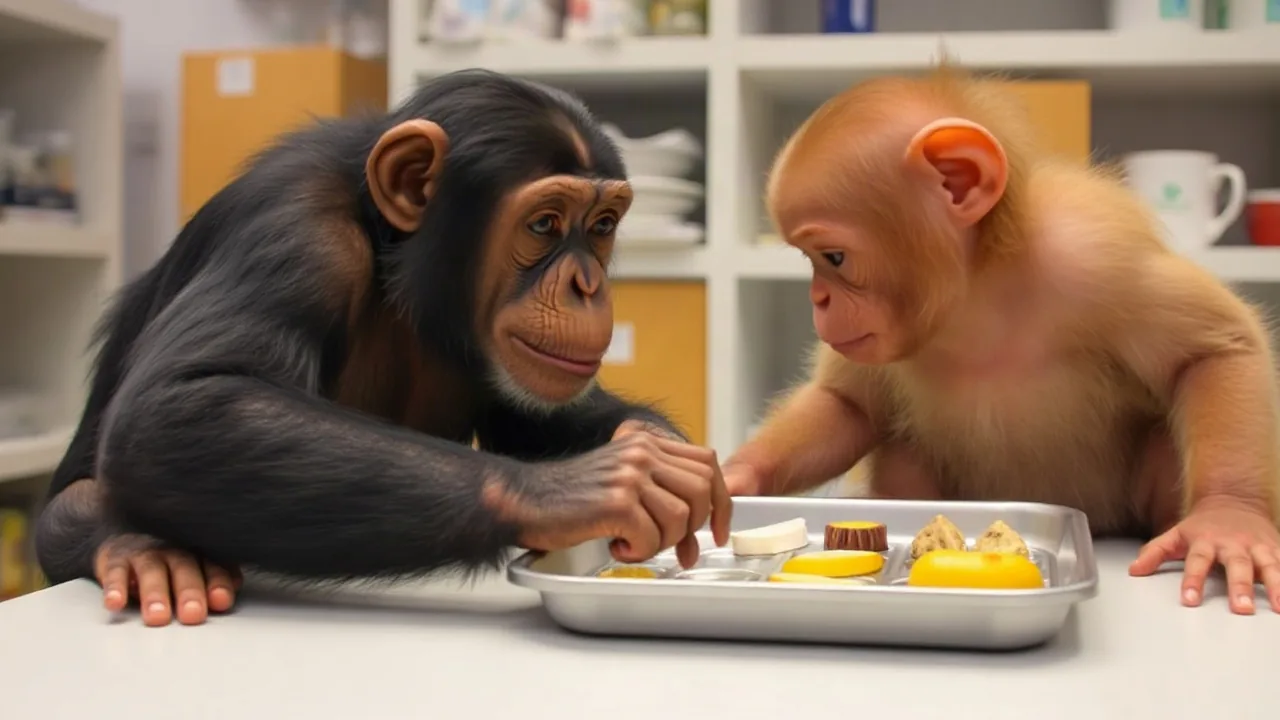
In a surprising display of social calculus, chimpanzees have demonstrated a willingness to sacrifice immediate rewards, such as food, in favor of nurturing social relationships, according to a study published in the journal Animal Behaviour. Researchers observed that when presented with a choice between a food reward and an opportunity to engage in social grooming or interaction with a preferred companion, the chimpanzees often chose the latter.
The experiment involved captive chimpanzees at the Yerkes National Primate Research Center, where a specially designed apparatus allowed them to choose between two options: one that provided a high-value food item but isolated them, and another that offered a lower-value food item but facilitated social interaction with another chimpanzee.
Dr. Sarah Hayes, lead researcher on the project, explained the significance of the findings. "We were particularly struck by how consistently the chimpanzees prioritized social connection over immediate gratification," Hayes said. "This suggests that for these primates, the long-term benefits of strong social ties, such as increased cooperation and support, may outweigh the short-term gain of an extra piece of fruit."
Understanding Primate Social Structures
This research delves into the intricate social dynamics of chimpanzees, our closest living relatives. Chimpanzees live in complex fission-fusion societies, where group composition changes frequently. Maintaining positive relationships within these fluid groups is crucial for individual survival and reproductive success. Previous studies have indicated the importance of grooming in chimpanzee societies, not just for hygiene but as a vital social currency to build and maintain alliances.
The experimenters introduced a tool that required participants to choose between two levers. Pulling one lever dispensed a preferred food item, like grapes or banana slices, but the chimpanzee had to consume it alone. Pulling the other lever dispensed a less desirable food item, such as a piece of carrot, but allowed a conspecific to join the chimpanzee and engage in social activities like grooming or playing.
In a significant portion of trials, the chimpanzees opted for the smaller food reward when it meant they could share the experience with a favored individual. This behavior was more pronounced when the social partner was a close ally or a potential mate, indicating a nuanced understanding of social hierarchy and preference. The study highlights that these decisions are not random; they are calculated choices aimed at optimizing social capital.
The findings contribute to a growing body of evidence suggesting that altruistic behaviors and a valuation of social bonds are not unique to humans. Understanding these behaviors in chimpanzees provides valuable insights into the evolutionary roots of complex sociality. It raises questions about the cognitive mechanisms underlying such decisions, including the capacity for empathy and future-oriented thinking in non-human primates.
Researchers are now planning follow-up studies to explore the factors that influence these altruistic choices, such as the specific relationship between the chimpanzees, their current hunger levels, and the availability of other social partners. The implications extend to conservation efforts, underscoring the importance of maintaining social group integrity for chimpanzee welfare in both captive and wild environments.