
Eagles Hunt HumanSized Baboons in Sahara Desert, Challenging Evolutionary Defense Theory
Researchers discover eagles preying on human-sized baboons in the Sahara, challenging long-held assumptions about early human predator threats.

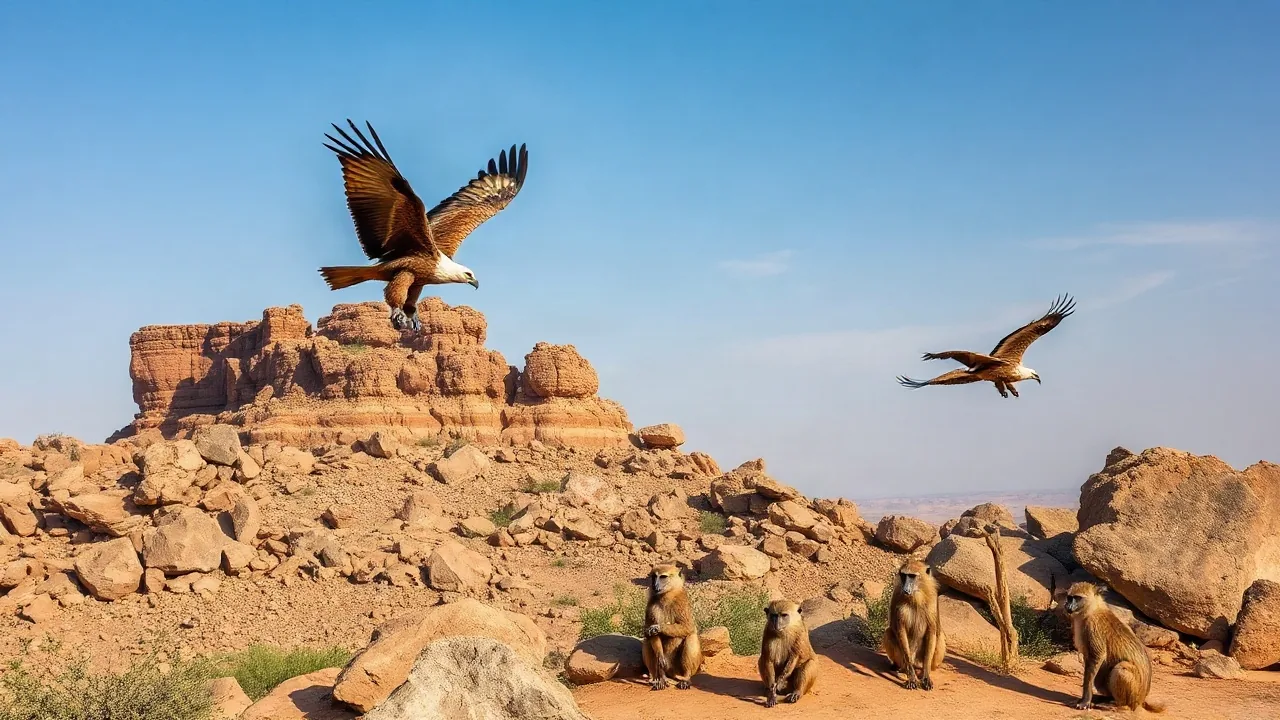
A recent study published on Nov. 18 in the American Journal of Biological Anthropology reveals that eagles are hunting baboons weighing up to 57 pounds in the Sahara Desert. Conducted by researchers from the University of St Andrews, Dartmouth College, the University of Konstanz, the Max Planck Institute of Animal Behavior, and African Parks, the research uncovers physical evidence of raptor predation on primates far heavier than previously thought possible.
Scientists discovered the skulls and bones of adult male baboons on the Ennedi plateau of northern Chad featuring signature talon punctures and characteristic scrapes on the shoulder bones. Prior to this finding, no primate over 29 pounds had been confirmed as killed by raptors, leading researchers to believe that animals of that weight class were safe from both modern and ancient giant eagles.
Challenging Long-Held Assumptions About Human Evolution
This revelation forces scientists to rethink predator-prey interactions during human evolution, particularly regarding how early hominins defended themselves. While land predators like big cats and crocodiles prompted different defense tactics, primates typically respond to aerial threats through mobbing, where large adult males charge attackers.
Lead author Catherine Hobaiter, a professor from the School of Psychology and Neuroscience at the University of St Andrews, said, “This was such an extraordinary expedition—any primatologist's dream! Some of the baboons there are so remote they rarely, if ever, see people, and so after a couple of days they ended up following us around—we were probably the most interesting thing they'd seen for a while.”
She added, “We saw the eagles while we were searching for the baboons, but we never imagined that they might be a threat to them. Then we found the first skull with a puncture mark, and then another, and another.”
Senior author Nathaniel Dominy, a professor from Dartmouth College, noted the initial disbelief of the research team. “At first, the idea of eagles hunting adult male baboons seemed to exist on the thin edge of possibility, until it didn't. Our skepticism slowly gave way to acceptance. The evidence was convincing,” Dominy said.
Hobaiter also described observing the primates reacting to airborne threats. “One of the most exciting observations was seeing the baboons respond when a pair of Verreaux's eagles swept overhead—primates are very specific about only responding to eagles that are a genuine threat. We'd seen them very relaxed around other big birds of prey, but as soon as the Verreaux came into view they alarm called and dropped down to safety,” she explained.
Dr. Gisela Kopp from the University of Konstanz and the Max Planck Institute of Animal Behavior emphasized the value of exploring uncharted regions, stating that shifting focus to an area without prior primatological data proved exceptionally rewarding. Meanwhile, Dr. Jean Didier Akpona from African Parks shared that after working in the region for approximately three years and observing Verreaux's eagles near local water pockets known as gueltas, he had never imagined such predators would target primates of this size.
The research team intends to continue studying the Ennedi baboon population to better understand their unique behavioral patterns and survival strategies in the desert environment.