
Giant Predatory Eagles Once Hunted Humans, Shaped Evolution
Fossil evidence suggests giant eagles, some the size of small aircraft, once roamed the skies. These formidable predators may have hunted early humans, influencing our evolutionary path.

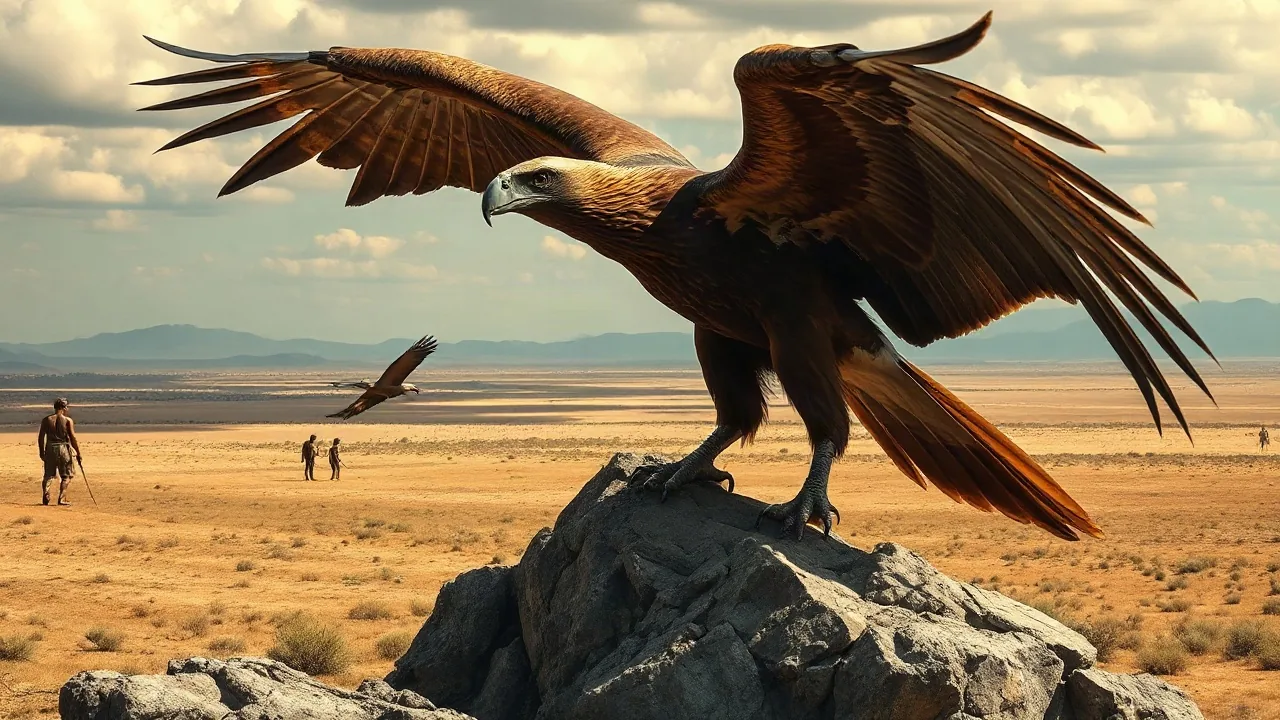
A new study revisits the astonishing evidence of colossal eagles that once dominated the prehistoric skies, some boasting wingspans comparable to small aircraft. These formidable birds of prey, now extinct, may have not only terrorized ancient landscapes but also played a significant role in shaping human evolution by preying on our early ancestors.
Paleontologists and paleoanthropologists are piecing together a picture of a world where humans were not always at the apex of the food chain. The fossil record reveals a diverse array of giant raptors, including species like the Haast's eagle (Aquila moorei) in New Zealand and the powerful Verreaux's eagle (Aquila verreauxii) in Africa, which were considerably larger and more dangerous than any eagle species alive today. Some of these extinct giants possessed talons strong enough to crush bone and beaks capable of tearing through flesh, making them a serious threat to any creature, including the early hominins that walked the Earth.
A Prehistoric Apex Predator
The theory that these giant eagles preyed on humans is not new, but recent research is reinforcing the idea that this predation could have had a lasting evolutionary impact. By regularly hunting early humans, these aerial predators might have driven behavioral and physical adaptations. For instance, early humans might have developed stronger social cohesion for defense, improved vigilance, and perhaps even quicker reflexes to evade aerial attacks. The constant threat could have influenced where early humans chose to settle, how they built shelters, and the development of tools for defense against such formidable predators.
Dr. Aris Katzourakis, a researcher at the University of Oxford, has explored the potential impact of such large predators on human evolution. He notes that ecological pressures, including predation, are well-established drivers of evolutionary change. "When you have a predator that is large, efficient, and occupies a niche that overlaps with humans, it's highly probable that it would have exerted selective pressure," Katzourakis stated in a recent publication. "We see this pattern throughout the animal kingdom, and there's no reason to assume early humans were exempt."
The sheer size of these extinct eagles is difficult to comprehend. The largest known, the Malagasy Crowned Eagle (Stephanoaetus mahery), had an estimated weight of up to 22 pounds (10 kilograms) and a wingspan of nearly 10 feet (3 meters). The Haast's eagle, which coexisted with the early Māori people of New Zealand, was even more imposing, with a weight of up to 35 pounds (16 kilograms) and a wingspan that could exceed 12 feet (3.6 meters). The Māori people themselves have oral traditions that speak of large, predatory birds, suggesting a long history of interaction, and likely conflict, with these powerful raptors before their extinction around the 15th century, partly due to human hunting and habitat destruction.
The implications extend beyond mere survival. The constant need to evade these aerial threats could have spurred cognitive development, encouraging problem-solving skills and the use of early projectile weapons. It's a compelling thought that the very survival instincts honed by the fear of being snatched by a giant eagle might have played a role in the intelligence and adaptability that ultimately allowed *Homo sapiens* to thrive.