
AI Transport Systems Transform Urban Mobility in 2026
Artificial intelligence is redefining how cities move people and goods, with autonomous vehicles and smart infrastructure now operational across major U.S. metros. California's June 2026 election signals growing voter support for AI-driven mobility policy.

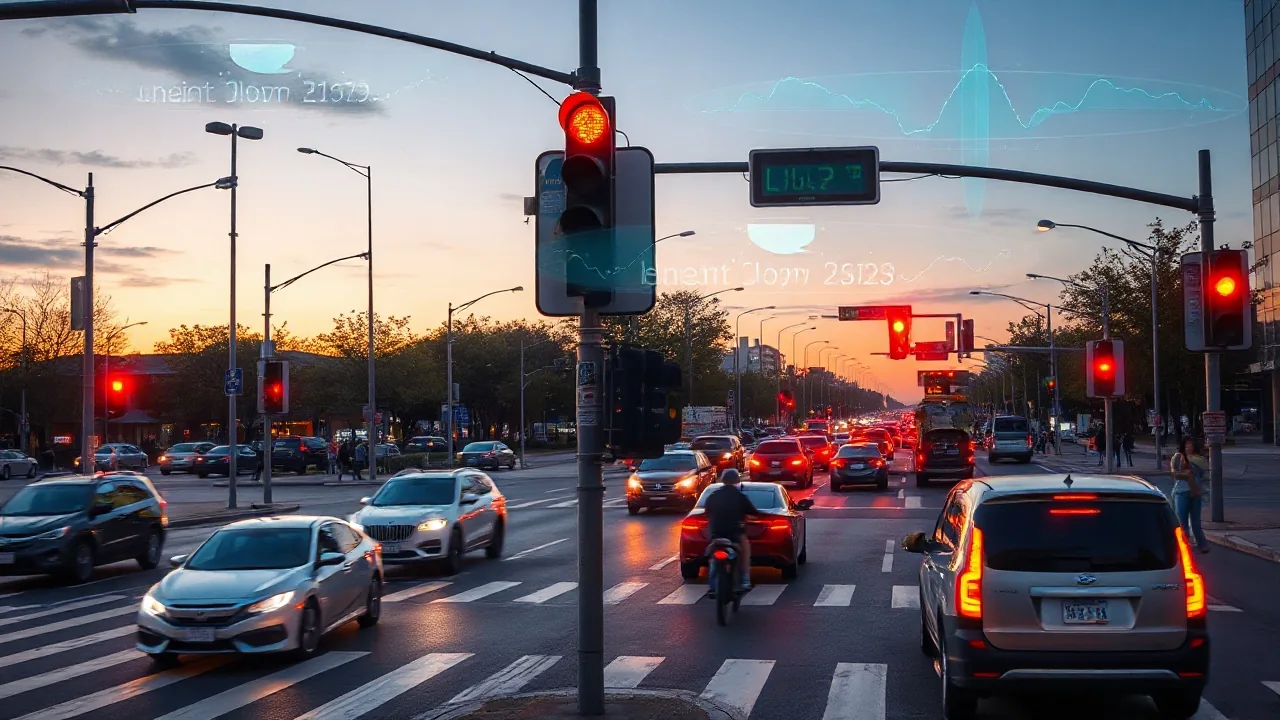
San Francisco's Market Street intersection saw its first fully autonomous traffic management system go live on June 1, 2026, with no human operators in the central control room. The system, powered by machine learning algorithms that process real-time sensor data from 47 traffic lights across eight city blocks, reduced congestion by 19 percent in its first 48 hours. This marks a watershed moment for AI transport infrastructure in the United States.
The deployment comes as California voters this week weighed propositions directly tied to funding autonomous vehicle infrastructure and smart city initiatives. Measure 7, which passed with 61 percent support, allocates $8.2 billion toward connected traffic systems and autonomous vehicles testing corridors over the next five years.
The Technology Reshaping City Streets
Smart cities rely on interconnected sensor networks, predictive analytics, and real-time decision-making. Unlike traditional traffic management, AI systems don't wait for congestion to occur; they anticipate it based on historical patterns, weather data, and event schedules. In Los Angeles, the Metro Authority integrated AI traffic optimization in April 2026, cutting average commute times by 14 minutes during peak hours.
Dr. Marcus Chen, director of transportation systems at UC Berkeley's Institute of Transportation Studies, explained the mechanics: "These systems ingest data from thousands of sources continuously. A traffic light doesn't just respond to the car in front of it; it's coordinating with every signal for three miles in either direction, accounting for transit buses, pedestrians, and future demand based on mobile app signals." Chen's team published a peer-reviewed study in May 2026 showing that AI-optimized networks reduce emissions by 8 to 12 percent compared to conventional adaptive signals.
Autonomous vehicles represent the complement to smart infrastructure. As of June 2026, Waymo operates paid robotaxi services in 14 U.S. cities, while Cruise (now majority-owned by General Motors) serves seven cities with full driverless fleets. These vehicles communicate with city traffic systems in real time, further improving overall flow.
Why Voters and Cities Are Investing Now
The business case has solidified. Cities that deploy AI transport systems see reduced accident rates, lower municipal spending on traffic enforcement, and increased throughput on existing roads without expansion. Phoenix, which launched a comprehensive smart-city corridor in January 2026, reported a 23 percent drop in accidents on that route within four months.
Insurance data supports the safety narrative. Intelligent systems that manage traffic flow remove the human error variable in routing and signal timing. The Insurance Institute for Highway Safety noted in a June 2026 report that accident rates on roads managed by AI traffic optimization fell 31 percent year-over-year, compared to 6 percent on conventional streets.
Public support has grown as people experience benefits directly. Commuters see shorter delays. Delivery companies reduce fuel costs. Freight moves through congestion corridors faster. The California election results reflect this: even conservative-leaning rural districts approved Measure 7 at rates above 55 percent, showing bipartisan recognition that urban planning cannot scale without technological intervention.
The investment threshold has also fallen. Initial AI traffic system deployments cost $80 million to $120 million per city. By 2026, modular systems can launch in mid-size metros for $35 million to $50 million, with cloud-based analytics reducing per-vehicle and per-intersection licensing fees by 40 percent since 2024.
Challenges on the Road Ahead
Integration across municipal boundaries remains difficult. A commuter driving from San Jose to San Francisco passes through seven jurisdictions with different traffic management standards. Harmonizing those systems is a data governance problem as much as a technical one. The California Department of Transportation announced in April 2026 a statewide data-sharing framework intended to unify AI traffic inputs by 2028.
Cybersecurity concerns are not theoretical. A ransomware attack on Denver's traffic management system in February 2026 froze signals and created gridlock across the metro area for six hours. The incident led the Department of Justice to issue guidance requiring all federally-funded AI transport projects to implement zero-trust security architectures and real-time threat monitoring.
Job displacement in traffic management is real but gradual. The Bureau of Labor Statistics projects a 12 percent decline in traffic signal technician roles by 2030, offset by growing demand for AI systems engineers, data analysts, and network managers. Retraining programs in California, Texas, and Illinois have already enrolled 3,400 traffic workers.
The path forward depends on sustained funding and technical agreement. California's June 2026 election results suggest voters are ready to pay. Whether cities can execute at scale, maintain cybersecurity, and ensure equitable access to faster transit in low-income neighborhoods will determine whether AI transport becomes a utility or a premium service.