
EV Charging Infrastructure Powers 2026 Mobility Growth
California's election results underscore voter demand for expanded electric vehicle charging networks. In 2026, rapidly growing infrastructure is reshaping how Americans adopt clean energy transport.

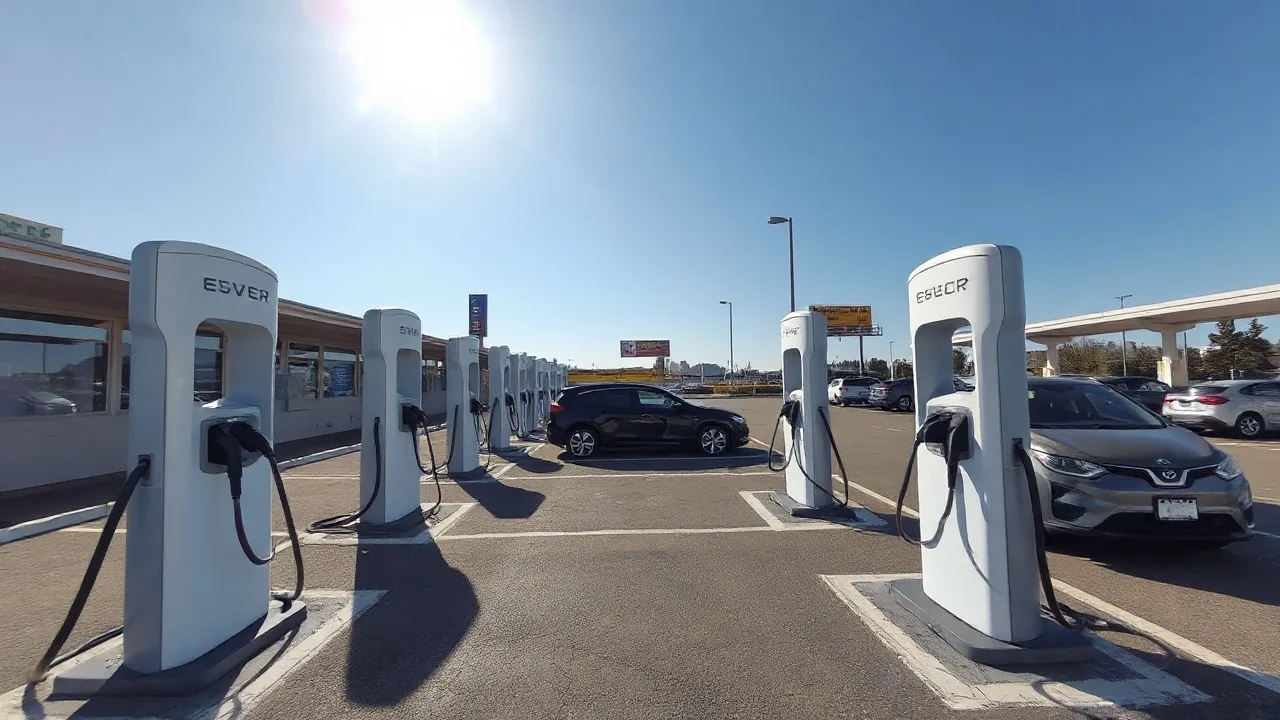
California voters approved $10 billion in infrastructure bonds during the June 2026 election cycle, with electric vehicle charging expansion emerging as a centerpiece of the mandate. The decision reflects a broader national shift: EV charging infrastructure is no longer a niche concern but a mainstream utility requirement, comparable to gas stations a generation ago.
The vote followed months of debate over transport emissions and grid readiness. Major utilities and state planners had warned that without coordinated investment, the state's 8 million registered electric vehicles would face bottlenecks at charging hubs, particularly outside urban centers. California's Public Utilities Commission reported in Q2 2026 that charging wait times in rural and suburban areas averaged 18 minutes during peak evening hours, up from 12 minutes two years earlier.
"We're at an inflection point," said Dr. Sarah Chen, director of the Stanford Sustainable Transportation Lab, in a June 2026 interview. "The infrastructure isn't just about convenience anymore. It's about whether grid modernization and sustainable transport can actually scale together without massive rate increases for consumers."
National Momentum Accelerates
California's election result follows similar measures across six states in the past 18 months. Texas, Florida, New York, and Colorado all greenlit multi-billion-dollar infrastructure initiatives in 2025 and 2026 that included charging expansion, fast-track permitting for new sites, and grid upgrades to handle peak demand.
Federal data released in May 2026 showed 142,000 public charging ports nationwide, a 35 percent increase since the start of 2024. Private operators like Tesla, Electrify America, and EVgo account for roughly 80 percent of that growth. However, rural coverage remains uneven: the Department of Energy found that 22 percent of US counties still lack a single fast-charging station.
- Interstate corridor buildout: All major US highways now have charging every 150 miles or less, with Tesla's Supercharger network leading adoption.
- Workplace and residential charging: Corporate campuses and apartment complexes have added 67,000 Level 2 chargers since 2024.
- Grid integration: Smart charging pilots in 18 cities now coordinate vehicle charging with renewable energy generation and time-of-use rates.
The economics are shifting too. Installation costs for Level 3 DC fast chargers have fallen 22 percent since 2023, to roughly $42,000 per unit. Combined with federal and state tax credits now available to charging networks, profitability timelines have compressed from 12 years to 6-7 years for prime locations.
The Grid and Cost Challenge
Mass adoption of electric vehicles depends on three interlocking systems: vehicle availability, charging accessibility, and grid capacity. The first two are advancing rapidly. The third remains contested.
Electric vehicles consumed 4.2 percent of total US electricity in 2026, up from 1.8 percent in 2023. That's manageable, but not evenly distributed. California's peak charging hours (6 p.m. to 11 p.m.) now account for 12 percent of evening grid demand in some regions. Engineers warn that reaching 30 million electric vehicles on US roads by 2035—the current net-zero pathway target—could require 200 gigawatts of additional generation or a major shift in charging behavior.
"The grid can handle it, but not passively," said Marcus Webb, senior analyst at the National Renewable Energy Laboratory, in a statement issued in May 2026. "We need intelligent load management, demand response pricing, and probably 40 to 50 gigawatts of new renewable capacity specifically dedicated to vehicle charging over the next five years."
That prospect divides policymakers. Some states are pairing charging expansion with aggressive renewable buildout mandates. Others are taking a wait-and-see approach, betting that battery costs and home charging will naturally distribute demand more evenly than current projections assume.
Consumer bills tell the story differently in different regions. In California, where grid stress is highest, charging costs at public fast-chargers have risen 8 percent year-over-year. In Texas, where wind capacity expanded aggressively in 2025-2026, public charging prices have declined 12 percent. Regional arbitrage on electricity costs is emerging as a hidden factor in EV adoption patterns.
What Comes Next
Clean energy advocates point to June 2026 election results as a mandate for acceleration. But implementation faces real constraints. Permitting timelines for new charging sites average 7 months in urban areas and up to 18 months in rural zones, due to environmental reviews and grid interconnection studies. Supply chains for charging components remain tight, with lead times of 20-24 weeks for some DC fast-charger models.
The next phase of infrastructure will likely focus on three areas: rural buildout funded by grants rather than market forces, workplace and destination charging to ease daytime grid stress, and grid-balancing technologies that allow vehicles to feed power back to the network during peak demand. That last capability, vehicle-to-grid (V2G), is technically mature but remains a small fraction of actual charging; fewer than 2 percent of US EV models and charging networks support it yet.
California's bond approval, combined with federal funding announcements expected in Q3 2026, signals that electric vehicle charging is entering infrastructure-utility status. The question now is whether policy, pricing, and grid investment can keep pace with vehicle sales growth, or whether bottlenecks will emerge by 2028-2029 as electric vehicles penetrate middle and lower-income markets where home charging is less common.
The infrastructure exists in outline. Scaling it equitably is the work ahead.