
Atlantic Ocean 'Cold Blob' Spurs Climate Concerns Amid Heatwaves
A mysterious 'cold blob' in the North Atlantic, the sole region to cool since the 19th century, is raising alarms among scientists about its impact on global weather and ocean currents like the AMOC.

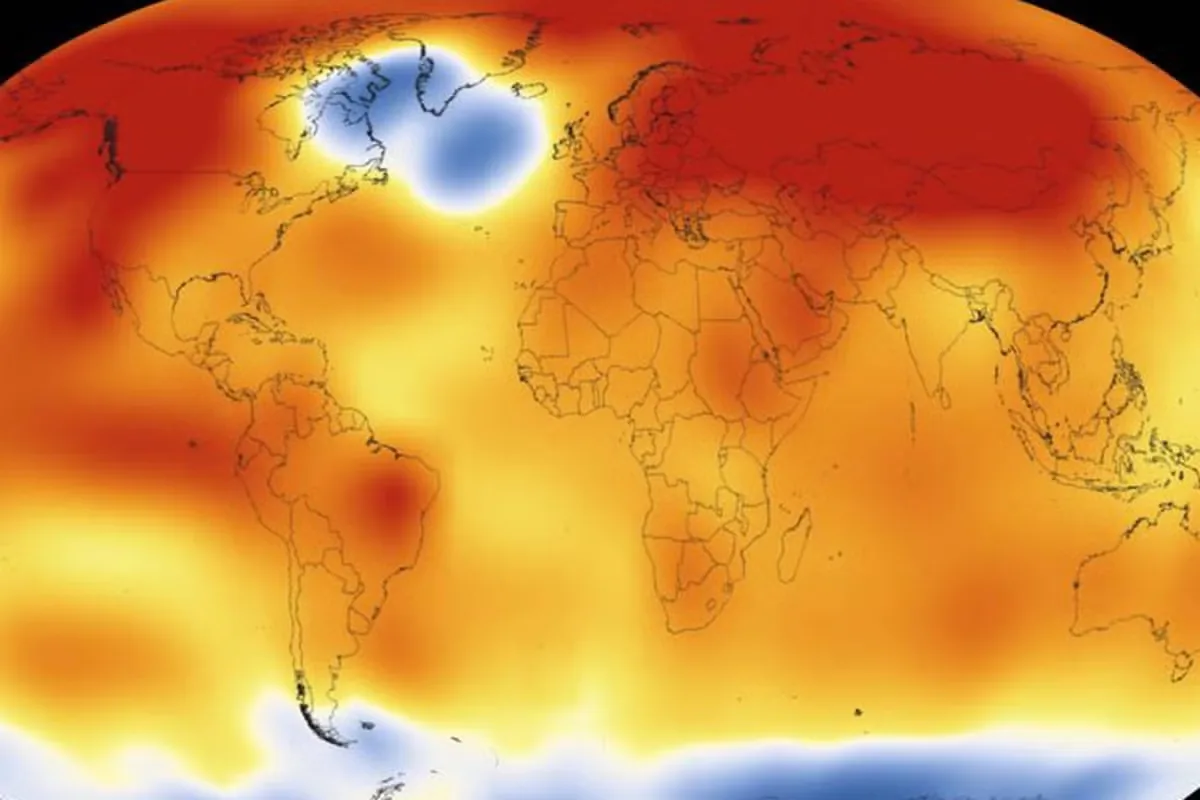
While much of the United States grapples with severe heatwaves this summer, a peculiar climatic phenomenon in the North Atlantic Ocean is drawing significant scientific attention. Dubbed the 'cold blob' or 'warming hole,' this expansive area of cooler water south of Greenland is the only place on Earth to have registered a significant temperature decrease since the 1800s, cooling by nearly 1 degree Celsius since 1900. This anomaly, first flagged by researchers about a decade ago, is now prompting concerns about its potential to disrupt global climate and weather systems, with a recent study suggesting its existence hints at more profound oceanic changes.
Oceanographers and climate scientists are exploring two primary hypotheses for the cold blob's formation: shifts in ocean currents and altered surface heat exchanges between the ocean and atmosphere. "They are debating the relative importance of the two mechanisms," stated Flavio Lehner, a climate scientist at Cornell University, indicating that a definitive consensus has yet to emerge. One theory posits that the cooling is largely due to heat transferring more readily from the ocean surface into the atmosphere. The other, and perhaps more concerning, explanation centers on the Atlantic Meridional Overturning Circulation (AMOC), a critical system of global ocean currents.
AMOC Slowdown Linked to Arctic Melt
A study published in Geophysical Research Letters earlier this year, led by Professor Stefan Rahmstorf of Potsdam University, concluded that changes in ocean heat transport driven by the AMOC system, rather than surface heat fluxes, are the primary cause of the cold blob. Understanding this requires a basic grasp of ocean water density. "It's all about buoyancy – what floats and what sinks," explained Dr. Lee de Mora, a marine ecosystems modeller at Plymouth Marine Laboratory. Cold water and freshwater are less dense and tend to float, while warmer, saltier water is denser and sinks. This interplay of temperature and salinity dictates ocean circulation patterns.
The AMOC functions like a global conveyor belt. Warm, salty water travels northward from equatorial regions towards the North Atlantic via currents like the Gulf Stream. As this water cools and becomes denser, it sinks in the subpolar regions and flows southward along the ocean floor, eventually returning to the equator. "The AMOC is one of the two main engines of global circulation, which is why it's so important," Dr. de Mora noted. "You get warm Caribbean water coming north, it emits that heat to the atmosphere and keeps us nice and warm here in Europe, and then that water sinks and heads southwards."
However, evidence suggests this vital circulation system has slowed. Scientists like Dr. de Mora point to the melting of the Greenland ice sheet, a consequence of rising global temperatures and increased atmospheric CO2, as a potential disruptor. The influx of cold, fresh meltwater into the North Atlantic dilutes the salinity, making the surface water less dense. "It just sits at the surface and it actually stops that water from sinking; it stops the sinking part of the engine," Dr. de Mora said. "So that's where you get this slowdown in the global circulation. That patch of fresh, cold water sits there in the North Atlantic and blocks water from getting to it." This phenomenon directly contributes to the formation and persistence of the cold blob.
The cold blob's considerable size also influences atmospheric patterns. It forces the jet stream, a high-altitude air current, to deviate around it, potentially leading to more extreme weather events. "That's when you get these heat dumps and cold snaps, where it hits the bottom and then it creates a wave in the jet stream that passes over Europe," Dr. de Mora elaborated. Dr. Dafydd Gwyn Evans, a senior research scientist in physical oceanography at the National Oceanography Centre, has co-authored research linking the subpolar North Atlantic cooling to extreme European heatwaves. "Essentially, the gradient in temperature of the ocean affects the path of the jet stream and how far north or south it flows over the continent," he explained. "The tendency is for us to have more extreme summer heat waves with this cold blob in the subpolar gyre."
While the cold blob may contribute to shorter-term heat extremes in some regions, its long-term implications for northern Europe could be a significant cooling. Dr. Evans suggested that the climate could become more akin to that of eastern Canada, currently known for its colder temperatures, if the AMOC continues to weaken and fail to transport warm water northward. The stability of the AMOC itself remains a subject of scientific debate, partly due to limited long-term observational data. Direct ocean measurements have only been available for about 25 to 30 years, far short of the 60 years considered necessary for definitive conclusions. Current studies often rely on reanalysis data from computer models, which, as Dr. Lehner noted, "comes with sizable uncertainties."
Despite observational uncertainties, major climate models, including those used in IPCC reports, consistently project a weakening of the AMOC this century. "There is that conflict between: this is what the models tell us; this is what we expect from the science; and this is what the observations are doing," Dr. de Mora commented. While the exact timing and extent are unclear, a weakening is widely anticipated. Furthermore, scientists are divided on whether the AMOC might undergo a sudden collapse or a more gradual decline. A collapse, though considered a low-likelihood, high-risk scenario by the latest IPCC report, would have severe consequences, including massive heatwaves, rapid sea-level rise along the North Atlantic, and significant disruptions to marine ecosystems. "Shifts in plankton communities could ripple through the food chain, affecting fish stocks, seabirds and marine mammals," warned Helen Findlay, a biological oceanographer at Plymouth Marine Laboratory. "Fisheries that currently support coastal economies could become less reliable or collapse altogether." Such a collapse would also exacerbate existing climate change impacts.