
Apple iPhone Duo: First Look at Apple's Foldable Phone Debut
Apple has officially entered the foldable phone market with the iPhone Duo, aiming to challenge established players like Samsung. Early impressions highlight its refined design and unique software adaptations.

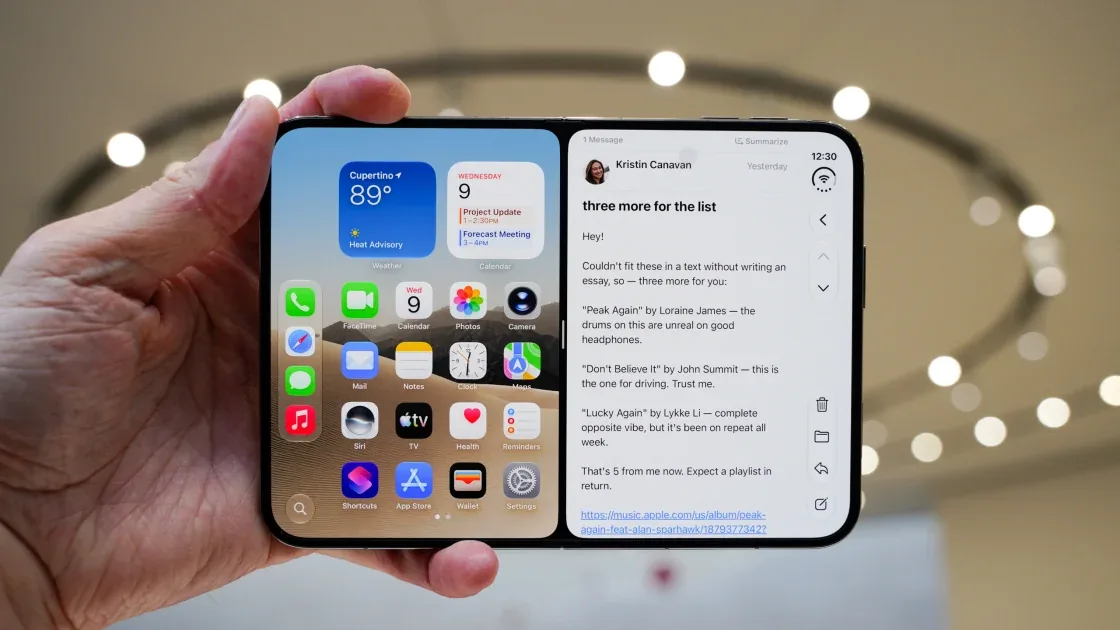
CUPERTINO, Calif. – Apple has finally launched its highly anticipated foldable smartphone, the iPhone Duo, at the company's Surprise and Shine event. The device, shaped like a passport, enters a competitive market dominated by Samsung's Galaxy Z Fold 8, with strong offerings also from Google and Motorola. This marks Apple's significant entry into a product category where rivals have been iterating for years.
The design of the iPhone Duo, while not entirely unexpected due to pre-event leaks, mirrors the passport-like form factor seen in some competitors. This specific shape prioritizes screen aspect ratios, a characteristic shared with Samsung's Galaxy Z Fold 8. Unlike the book-style folding devices such as the Google Pixel 11 Pro Fold or Motorola Razr Fold, the Duo adopts a more compact profile when closed. Internally, it features a metal frame, glass front and back, and a hinge capable of folding 180 degrees. While it feels substantial, it is notably lighter than some of its direct foldable competitors from Google and Motorola, though heavier than Samsung's latest offerings.
For users transitioning from traditional smartphones, the iPhone Duo represents a paradigm shift in user experience. Apple's execution of the hardware, however, appears to set a new standard for first-generation foldables. The hinge mechanism, reportedly composed of hundreds of parts and protected by a titanium shield, incorporates advanced spring and magnetic components. These ensure a smooth opening and closing action, allowing the device to maintain any angle once positioned, a stark contrast to some competitors that can feel less refined.
Refined Engineering and Durability
The attention to detail in the iPhone Duo's construction is evident. Apple has utilized premium materials, including titanium, stainless steel, aluminum, and its signature Ceramic Shield for the display, assembling the device with the tight tolerances characteristic of its Pro iPhone lineup. Crucially, the iPhone Duo boasts an IP68 rating for dust and water resistance, surpassing the IP48 rating of Samsung's foldables and matching Google and Motorola's offerings. This level of durability is a significant advantage for an expensive device class. While the absence of Face ID is a notable omission, Apple's integrated Touch ID fingerprint scanner is reported to be among the best available.
The display technology on the iPhone Duo is designed for adaptability. The device features an external screen measuring 5.4 inches and an internal foldable display of 7.6 inches. Both screens share consistent aspect ratios, ensuring a seamless transition when moving between the two. The outer screen, while offering less vertical space than a standard iPhone Max model, provides a wider area for typing. The inner screen, similar to Samsung's Flex Titanium display, incorporates a 10-layer structure with a titanium plate for rigidity. A unique nano-etched texture on the top layer scatters light, reducing glare and reflections for a more comfortable viewing experience, especially during video playback or multitasking. The screen also supports the Apple Pencil USB-C, further enhancing its versatility.
Running on a modified version of iOS, dubbed internally as DuoOS for this review, the iPhone Duo introduces substantial UI changes that lean towards iPadOS. Key traditional iOS controls have been relocated to the right edge of the screen for easier thumb access. The camera application has also seen significant enhancements, allowing users to preview shots on the external screen, switch cameras effortlessly, and utilize the foldable form factor for selfies. Multitasking is streamlined, supporting up to two split-screen apps in landscape orientation. New APIs have been released to aid developers in adapting their applications to the Duo's unique interface, promising a richer software ecosystem over time.
The iPhone Duo is positioned at a premium price point, starting at $1,999 for the 256GB model. Higher storage options include a 512GB model at $2,199, a 1TB model at $2,599, and a 2TB model at $3,199. The device will be available in white and deep blue. Folding phones inherently involve compromises, often impacting battery life and camera performance, and the iPhone Duo is expected to be no exception. While initial impressions are positive, a full assessment of its everyday usability, battery performance, and camera capabilities awaits further testing. Preorders for the iPhone Duo are scheduled to begin on October 16, with the official sales launch set for October 23.