
Google Unveils New Android XR Glasses with Samsung Partnership
Google showcased its upcoming Android XR glasses, a collaboration with Samsung and fashion brands like Gentle Monster and Warby Parker, focusing on enhanced AI features and a more integrated user experience.

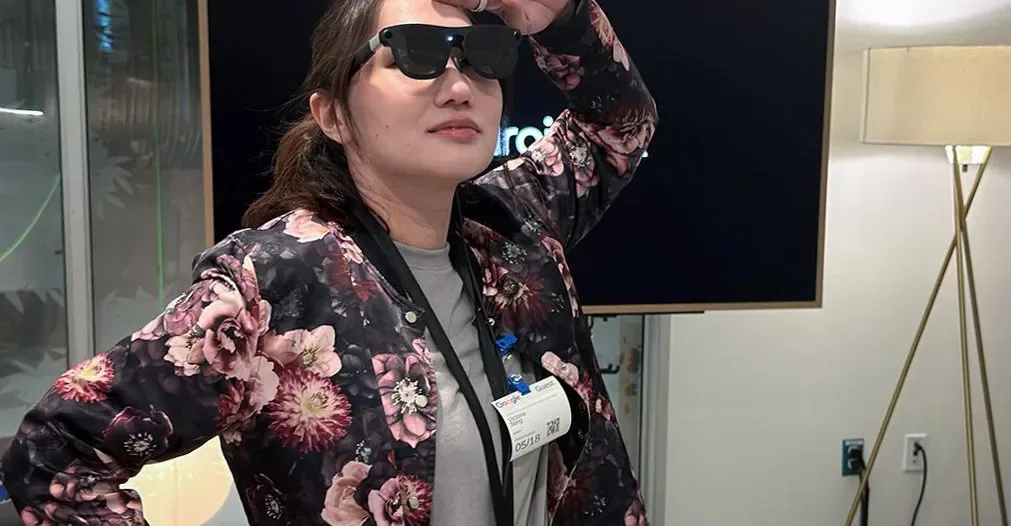
Mountain View, CA – Google offered a detailed look at its next generation of Android XR glasses, set to launch later in 2026, showcasing significant advancements in augmented reality and artificial intelligence. The tech giant, in partnership with Samsung and renowned eyewear designers, revealed prototypes and discussed future capabilities that aim to blend digital information seamlessly with the physical world.
The company has been refining its Extended Reality (XR) hardware, with Project Aura representing a key development. These new glasses, a collaboration with Xreal, are positioned between full VR headsets and lighter mixed-reality eyewear. Recent hardware updates include an improved carrying case and a redesigned compute puck, now featuring a more powerful internal chip and a fingerprint scanner for easier device unlocking. For added convenience, the compute puck can be worn around the neck via a lanyard or attached with a waist clip, offering users multiple ways to carry the essential hardware.
While the aesthetics might not appeal to everyone, Google is targeting dedicated XR enthusiasts seeking a more portable and discreet alternative to bulky headsets. The user interface navigation closely mirrors that of existing devices like the Samsung Galaxy XR, indicating a push for cross-platform familiarity. Early demonstrations focused on experiences such as tabletop gaming in mixed reality, managing multiple app windows in a user's environment, and wireless laptop display mirroring, similar to functionalities seen in the Apple Vision Pro and Samsung Galaxy XR.
Intelligent Eyewear and AI Integration
This year's demonstrations highlighted more sophisticated spatial computing experiences, including the ability to create 3D AR doodles and identify real-world objects by analyzing their molecular structure. These features underscore the shift towards making spatial applications accessible without requiring full-scale headsets. Display mirroring is now as simple as connecting the glasses to a laptop via USB-C, potentially transforming portable workstations by eliminating the need for a separate physical monitor and independent of Wi-Fi connectivity.
A notable feature is the adaptive transparency mode, which allows users to adjust the opacity of the lenses. The system is intelligent enough to detect when a user is viewing content versus interacting with people. If full opacity is set for an immersive work environment, the glasses automatically adjust to allow clear visibility when the wearer looks at someone speaking to them, returning to the chosen opacity when they resume viewing their digital display.
Google also unveiled stylish designs in collaboration with fashion brands Gentle Monster and Warby Parker, aiming to rival offerings like Meta's Ray-Ban smart glasses. While specific pricing and detailed specifications remain under wraps, the new models are expected to be lighter than the 49-gram prototypes. The partnership with Samsung is heavily emphasized, with the devices being presented as a joint effort across all involved companies, referred to as "intelligent eyewear."
The integration of Gemini, Google's AI model, is a central theme. Gemini's responsiveness has been significantly enhanced, enabling more complex queries and creative tasks, such as blending different stylistic elements for image generation. The AI can also perform advanced photo editing, like removing specific objects or background elements from images, showcasing its practical utility. Gemini's capabilities extend to other Google applications, allowing users to capture a recipe and send its ingredients to Google Keep, or directly add event details for concerts, like a Mitski performance, to Google Calendar.
While many AI-driven features function with audio-only glasses, the display-equipped models offer advanced functionalities like multi-color, 3D widgets. These widgets can display information such as stock prices, sports scores, weather updates, and translation shortcuts. The technology also extends to educational and enterprise applications, with demonstrations of 3D models that respond to head movements, envisioned for fields like biology or engineering.
Despite the impressive advancements, the article notes that real-world performance may differ from controlled demonstrations. Challenges such as filtering background noise in chaotic environments and accurately understanding user context, like travel intentions, are still being addressed. The current microphone arrays focus sound capture within a narrow 30-degree angle. Furthermore, the AI's contextual awareness, such as understanding that a concert added to a calendar is in a different city than the user's residence, requires further development.
Google's persistent efforts in the smart glasses market, despite a mixed history, signal a strong commitment to the technology. With multiple Android XR glasses slated for release in Fall 2026 from various partners, the company appears poised to be a major competitor against established players like Meta and EssilorLuxottica, driving the future of wearable technology forward.