
Motorola Razr Fold Challenges Samsung, Google Foldables
Motorola's new Razr Fold enters the competitive foldable market, offering impressive displays, strong battery life, and stylus support. It aims to rival established players like Samsung and Google.

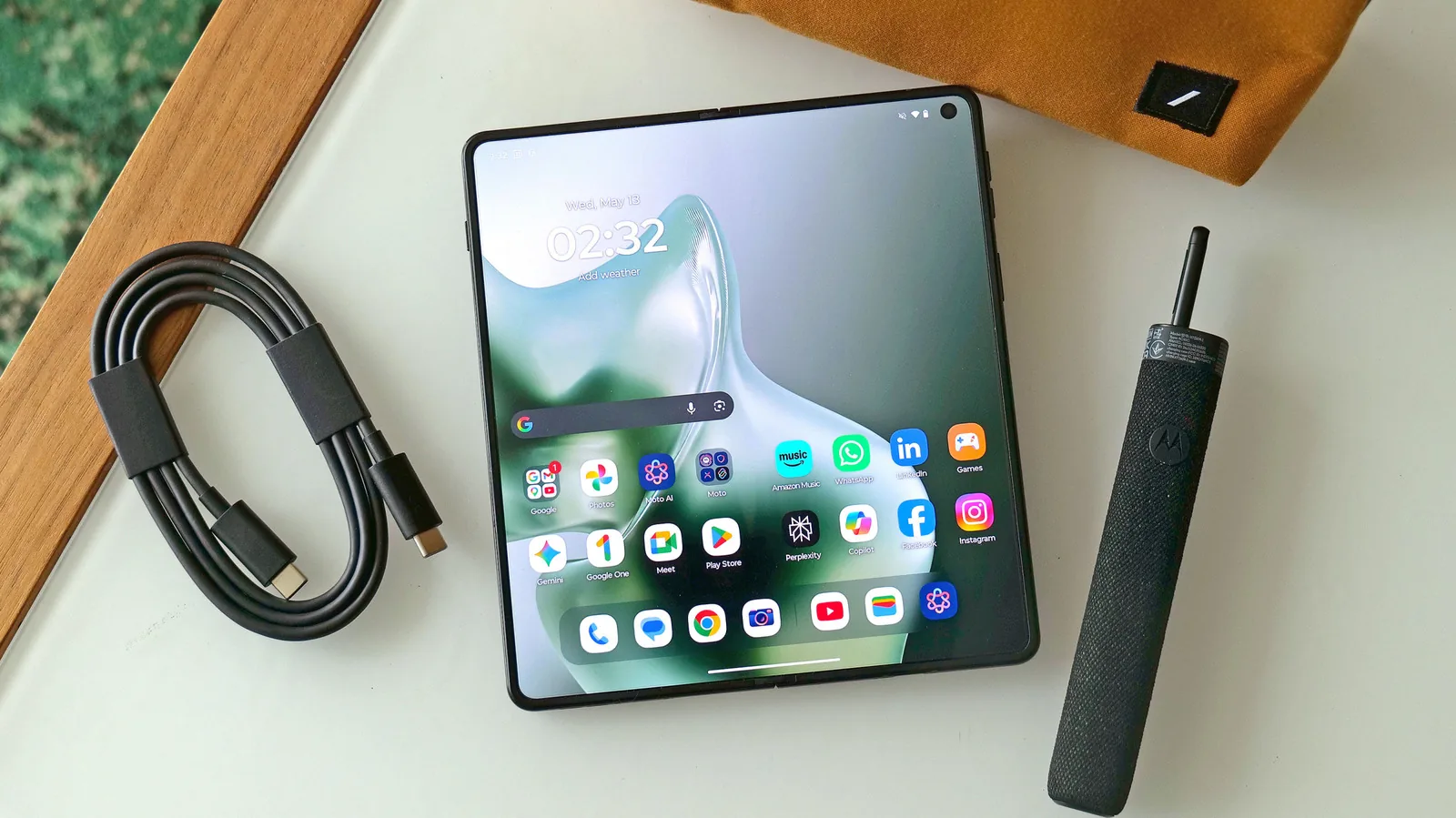
Motorola has officially entered the premium foldable smartphone arena with its new Razr Fold, aiming to directly challenge established giants like Samsung and Google. The device features a large 8.1-inch interior display that unfolds from a 6.6-inch exterior screen, a design familiar to users of competing foldables. However, Motorola has infused the Razr Fold with distinct design elements, including curvier edges and a unique textured back that, on a darkened blue model, evokes the feel of rugged outdoor gear. A dedicated button for AI applications is also a notable addition. The phone's fingerprint sensor is integrated into a slim side-mounted lock button, a design choice that, while common on large foldables, proved slightly less intuitive to locate by feel compared to wider buttons on rivals.
Despite its sleek aspirations, the Razr Fold measures 8.6 ounces and 4.7mm thick, positioning it as sleeker than the Pixel 10 Pro Fold but noticeably thicker and heavier than Samsung's Galaxy Z Fold 7. While the added heft is tolerable, the preference for Samsung's more streamlined design, a result of extensive year-long use, remains. In terms of durability, the Razr Fold boasts water resistance up to five feet for 30 minutes with an IP49 rating. This falls short of the superior IP68 dust resistance offered by the Pixel 10 Pro Fold, a crucial factor for devices designed to maximize screen space in a portable form factor.
Display Technology and User Experience
Motorola has spared no expense on the Razr Fold's display technology. Both the internal and external panels are among the largest in their class, measuring 0.1 to 0.2 inches bigger than those on competing devices. The screens also achieve an impressive peak brightness exceeding 6,000 nits, delivering a world-class viewing experience. While a subtle crease is present on the main display, it becomes virtually unnoticeable after initial acclimation. A standout feature for productivity and creativity is native stylus support on the main screen, a nod to functionality that had faded from some earlier foldable models. However, the proprietary Moto Pen Ultra comes at an additional $100 cost and lacks integrated storage within the phone itself. Users must rely on a separate charging case, which requires a wired USB-C connection for recharging, presenting a less cohesive solution for stylus management.
Performance on the Razr Fold is robust, powered by a Qualcomm Snapdragon 8 Gen 5 chip paired with up to 1TB of storage and either 12GB or 16GB of RAM. This configuration ensures a highly responsive user experience, with rapid app loading times and strong gaming performance. Motorola's multitasking software enhances productivity, offering an intuitive split-screen system and the ability to easily save app pairs for quick access. Apps can also be launched in free-form windows, providing further flexibility.
The integration of artificial intelligence features on the Razr Fold, while present, is described as somewhat rudimentary compared to the more advanced offerings from Samsung and Google. Motorola includes its own AI tools alongside pre-installed applications like Perplexity and Microsoft Copilot, enabling basic functions such as image generation and automatic screenshot saving for later retrieval. However, it lacks more sophisticated AI capabilities found on competitor devices.
Regarding its camera system, the Razr Fold features a 50-megapixel main sensor. While it captures fewer pixels than the 200MP camera on the Z Fold 7, the review suggests it produces sharper, more detailed images with more natural color saturation in various lighting conditions. Nevertheless, for extreme low-light photography, Google's Night Sight mode on the Pixel 10 Pro Fold retains an edge. The device also includes a 50MP telephoto lens with 3x optical zoom and a 50MP ultra-wide camera capable of macro photography. For selfies and video calls, a 20MP sensor is embedded in the exterior display, and a 32MP sensor is situated within the main flexible screen.
Battery life represents a significant achievement for the Razr Fold, thanks to a new silicon-carbon 6,000mAh battery. In local video rundown tests, the device lasted an impressive 24 hours and 22 minutes on its main display, surpassing both the Galaxy Z Fold 7 (20 hours, 50 minutes) and the Pixel 10 Pro Fold (21 hours, 20 minutes). Charging speeds are also top-tier, supporting up to 80W wired and 50W wireless charging. A notable drawback is the absence of a power adapter in the box, and achieving peak charging speeds requires Motorola's proprietary TurboPower accessories, as standard USB-PD or Qi2 chargers are not compatible for maximum wattage.
Motorola's debut in the large foldable market with the Razr Fold is a strong one. It successfully combines excellent displays, capable cameras, extended battery life, and fast charging. The inclusion of stylus support is a welcome addition for users seeking note-taking and drawing capabilities. While the overall design of the Galaxy Z Fold 7 might still be preferred for its superior portability, and the Pixel 10 Pro Fold excels in camera technology and durability, the Razr Fold stands as a compelling alternative. Priced at $1,900, it offers a slightly more affordable entry point than the Z Fold 7. For those not wishing to wait for potential refreshes of existing models this summer, the Razr Fold presents a highly capable option that promises not to disappoint.