
2026 Blue Moon Dazzles Skies as Smallest Full Moon of Year
May 2026's Blue Moon illuminated the night sky globally, marking the second full moon in a calendar month and the smallest full moon of the year. Stargazers captured breathtaking images from around the world.

The full Blue Moon of May 2026 captivated skywatchers worldwide over the weekend, bathing the night in moonlight as the celestial event coincided with the nearby glow of the red supergiant star Antares. This particular full moon, occurring on May 31, was notable for being the second full moon within a single calendar month, a phenomenon that happens roughly every 2.5 years due to the moon's 29.5-day orbital cycle not aligning perfectly with our 30 or 31-day months. This May's lunar event also qualified as the smallest full moon of 2026, a classification known as a micromoon. This occurs when the moon reaches its full phase at the farthest point in its elliptical orbit around Earth, resulting in a subtly diminished apparent size in the sky while still providing ample illumination.
The rarity of a Blue Moon, defined as the second full moon in a calendar month, contributes to its fascination for observers. While the term can also refer to the third full moon in a season with four full moons, the May 31 event fit the more common calendrical definition. The micromoon aspect further added to its unique astronomical characteristics, making it a point of interest for both casual observers and dedicated astronomers alike. The reduced apparent size, though subtle, is a direct consequence of celestial mechanics, demonstrating the dynamic nature of lunar orbits.
Global Spectacle Captured in Photos
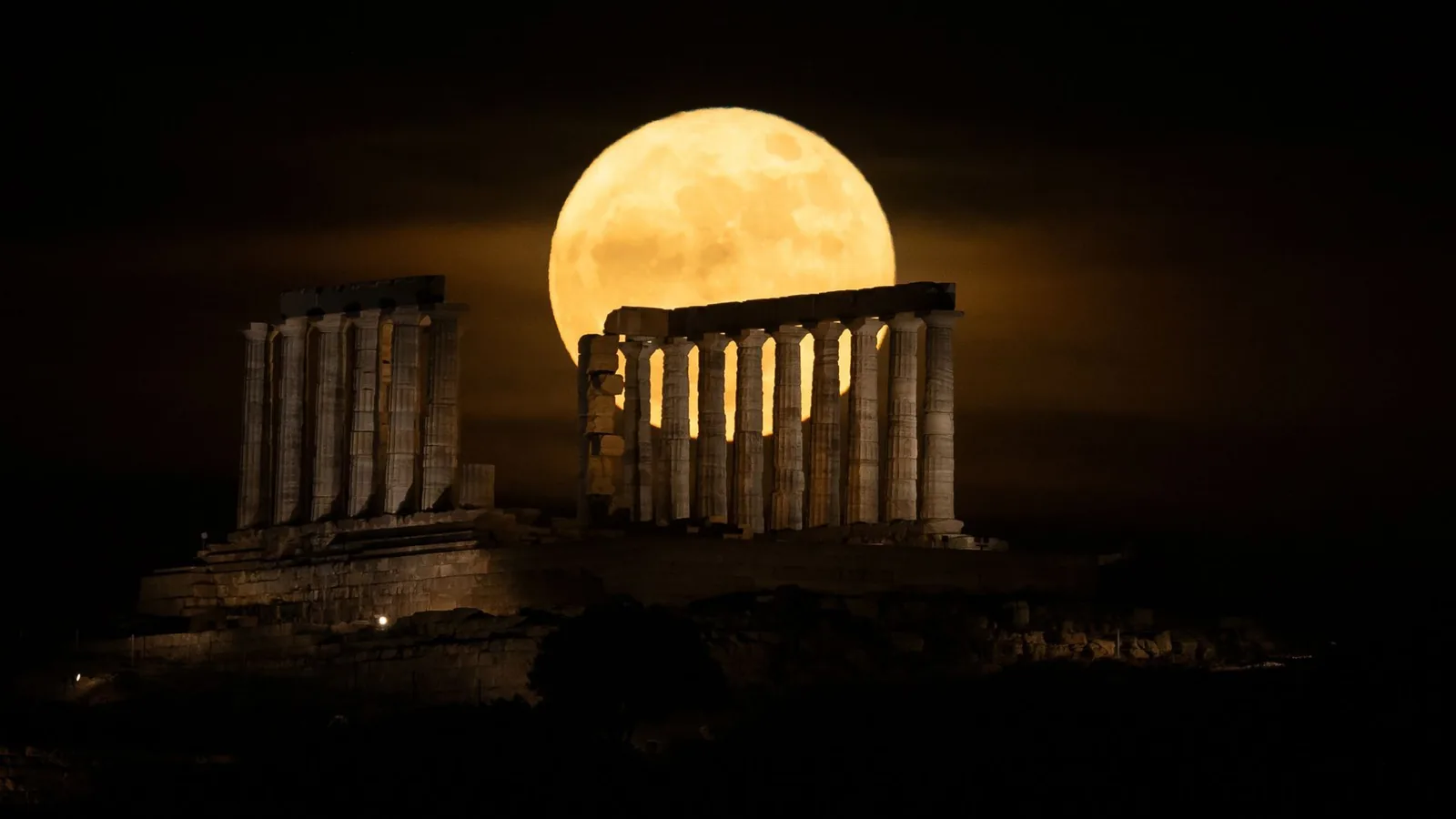
Photographers across continents documented the May 2026 Blue Moon, capturing its ethereal beauty against iconic landmarks. In Paris, France, Gary Hershorn framed the near-full moon rising between the metallic legs of the Eiffel Tower, an image taken shortly after a significant soccer match. New York City offered another striking perspective, with Lokman Vural photographing the lunar disk ascending behind the Statue of Liberty, with a helicopter momentarily appearing to navigate near the moon. Greece provided an ancient backdrop, as Castas Baltas captured the Blue Moon cresting over the historic Temple of Poseidon at Cape Sounion near Athens.
The West Coast of the United States also featured prominently in the photographic record. In California, Tayfun Coskun captured the moon ascending over San Francisco Bay, with its reflection shimmering on the water. Coskun also documented the moon’s rise above the Bay Bridge, with the infamous Alcatraz Island visible in the foreground. Further afield in Australia, Steve Christo-Corbis captured a serene image of the full moon glowing in a peach-colored sky above the Sydney Opera House on May 31. In Thailand, Pongmanat Tasiri documented the moon peeking through clouds above Chiang Mai. Even through dense cloud cover in Kechnec, Slovakia, Robert Nemeti managed to capture the moon's glow illuminating a communication tower.
Across the surface of the moon itself, dark plains known as lunar maria were visible, remnants of ancient volcanic activity where lava once flowed. These features were also apparent in images taken by Juliane Sonntag atop the Brooklyn Bridge in New York, where the full moon contrasted with the city's lights. Each photograph, from diverse global locations, highlights the universal appeal of lunar events and the artistic endeavors of photographers to capture them. The next full moon, the Strawberry Moon, is set to rise on June 29, marking the first full moon of summer in the Northern Hemisphere.