
NASA Reveals Near-Earth Object 1998 SH2 is Unusual Dark Comet
A near-Earth object, long classified as asteroid 1998 SH2, has been reidentified as a "dark comet" by NASA. The discovery impacts planetary defense strategies.

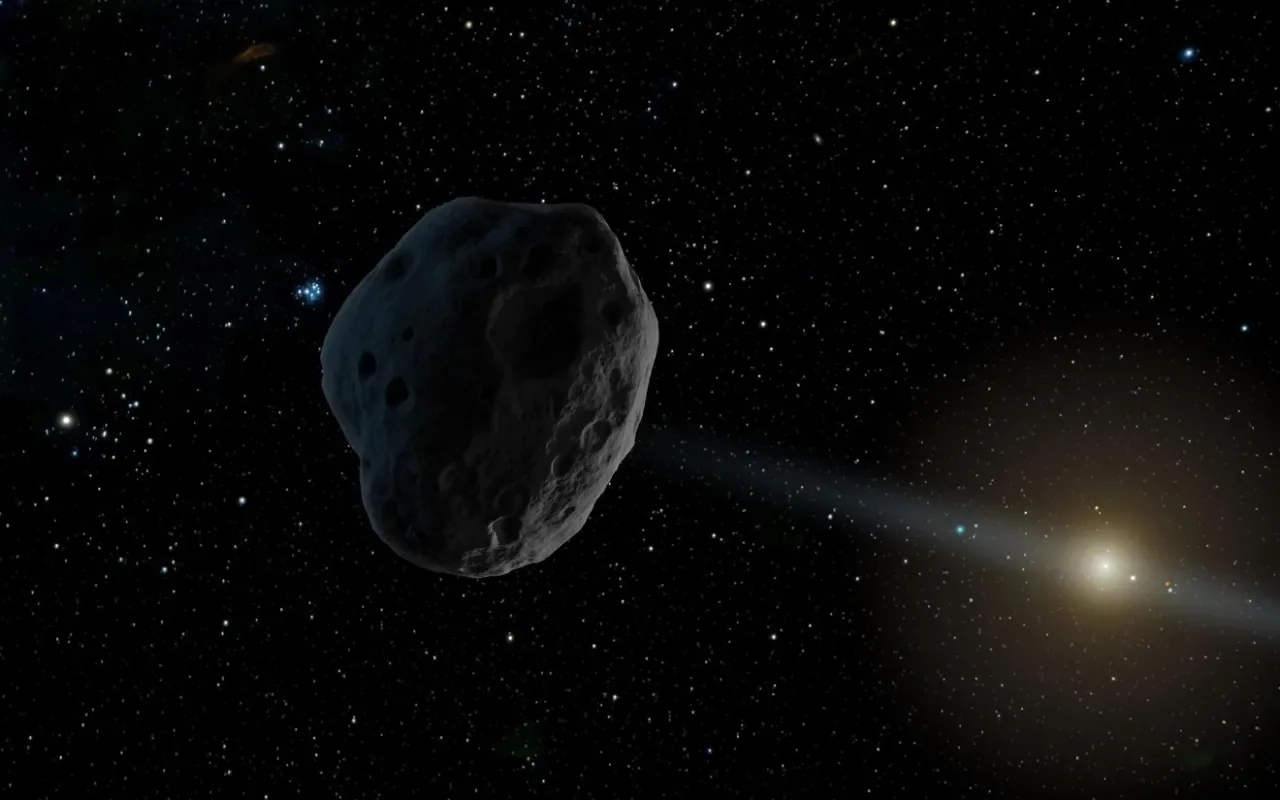
NASA scientists have reclassified a near-Earth object, initially discovered in 1998 and designated 1998 SH2, as a "dark comet" rather than an asteroid. The object's unusual behavior was noted when it made a close pass by Earth in August 2025, deviating from predicted trajectories that accounted only for gravitational forces. Decades of observational data revealed that escaping gas from the object's surface was subtly altering its path—a characteristic behavior of comets as their icy components sublimate under solar heating.
Astronomers utilizing powerful telescopes in Hawaii and Chile eventually observed a faint tail extending from the object, confirming its cometary nature. It has since received the dual designation P/1998 SH2. Unlike the luminous comets commonly depicted, 1998 SH2 belongs to a rare category known as dark comets. These celestial bodies exhibit cometary activity but emit so little gas and dust that they often appear indistinguishable from asteroids to observers, making their identification challenging.
Implications for Planetary Defense
The reclassification of 1998 SH2 holds significant implications for planetary defense initiatives. Accurately identifying whether a near-Earth object is an asteroid or a comet is crucial for refining orbital predictions and assessing potential impact risks. Davide Farnocchia, a lead navigation engineer with NASA's Center for Near-Earth Object Studies at the Jet Propulsion Laboratory, emphasized the importance of continuous monitoring.
“This work shows the importance of continuously tracking near-Earth objects,” Farnocchia stated. “Detecting these perturbations can be an important diagnostic tool for planetary defense that will help understand which objects may be comets rather than asteroids, how their orbits evolve, and how that influences their Earth impact risks.”
The discovery underscores the dynamic nature of space and the ongoing need for sophisticated observation and analysis. Traditional asteroid detection methods might overlook such elusive objects, potentially underestimating the full spectrum of threats from near-Earth objects. Understanding the nuances between asteroids and comets, especially these less visible ones, provides a more comprehensive picture for future risk assessments.
NASA's forthcoming Near-Earth Object Surveyor mission is expected to enhance the detection capabilities for dimly appearing objects like dark asteroids and dark comets. This advanced mission aims to improve the identification and ongoing monitoring of potentially hazardous objects navigating the space around Earth, bolstering the agency's overall planetary defense strategy.