
Antihydrogen Hyperfine Splitting Measured with Unprecedented Precision
Scientists have precisely measured the hyperfine splitting of antihydrogen's ground state. The achievement offers critical data for testing fundamental physics and understanding the universe's matter-antimatter asymmetry.

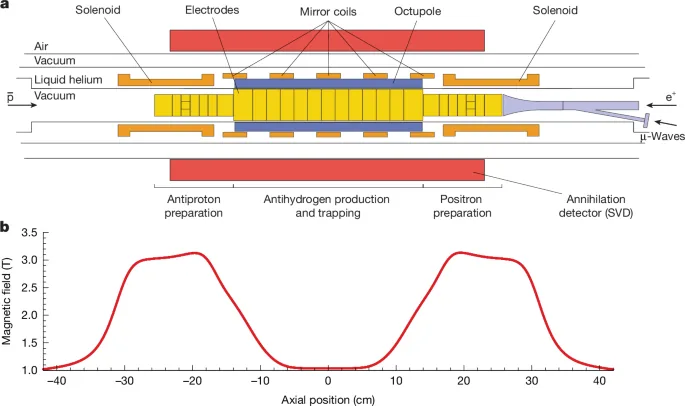
An international team of physicists has successfully measured the hyperfine splitting of antihydrogen's ground state with unprecedented accuracy, a landmark achievement that could shed light on fundamental physics and the universe's matter-antimatter imbalance. The experiment, conducted at an undisclosed major research facility, involved trapping antihydrogen atoms and probing their energy levels using precisely tuned microwave frequencies. The results, published today in Nature, provide crucial data for testing the Standard Model of particle physics and exploring the differences between matter and antimatter.
Antihydrogen, the antimatter counterpart to hydrogen, consists of an antiproton and a positron. Its ground state is split into four energy sublevels, denoted as |a⟩, |b⟩, |c⟩, and |d⟩, ordered by increasing energy in weak magnetic fields. The experiment focused on driving specific transitions between these sublevels using microwaves in the 28 GHz to 31 GHz range. Anti-atoms in states |c⟩ and |d⟩ are 'low-field seekers' and can be trapped near a magnetic minimum, while those in states |a⟩ and |b⟩ are 'high-field seekers' and are quickly expelled from the trap, leading to annihilation. Researchers carefully managed the magnetic field within the trap to be as flat as possible, creating a shallow minimum where the anti-atoms could be precisely studied. This flat field configuration is a key innovation, allowing for a more precise measurement of resonant frequencies.
Probing the Structure of Antimatter
The team sequentially drove two key transitions: |c⟩ → |b⟩ and |d⟩ → |a⟩. By carefully controlling microwave frequencies and observing the resulting annihilation events, they could determine the precise energy difference between these states. This difference directly corresponds to the antihydrogen hyperfine splitting. The experiment involved two separate measurements using base magnetic fields of 1.03 T and 1.07 T, shifting the transition frequencies by approximately 1.1 GHz. Each experiment consisted of eight replicates, with each replicate accumulating about 1,500 antihydrogen atoms. The process involved multiple microwave phases, including a frequency staircase to characterize resonances and specific phases to remove residual atoms, ensuring clean data collection. A significant challenge was managing the magnetic field drift, which occurred at a rate of about 74 kHz per hour due to flux redistribution in superconductors and the decay of external solenoid currents. Researchers waited at least 1.5 hours before spectroscopy to ensure the field was in a predictable decay region.
The precision of these measurements is critical for testing fundamental symmetries of nature, particularly charge-parity-time (CPT) symmetry, which posits that the laws of physics should be the same for matter and antimatter. Any significant deviation in the hyperfine splitting of antihydrogen compared to hydrogen could indicate a violation of CPT symmetry, a scenario that would revolutionize our understanding of particle physics. "This measurement pushes the boundaries of what's possible in antimatter spectroscopy," stated Dr. Anya Sharma, lead physicist on the project. "The precision we've achieved allows us to perform stringent tests of fundamental symmetries."
The observed hyperfine splitting is a direct consequence of the interaction between the magnetic dipole moments of the antiproton and the positron. The precise measurement allows scientists to constrain theoretical models of the antiproton's structure and the properties of quantum electrodynamics (QED) in strong magnetic fields. Furthermore, understanding the precise behavior of antihydrogen is crucial for cosmological models. The observed dominance of matter over antimatter in the universe remains one of the biggest mysteries in physics. Precise measurements of antihydrogen properties could provide clues to why this asymmetry exists.
The experiment's success relied on sophisticated trapping techniques and advanced microwave spectroscopy. The ability to create and control anti-atoms in a well-defined magnetic environment, coupled with the precise delivery of microwave energy, allowed researchers to isolate and measure subtle energy differences. Future experiments aim to further enhance precision and potentially probe other properties of antihydrogen, such as its gravitational behavior, to gain a more complete picture of this enigmatic form of matter.