
Moon's Largest Crater Linked to 'Decapitated' Asteroid, Artemis May Find Clues
A new study suggests the moon's vast South Pole-Aitken basin was formed by a differentiated asteroid that sheared apart on impact. NASA's Artemis astronauts may land near resulting deep lunar material.

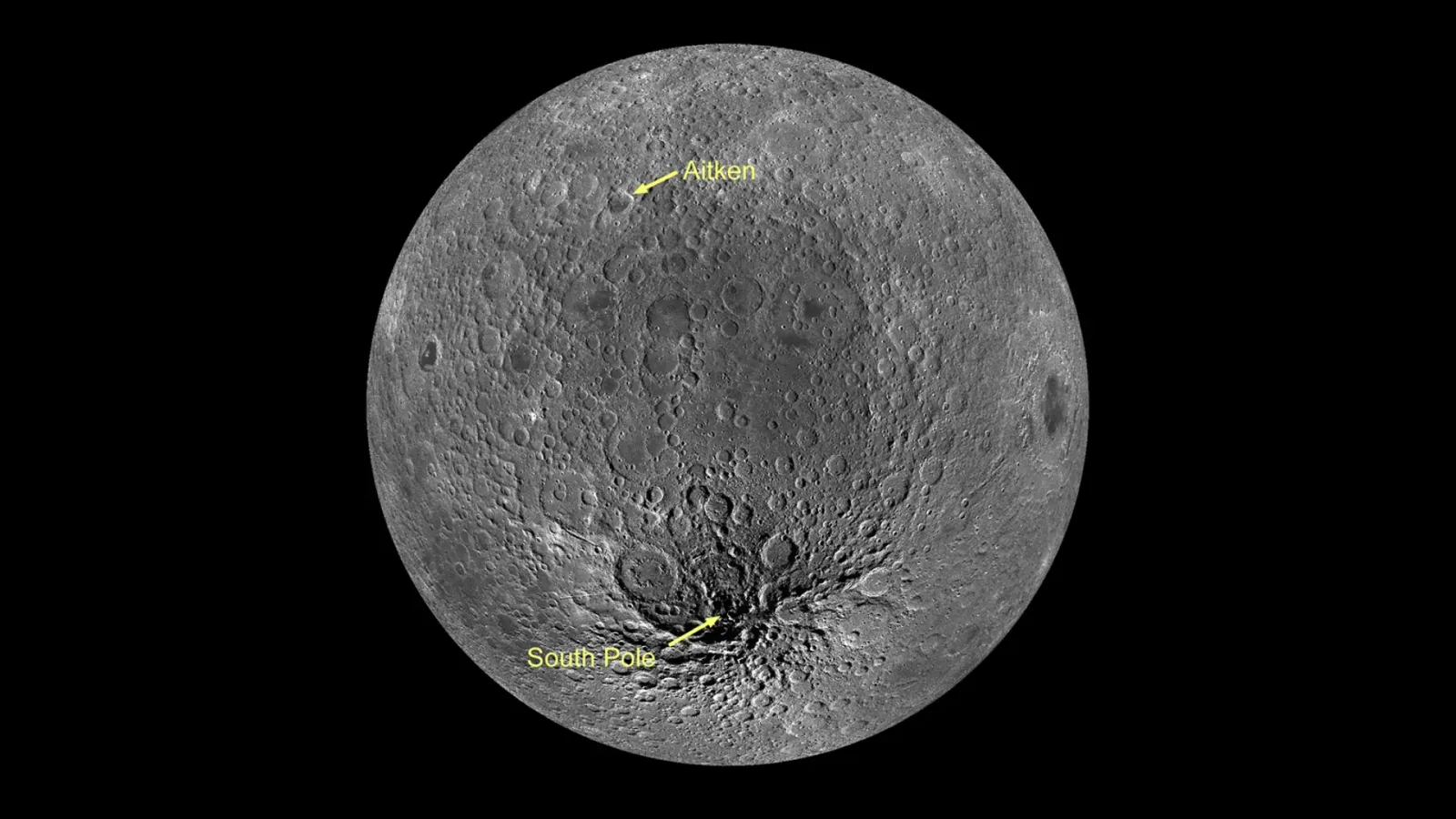
The moon's largest impact basin, the South Pole-Aitken (SPA) basin, may have been created by a "decapitated" asteroid, a new study reveals. This violent cosmic collision, which carved out the massive crater more than 1,200 miles wide, could have scattered deep lunar material near the moon's south pole — precisely where NASA plans to send its Artemis astronauts. The findings offer potential insights into the basin's formation and have significant implications for future lunar exploration.
Scientists have long debated the origins of the SPA basin, a scientifically invaluable structure for potentially exposing material from the moon's deep mantle. Key questions revolved around the size, speed, and trajectory of the celestial body that caused the impact. Utilizing high-resolution 3D simulations, a research team led by Shigeru Wakita of Purdue University determined that the SPA basin's unique tapered-ellipse shape is best explained by an impactor roughly 160 miles wide. This impactor was a differentiated asteroid, meaning it had already separated into a dense iron core and a rocky outer layer, akin to a miniature planet.
The study proposes that this differentiated asteroid struck the moon at approximately eight miles per second, traveling from north to south at a shallow 30-degree angle. This oblique angle is crucial, as it would have caused the impactor to essentially shear apart. The upper layers would have been stripped away, allowing the dense iron core to continue its trajectory and excavate the deep lunar material. "The impactor's core is responsible for the tapered shape of SPA," the study's authors explained. In contrast, a simpler, undifferentiated asteroid impact would have likely resulted in a more circular basin.
Implications for Artemis Missions
Crucially, the simulations indicated that this impact event would have propelled mantle ejecta towards the lunar south pole. The researchers suggest that astronauts on NASA's Artemis III mission, planned for the south polar region, could potentially encounter deposits containing material originating from depths exceeding 56 miles below the lunar surface. "Our work suggests that NASA's Artemis III mission, which will send astronauts to the moon, is likely to sample SPA ejecta, if it lands as planned in the south polar region of the moon," the researchers stated in their publication. (Note: NASA has since adjusted its Artemis program, with the first crewed lunar landing now anticipated no earlier than 2028, potentially with the Artemis 4 mission.)
If these simulations accurately reflect the impact event, samples collected by future astronauts could provide invaluable data. Scientists could use these materials to determine the age of the SPA basin and gain a clearer understanding of the moon's internal composition. This information would offer vital clues about the moon's evolution in the early stages of the solar system, shortly after its formation over 4 billion years ago. The potential discovery of deep lunar material offers a unique scientific opportunity for lunar exploration, connecting a massive ancient impact event to the immediate goals of human missions to the moon.