
NASA Webb Telescope Captures Luminous Heart of Spiral Galaxy M77
NASA's Webb Telescope has unveiled a stunning new image of the spiral galaxy Messier 77, highlighting its brilliant core powered by a supermassive black hole. The picture reveals intricate details previously unseen.

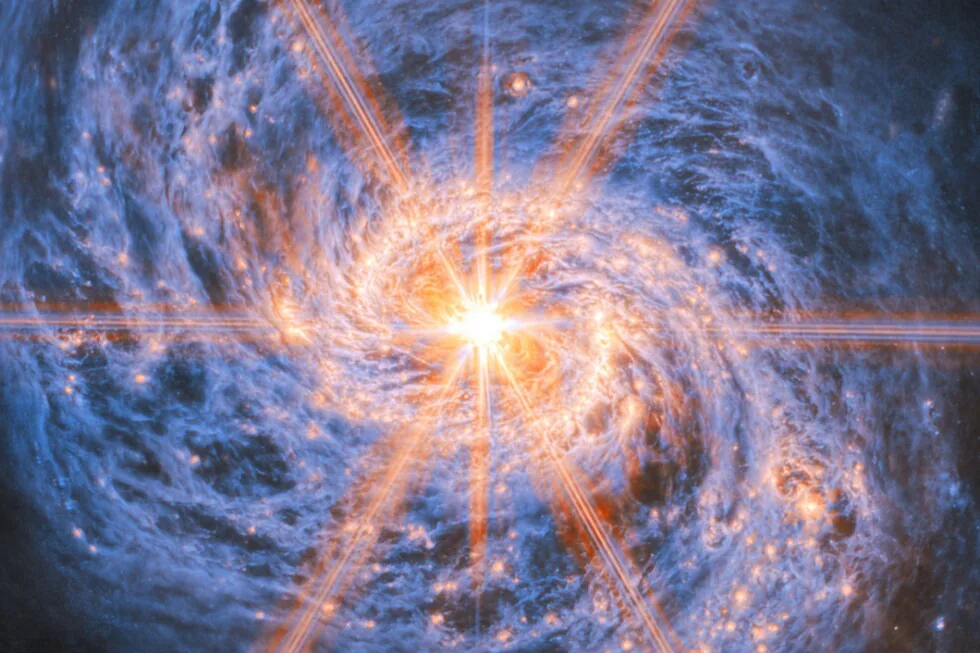
NASA's James Webb Space Telescope has captured a breathtaking image of the spiral galaxy Messier 77, showcasing its luminous heart in unprecedented detail. Released this week, the photograph, taken 45 million light-years away in the Cetus constellation, offers a new look at the galaxy's powerful, active nucleus. This central region is fueled by a supermassive black hole estimated to be 8 million times the mass of our sun.
The image was produced using Webb's Mid-Infrared Instrument (MIRI), which allows the telescope to peer through cosmic dust and observe the thermal emissions from celestial objects. The surrounding gas and dust particles are drawn into a rapid orbit around the supermassive black hole, reaching extreme temperatures that cause them to glow brightly in the infrared spectrum. This process illuminates the galaxy's core, outshining many of its surrounding structures.
Unveiling the Hidden Nucleus
The Messier 77 galaxy, also known as NGC 1068, is a well-studied object, but Webb's advanced capabilities have revealed new layers of its structure. For decades, astronomers have known that M77 harbors an active galactic nucleus (AGN), a compact region at the center of a galaxy that has a much higher than normal luminosity. The supermassive black hole at its center is believed to be actively consuming matter, a process that generates immense energy and heat. Webb's infrared vision is particularly adept at penetrating the dense dust clouds that often obscure the central regions of galaxies, allowing scientists to study the black hole and its immediate surroundings more clearly than ever before.
The ability of the Webb Space Telescope to capture these mid-infrared wavelengths is crucial for understanding the intricate processes occurring within AGNs. These observations are not just aesthetically pleasing; they provide vital data for astronomers seeking to understand galaxy evolution and the role of supermassive black holes. The detail in the new image shows intricate structures within the galaxy's dusty torus, a donut-shaped structure of gas and dust that encircles the central black hole.
Launched in December 2021, the NASA's Webb Telescope is the most powerful space telescope ever built. It orbits the sun about 1 million miles from Earth and has been instrumental in providing stunning images and scientific data from across the universe. Its sophisticated instruments, including MIRI, are designed to capture light from the earliest stars and galaxies, as well as to study planets within and beyond our solar system. The telescope's observations of Messier 77 contribute to a broader scientific understanding of how galaxies form and grow, particularly those with active black holes at their centers.
Scientists hope that further analysis of this image and other data from Webb will shed more light on the feeding habits of supermassive black holes and their impact on their host galaxies. The clarity and detail provided by the telescope offer a unique opportunity to study these cosmic phenomena with a precision that was previously unattainable.