
NASA Engineers Break Sound Barrier With Mars Helicopter Rotors
NASA's Jet Propulsion Laboratory engineers achieved a significant rotor technology breakthrough, pushing next-generation Mars helicopters closer to reality by enabling them to fly faster and carry heavier payloads.

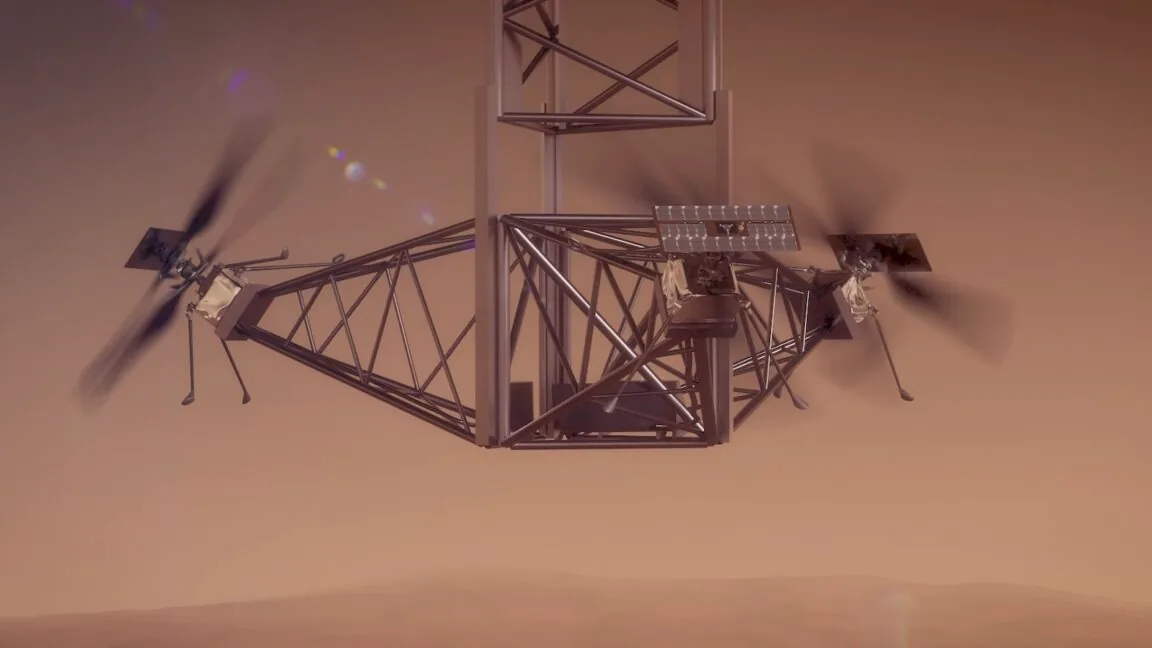
Engineers at NASA’s Jet Propulsion Laboratory (JPL) in California have achieved a critical advancement in rotor technology, clearing a major hurdle for future Martian helicopters designed to explore the Red Planet. This breakthrough allows for larger, more capable rotorcraft to navigate Mars' thin atmosphere, potentially carrying heavier scientific payloads over greater distances.
Following the immense success of the Ingenuity helicopter, which completed 72 flights and far surpassed its initial mission objectives before concluding in January 2024, NASA is planning more ambitious aerial missions. The upcoming SkyFall mission, slated for a potential late 2028 launch, aims to send three new helicopters to Mars aboard the Space Reactor-1 spacecraft. These next-generation vehicles will be larger and heavier than Ingenuity, necessitating innovative design changes to ensure successful landings and operations in the Martian environment.
Pushing Past Supersonic Limits
The core of this new development lies in recent tests where engineers deliberately pushed rotor blade tips beyond the speed of sound, a feat previously considered too risky. Ingenuity’s original rotors were designed to operate at a maximum of Mach 0.7 to avoid supersonic speeds, which could cause blade shatter. However, to enhance the performance of future, heavier helicopters, JPL engineers collaborated with AeroVironment to test new rotor designs. In a simulated Martian atmosphere within a specialized test chamber, these advanced rotors successfully reached Mach 1.08 without sustaining damage.
“If Chuck Yeager were here, he’d tell you things can get squirrely around Mach 1,” Jaakko Karras, the rotor test lead at JPL, stated in a NASA press release. “With that in mind, we planned Ingenuity’s flights to keep the rotor blade tips at Mach 0.7 with no wind so that if we encountered a Martian headwind while in flight, the rotor tips wouldn’t go supersonic. But we want more performance from our next-gen Mars aircraft. We needed to know that our rotors could go faster safely.”
The testing involved rigorous procedures. Teams monitored data from displays showing the internal chamber conditions as rotor speeds climbed to 3,750 rpm, with tips reaching Mach 0.98. The engineers then introduced simulated Martian headwinds, gradually increasing their velocity for subsequent tests. This iterative process allowed them to gauge the rotors' performance and resilience under increasingly challenging conditions.
Two distinct rotor designs were tested: a three-bladed configuration for potential use in missions beyond SkyFall, and the specific two-bladed design intended for SkyFall itself. The SkyFall blades, being slightly longer, achieved supersonic speeds at a lower revolution rate. The result was a significant 30 percent increase in lift capability. This gain is crucial for enabling future Mars helicopters to carry more substantial scientific instruments, advanced sensors, and larger batteries, thereby extending their operational range and duration.
“We thought we’d be lucky to hit Mach 1.05, and we reached Mach 1.08 on our last runs. We’re still digging into the data, and there may be even more thrust on the table. These next-gen helicopters are going to be amazing,” commented Shannah Withrow-Maser, an aerodynamicist from NASA’s Ames Research Center.
This advancement addresses a key limitation for future Martian exploration. Unlike the Ingenuity mission, which relied on the Perseverance rover for communication and recharging, the SkyFall helicopters will operate more autonomously. They will need to communicate directly with Earth via orbiting relay satellites and possess sufficient power for extended flights without a nearby support vehicle. The improved lift capability stemming from the supersonic rotor technology is essential for equipping these future craft with the necessary power sources and scientific payloads to conduct more in-depth research, such as searching for subsurface ice.
While JPL focuses on these Martian rotorcraft, NASA is also developing the much larger Dragonfly rotorcraft for a mission to Saturn’s moon Titan. Although Titan’s atmosphere is considerably thicker than Mars’s, presenting different challenges, the ongoing advancements in rotor dynamics at JPL underscore a broader push towards aerial exploration of diverse planetary bodies. Breaking the sound barrier with robust hardware represents a monumental step toward unlocking the full potential of helicopter-based planetary science.