
Astronauts Halt ISS Antenna Swap After Spacewalk Runs Long
Astronauts completed a 6-hour, 23-minute spacewalk to remove a faulty antenna from the ISS but ran out of time to install its replacement, opting to secure the old unit for now.

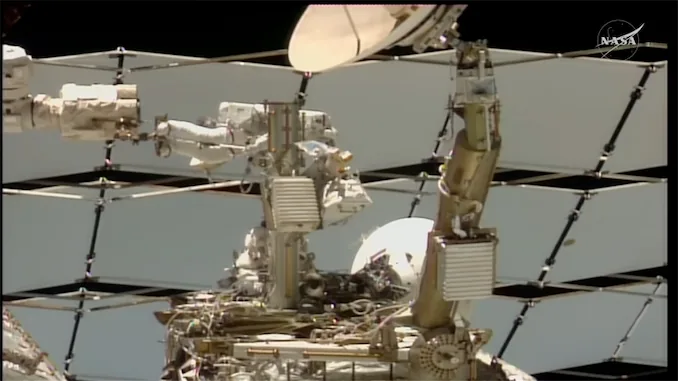
NASA astronaut Anil Menon and European Space Agency astronaut Sophie Adenot concluded a six-hour, 23-minute spacewalk on August 19, 2026, returning to the International Space Station's Quest airlock after a partially successful mission. The excursion, designated EVA 282, was the fifth station maintenance spacewalk this year and marked a significant milestone for Adenot as the first French woman to perform a space walk. While the astronauts successfully removed a malfunctioning space-to-ground antenna, unexpected difficulties with cable connections and securing the unit meant they could not install the spare. The station is currently operating with one functional antenna, with the replacement kept stowed for a future attempt.
The spacewalkers faced considerable challenges disconnecting the stubborn power and data cables attached to the failed antenna. The process of freeing these connections, along with installing locking pins in the antenna's gimbal assembly and unbolting it from its boom, consumed more time than mission planners had allocated. Despite their efforts, including the use of a ratchet wrench, the team ran out of time to complete the crucial installation of the replacement antenna. Consequently, flight controllers made the decision to postpone the final step, leaving the removed antenna temporarily secured near its original position.
Antenna Replacement Deferred Amidst Time Constraints
The International Space Station (ISS) is equipped with two primary space-to-ground antennas, with only one required for standard operations. However, having a fully redundant system is critical for maintaining the station's robust communication capabilities. Managers aim to have both antennas in optimal working order to mitigate risks associated with potential equipment failures or unexpected issues. The spare antenna remains attached to a storage platform, awaiting its installation on a future Extravehicular Activity (EVA). This situation highlights the inherent complexities and tight scheduling involved in maintaining a sophisticated orbital laboratory like the ISS.
This marks the second spacewalk for Menon this year and the first for Adenot. The total time spent on station assembly and maintenance EVAs now exceeds 74 days, underscoring the continuous effort required to keep the ISS operational. Menon's personal EVA time now totals 12 hours and 50 minutes. The successful removal of the faulty antenna, though incomplete in its replacement, is still a step forward in ensuring the station's long-term functionality. The decision to defer the installation was made to ensure the safety of the astronauts, who would have been working against critical time limits for their return to the airlock.
Mission planners are now considering options for the next scheduled spacewalk, which is slated for Tuesday. The possibility of integrating the antenna installation into that mission is under review, balanced against the pre-existing tasks on the agenda. The outcome of this assessment will determine when the ISS will have its full complement of two functional space-to-ground antennas restored. The successful removal of the old antenna provides a crucial preparatory step for the eventual installation of the spare, underscoring the methodical nature of space station maintenance.