
August 2026 Lunar Eclipse: See 96% of Moon Turn Red
A stunning partial lunar eclipse is set for August 27-28, 2026, with nearly the entire moon expected to glow red. The event will be visible across the US, peaking shortly after midnight.

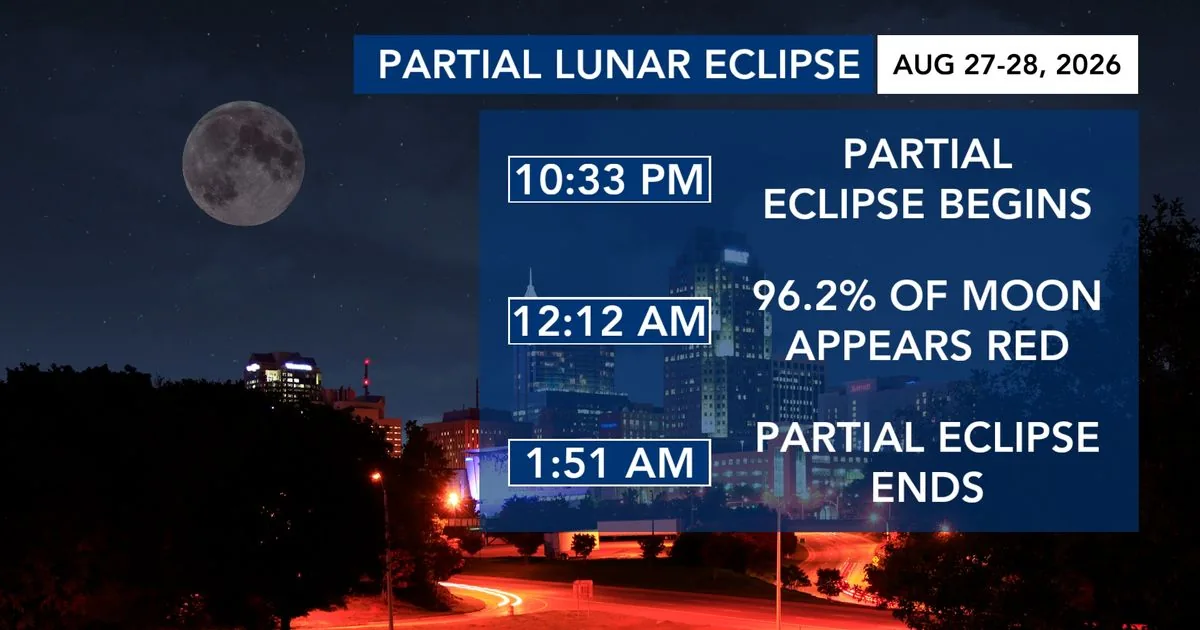
A striking partial lunar eclipse will grace the night sky late Thursday, August 27, transitioning into the early hours of Friday, August 28, 2026. During its peak, an impressive 96% of the moon's surface will pass through Earth's inner shadow, known as the umbra, taking on a distinct reddish hue. This celestial spectacle is scheduled to reach its maximum intensity shortly after midnight.
Lunar eclipses occur when the Earth positions itself directly between the sun and the moon, casting its shadow upon the lunar surface. The captivating red colors observed during an eclipse are a result of sunlight filtering through Earth's atmosphere and scattering, effectively projecting all of Earth's sunrises and sunsets onto the moon.
According to NASA Ambassador Tony Rice, who detailed the event on wral.com, there are specific times to observe this phenomenon. While the initial phase, known as the penumbral eclipse, where the moon enters Earth's fainter outer shadow, is subtle and difficult to detect with the naked eye, the visual drama begins later. Penumbral eclipse begins at 9:24 p.m. EDT on August 27. The umbral eclipse, marking the moon's entry into Earth's darker shadow, commences at 10:34 p.m. EDT. From this point, observers can witness Earth's shadow progressively obscuring the moon.
Witnessing the Peak Illumination
A significant marker for stargazers will be the 50% partial eclipse at 11:15 p.m. EDT, offering a clear view of how Earth's curvature affects the moon's silhouette. The apex of the event, the maximum eclipse, occurs at 12:12:53 a.m. EDT on August 28, when an extraordinary 96.3% of the moon will be engulfed by the umbra. Following this, the moon will gradually emerge. At 1:11 a.m. EDT, it will be 50% illuminated again by the umbra, and the umbral eclipse will conclude at 1:52 a.m. EDT. The penumbral eclipse will fully end at 2:02 a.m. EDT, with the moon returning to its full, unhindered illumination.
For those captivated by this astronomical display, missing this particular event means a considerable wait for the next significant lunar eclipse. According to Rice, there will be little to note in 2027 or 2028. The next chance to witness a total lunar eclipse will be in 2029. He notes that Raleigh, North Carolina, is particularly fortunate, as it will experience two total lunar eclipses in 2029: one on June 26, visible low in the eastern sky, and another on December 20, appearing much higher in the sky, similar to the position of the moon during the upcoming August 2026 event.
This upcoming lunar eclipse offers a prime opportunity for amateur astronomers and casual skywatchers alike to witness a dramatic transformation of our celestial neighbor. Unlike meteor showers, lunar eclipses are predictable events, and their visibility depends on geographic location and local weather conditions. The reddish appearance, often referred to as a "blood moon," is a direct consequence of atmospheric conditions on Earth, making each eclipse a unique visual record of our planet's atmosphere at that moment. The timing of this eclipse, occurring late at night, makes it particularly accessible for viewers across North America, without requiring specialized equipment beyond keen eyesight. Preparation for the event might include finding a location with minimal light pollution to enhance the viewing experience.