
August Solar Eclipse: Partial Views for US Watchers in 2026
A partial solar eclipse will be visible in parts of the US on August 12, 2026. While totality is limited to Greenland, Iceland, and Spain, several US locations will experience a notable, though not total, celestial event.

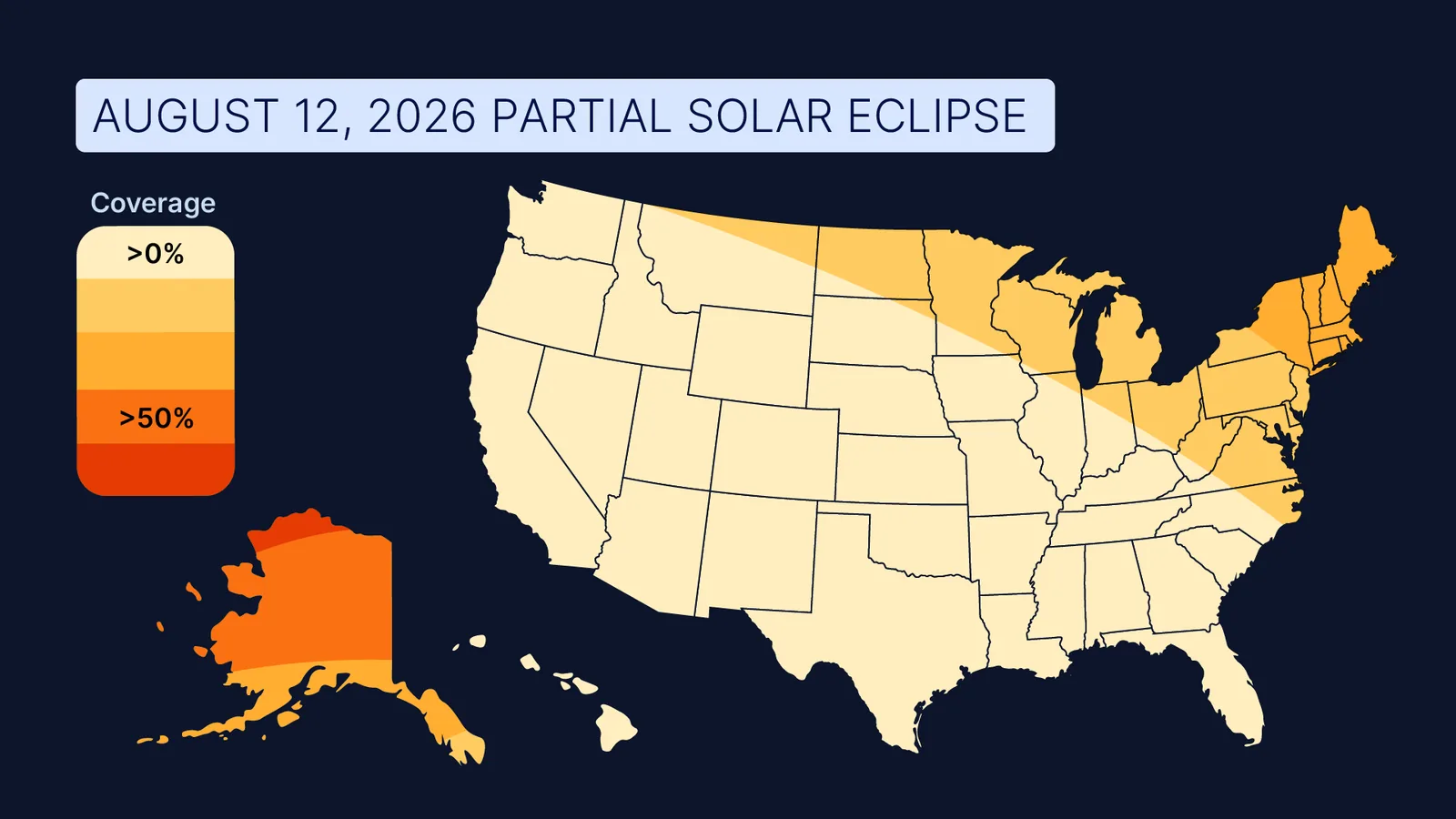
On August 12, 2026, sky gazers across the United States will have an opportunity to witness a partial solar eclipse. Although the path of totality will sweep across Greenland, Iceland, and Spain, numerous locations within the U.S. will still experience a significant celestial spectacle. This event offers dedicated astronomy enthusiasts and casual observers alike a chance to see the moon obscure a portion of the sun.
For those in Alaska, the viewing experience will be a morning event. Nome, Alaska, will see approximately 42.85% of the sun covered beginning at 8:25 a.m. AKDT. Fairbanks will experience about 36.86% coverage at 8:27 a.m. AKDT, while Anchorage will observe 27.9% coverage starting at 8:22 a.m. AKDT. Juneau's view will be the least dramatic in the state, with 16.7% coverage at 8:24 a.m. AKDT. Anchorage stands out as the largest U.S. city offering a reasonably observable event, with nearly a quarter of the sun appearing to be 'bitten' off.
Northern New England Offers Best Lower 48 Views
In the contiguous United States, the northernmost states will provide the most substantial views. Augusta, Maine, is projected to have the peak experience in the Lower 48, with 21.3% of the sun covered at 1:53 p.m. EDT. Nearby Portland, Maine, will see 19.4% coverage at the same time. Vermont cities like Montpelier and Burlington will observe around 17% coverage, while Concord and Manchester, New Hampshire, will experience roughly 16.9% and 16.6% coverage, respectively. These percentages, while modest, are sufficient to be noticeable with proper eclipse glasses.
Moving south into Southern New England, the percentage of solar coverage decreases. Boston, Massachusetts, is expected to see 16.0% of the sun obscured at 1:55 p.m. EDT. Worcester, Massachusetts, will have 14.8% coverage, and Providence, Rhode Island, will observe 14.6%. Cities further south along the coast, including Springfield, Massachusetts, and Hartford, Connecticut, will see coverage in the low to mid-teens.
The Mid-Atlantic region will experience even more marginal viewing conditions. Albany, New York, is scheduled for 13.0% coverage at 1:50 p.m. EDT. New York City, however, will only see about 9.5% of the sun covered around 1:54 p.m. EDT, a sliver that will require specialized filters to detect. Philadelphia, Pennsylvania, is set for 7.0% coverage at 1:53 p.m. EDT, and Washington, D.C., will observe a mere 3.7% coverage at 1:53 p.m. EDT. As one moves further south and west, the eclipse becomes less pronounced, with many cities in Virginia and Maryland experiencing less than 5% coverage.
The Great Lakes and Upper Midwest regions will see the eclipse at its weakest. Cities like Detroit and Cleveland will reach a maximum of 3.0% coverage. Further west, Chicago, Illinois, will experience only 0.1% coverage, and cities like Fargo, North Dakota, and Minneapolis, Minnesota, will see minimal to negligible obscuration. These westernmost areas will offer merely a technical grazing of the sun by the moon, rather than a visually striking event. It is crucial for all observers to use certified eclipse glasses or solar viewers to protect their eyes during any partial solar eclipse viewing, as regular sunglasses are insufficient for safe observation.