
Blood Moon Lunar Eclipse: North America Viewing Guide August 2026
North America will witness a significant partial lunar eclipse on August 27-28, 2026, with the Moon appearing a deep red. Here's what you need to know to see the celestial event.

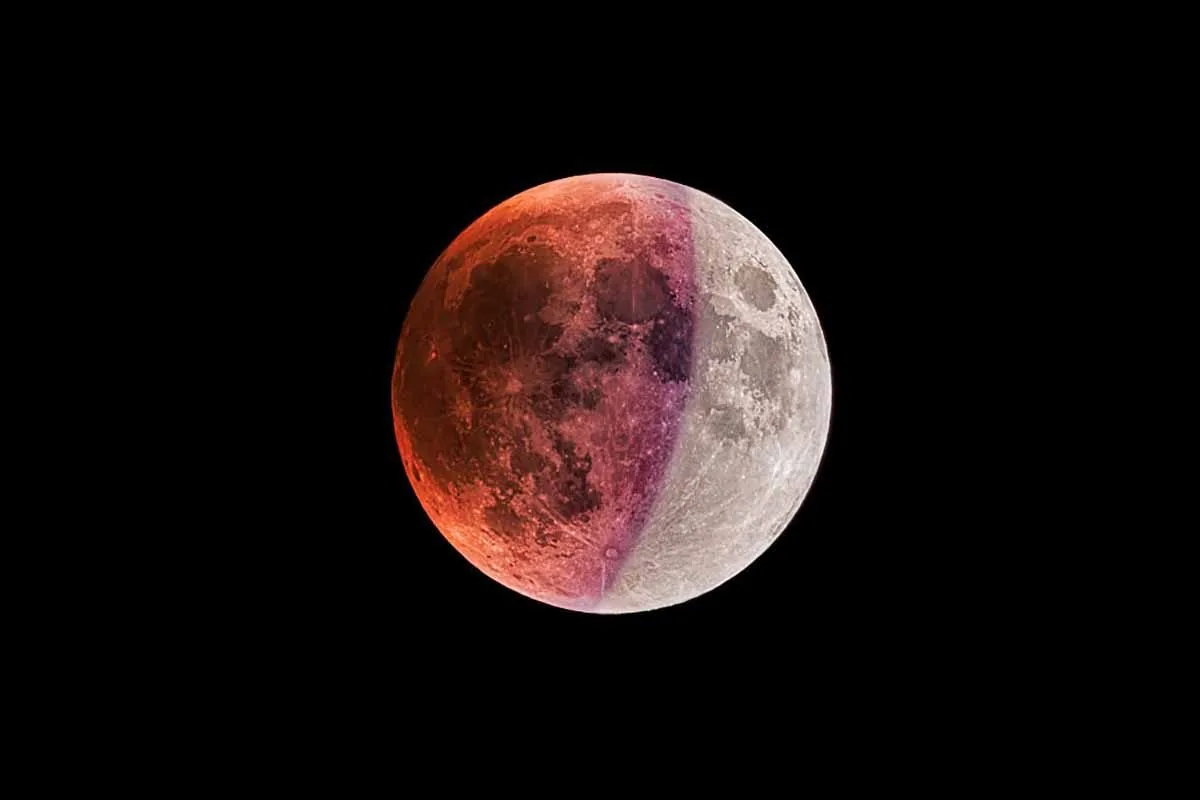
Residents of the United States and Canada are set to experience a dramatic celestial event next week as a deep partial lunar eclipse will occur on the evening of August 27 and into the early morning of August 28, 2026. This event promises to turn the full Moon into a captivating 'Blood Moon,' with approximately 96% of its surface entering Earth's shadow, casting a deep copper-red or orange hue. Unlike the recent solar eclipse, which offered limited views for many in North America, this lunar spectacle will be widely observable across the continent.
A lunar eclipse happens when Earth positions itself directly between the Sun and the Moon. During this alignment, the Moon reflects sunlight that has passed through Earth's atmosphere. Our atmosphere scatters blue light, allowing red and orange wavelengths to pass through and illuminate the Moon, creating the characteristic reddish color. While most lunar eclipses occur during a full Moon, the precise alignment required for Earth's shadow to visibly obscure the Moon is infrequent. This particular eclipse is notable for the extensive coverage, nearing total coverage, which enhances its visual impact.
Understanding the Phases of the Eclipse
The lunar eclipse will unfold in distinct phases. It begins with the penumbral phase, where the Moon enters the faint outer edge of Earth's shadow, causing a subtle dimming. This is followed by the partial (umbral) phase, as the Moon moves into the darker inner shadow, where a noticeable 'bite' appears on its surface, and the color transformation becomes apparent. The peak of the event, known as the greatest eclipse, occurs when the Moon is most deeply immersed in Earth's shadow, reaching approximately 96% coverage at 04:13 UTC (00:13 EDT). Following this, the umbral contact ends as the Moon exits the core shadow, and finally, the penumbral contact ends, marking the conclusion of the eclipse.
The full Moon in August is traditionally called the Sturgeon Moon, named for the abundance of sturgeon fish in North America during this month. The timing of the eclipse aligns with the rising of the Sturgeon Moon. Given that the Sun is lower in the sky during summer, the full Moon also appears lower in the sky. For observers in the USA and Canada, the Moon will rise in the east on August 27, track across the southern sky, and set in the west in the early hours of August 28. The precise timing of the greatest eclipse, whether it falls on August 27 or August 28, will depend on the viewer's specific time zone within North America.
Key timings for major North American cities indicate that the primary viewing window for the partial eclipse begins around 02:34 UTC (22:34 EDT) on August 27. For instance, in New York, the greatest eclipse occurs at 00:13 EDT on August 28. In Los Angeles, this moment happens at 9:13 PM PDT on August 27. These timings highlight the need for viewers to check local conditions and the precise schedule for their region to witness the lunar eclipse at its peak.
Unlike solar eclipses, lunar eclipses are completely safe to view with the naked eye, requiring no special protective eyewear. Standard binoculars or a small telescope can enhance the experience, revealing intricate details of the lunar surface as it passes through Earth's shadow. Observers are advised to find a location with minimal light pollution for the best possible view. Additionally, those located further west in North America should ensure they have a clear view of the eastern horizon, as the Moon may be rising while already in eclipse or about to enter Earth's shadow.