
City Labs Launches First Commercial Nuclear CubeSat
Miami-based City Labs has launched BOHR, the world's first commercial nuclear-powered CubeSat, utilizing a betavoltaic battery. The historic mission signals a new era for private nuclear applications in space.

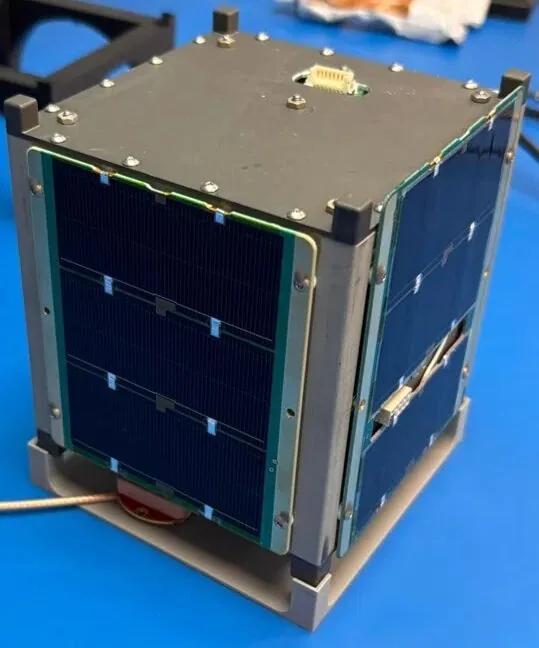
A significant milestone in the commercialization of space technology was reached Tuesday as Miami-based City Labs successfully launched its BOHR satellite, marking the first time a privately developed nuclear power source has been deployed on a satellite. The BOHR, an acronym for Betavoltaic Orbital High-Reliability, hitched a ride on a SpaceX Falcon 9 rocket during a rideshare mission that carried 80 other payloads into an orbit between 350 and 400 miles high.
While not a full-scale nuclear reactor, the deployment of BOHR represents a crucial step toward enabling long-duration space missions, potentially powering permanent lunar bases and facilitating efficient deep-space propulsion. City Labs bills the mission as a groundbreaking achievement, showcasing the world's inaugural commercial nuclear-powered satellite and the first nuclear CubeSat. CubeSats are miniaturized satellites, and BOHR, built on a compact "1U" platform roughly the size of a softball, demonstrates how even small spacecraft can leverage advanced power generation.
The satellite's innovative power source is a nuclear betavoltaic battery. This technology generates electricity through the natural decay of tritium, a radioactive isotope of hydrogen. "This is a historic step for commercial nuclear power in space," stated Peter Cabauy, CEO of City Labs. "BOHR demonstrates that safe, compact, and regulatory-approved nuclear power systems are ready for routine commercial deployment. This capability enables persistent, always-on payload operations that are not constrained by sunlight or battery life." City Labs will use its experimental NanoTritium power generator in a demonstration mode to power a specific payload aboard BOHR. For its primary operations, the spacecraft relies on conventional solar power.
Powering Persistent Operations
Betavoltaic batteries excel in applications demanding a consistent, long-term energy supply with minimal power output, such as remote terrestrial sensors in challenging environments like polar regions or the deep sea, and instrumentation for secure communications. City Labs is also exploring the use of its NanoTritium technology for implantable medical devices, highlighting its versatility.
The space industry, however, is identified as a more immediate and significant market. NASA has previously collaborated with City Labs to investigate the potential of tritium-based nuclear power sources for a constellation of small sensors. These sensors could be deployed within permanently shadowed craters on the Moon to identify vital resources like water ice. Additionally, the U.S. Air Force and Space Force have supported City Labs through various research contracts, funding the development of an experimental tritium-powered AA battery for cryptographic devices and a self-sustaining wireless imaging sensor.
City Labs asserts that its betavoltaic systems can also provide essential heating for microelectronics operating in extreme conditions. It is important to note that current betavoltaic systems, including those from City Labs, operate in the nanowatt to microwatt range, which is insufficient to power consumer electronics like smartphones, let alone large spacecraft or future lunar habitats. Nevertheless, the BOHR mission is seen as a vital advancement for advocates of nuclear power in space, moving beyond the exclusive domain of government agencies like NASA and the U.S. military.
Commercial nuclear space missions have historically faced significant regulatory hurdles. BOHR's launch marks the first commercial nuclear mission to successfully navigate the Federal Aviation Administration's (FAA) newly established nuclear launch approval process, which the FAA authorized last September. This approval was facilitated by the satellite's minimal radioactive content and the relatively quick decay rate of tritium, which also makes it less toxic than heavier isotopes like plutonium or uranium. The Nuclear Regulatory Commission notes that tritium emits low-energy beta particles, a form of radiation that has limited penetration in air and cannot breach the skin.
Future missions will undoubtedly require larger quantities of nuclear material, but the success of the BOHR mission serves as an essential proof-of-concept. "The BOHR mission serves as a pathfinder for future nuclear-powered spacecraft supporting both civil and national security missions," the company stated. The successful deployment of BOHR by City Labs paves the way for more ambitious private ventures leveraging nuclear energy in the cosmos.