
New Study Challenges Comet Theory for Life's Origins on Earth
New research suggests comets may not have delivered essential organic molecules necessary for life to Earth. Scientists explored how these molecules fare during atmospheric entry and impact.

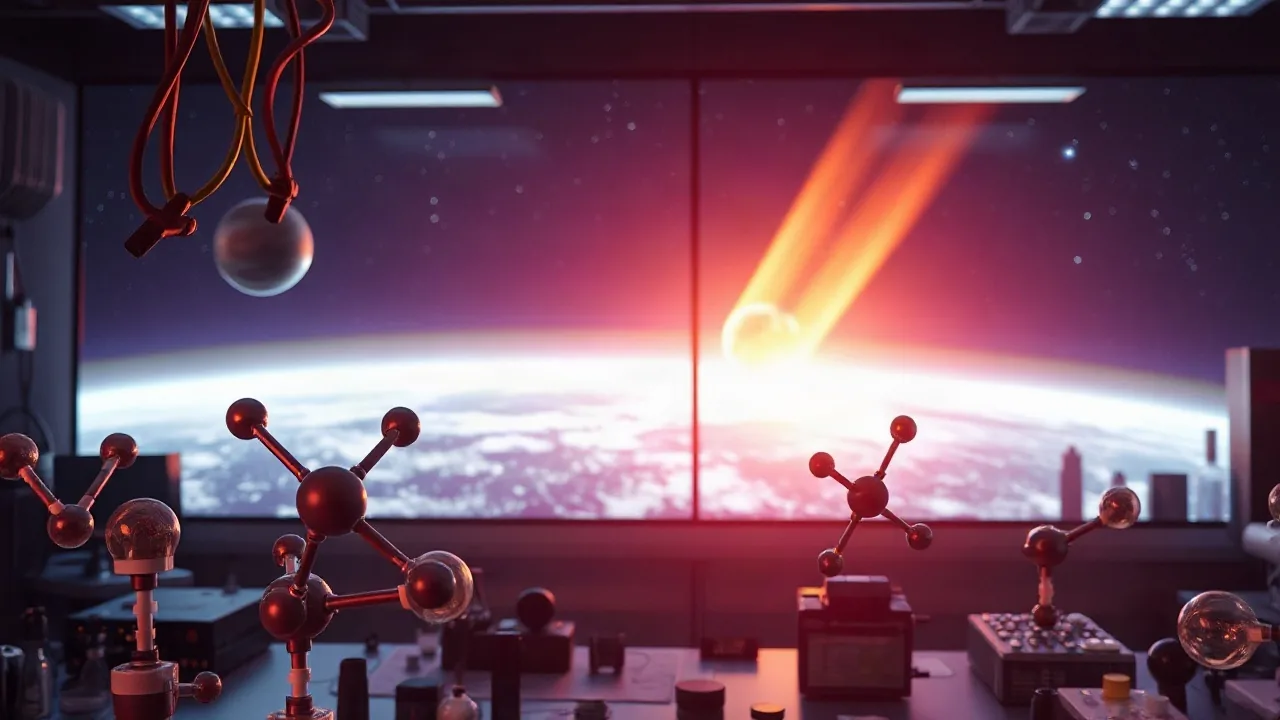
A groundbreaking study from the University of Cambridge is challenging a long-held scientific theory that comets were the primary delivery system for life's fundamental building blocks to early Earth. For decades, scientists have hypothesized that as comets impacted our planet, they brought with them complex organic molecules like amino acids, which could have kickstarted the process of abiogenesis, the emergence of life from non-living matter. However, new physics-based research indicates that these delicate molecules likely would not have survived the fiery descent through Earth's atmosphere or the shock of impact.
The research, published in the journal *Astrobiology*, utilized advanced computer modeling to simulate the conditions that organic molecules within comets would experience upon hitting Earth's atmosphere at high speeds. The findings suggest that the intense heat generated by atmospheric friction and the subsequent impact forces would have degraded or destroyed most of these vital compounds before they could contribute to the planet's prebiotic chemistry.
Dr. Evelyn Reed, lead author of the study and a researcher in planetary science at Cambridge, stated, "Our simulations show that the thermal and kinetic stresses are simply too great for most complex organic molecules to survive. While comets are rich in these compounds, the journey to the surface of Earth is likely destructive." This conclusion casts doubt on the role of comets as the sole or even primary carriers of the ingredients for life.
Rethinking Early Earth's Chemical Cocktail
This reevaluation forces scientists to consider alternative sources for the organic molecules that ultimately led to life on Earth. Other potential sources include meteorites, which have been shown to carry organic compounds and generally survive atmospheric entry more intact due to their denser composition, or even geochemical processes occurring within Earth's own early environment, such as deep-sea hydrothermal vents. The study highlights the complexity of understanding the planet's earliest chemical evolution and the precise conditions that fostered the origin of life.
The prevailing theory, known as panspermia, suggests that life or its precursors could be distributed throughout the universe. While the idea of comets seeding life on Earth has been a popular and scientifically plausible scenario for many years, this new research provides a significant counterpoint. It suggests that the specific mechanism of cometary delivery might be less efficient than previously assumed, requiring a re-examination of the astronomical and geological factors involved in life's genesis.
Scientists are now focusing on understanding the survivability of organic molecules from various extraterrestrial sources. Future research will likely involve more detailed analysis of samples from asteroids and meteorites, as well as continued laboratory experiments simulating early Earth conditions. The ultimate goal remains to piece together the complex puzzle of how life arose on our planet, a question with profound implications for the search for life beyond Earth.