
Cosmic Rays: Heavy Nuclei May Solve 60-Year-Old Space Mystery
New research suggests that ultra-high-energy cosmic rays, some with energies millions of times greater than particle accelerators, may be atomic nuclei heavier than iron, potentially solving a decades-old puzzle.

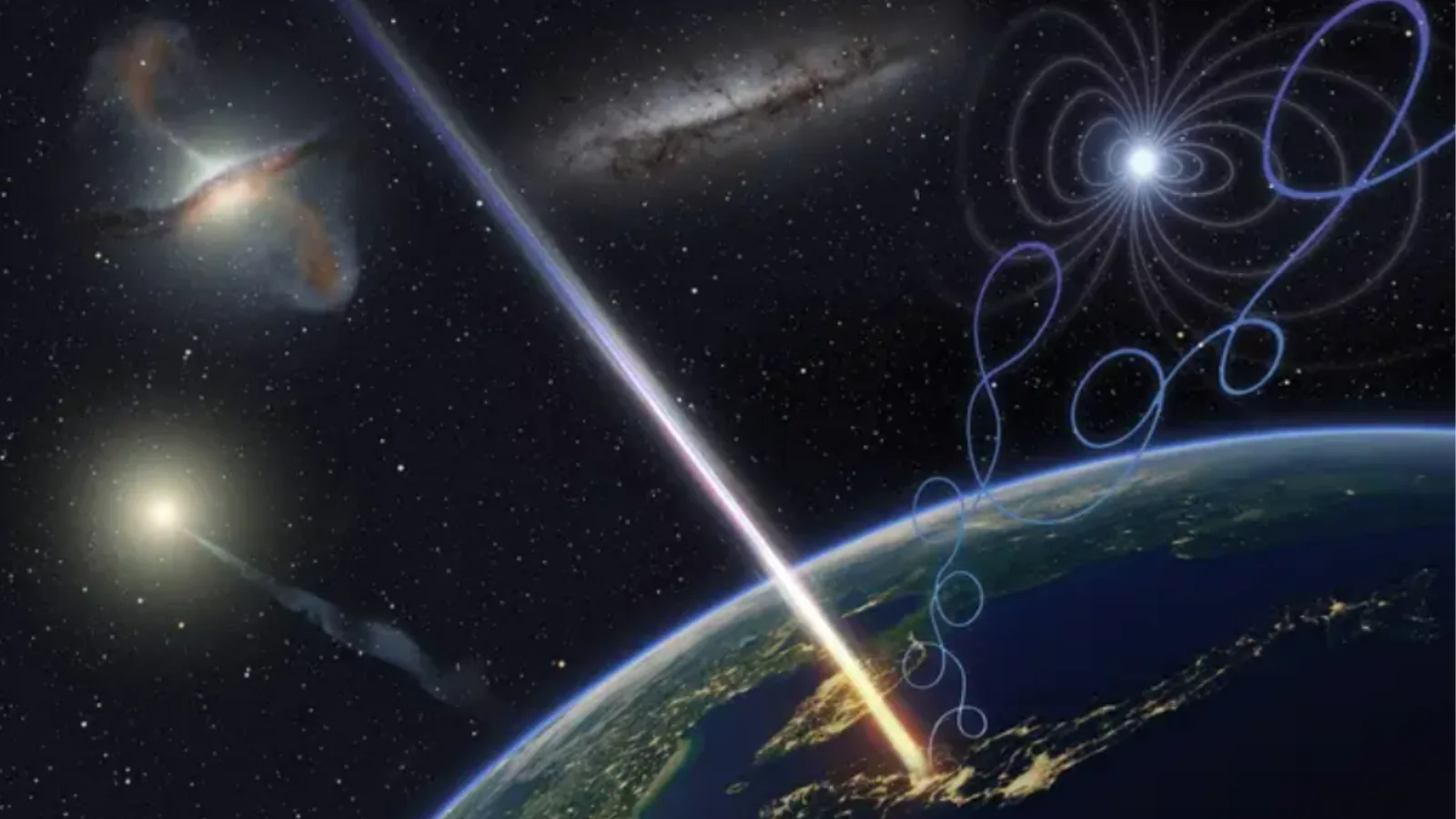
New research suggests that ultra-high-energy cosmic rays, particles with energies far exceeding those generated in terrestrial particle accelerators, may hold the key to a 60-year-old astrophysical mystery. The findings propose that these powerful cosmic visitors could be atomic nuclei of elements heavier than iron, a revelation that could reshape our understanding of the universe's most violent events.
One such particle, dubbed the Amaterasu particle, struck Earth in 2021 with an energy approximately 40 million times greater than particles accelerated at the Large Hadron Collider. This event, alongside the legendary "Oh-My-God particle" detected in 1991, represents some of the most energetic cosmic rays ever recorded. Despite their immense power, the origins and acceleration mechanisms of these particles have remained elusive, a puzzle that has baffled scientists for decades.
These cosmic rays possess kinetic energy equivalent to that of a fast-moving tennis ball, a staggering amount for a single subatomic particle. The Amaterasu particle, in particular, deepened the mystery by appearing to originate from a region of seemingly empty space with no discernible source. However, a recent study by researchers led by Kohta Murase of Penn State's Eberly College of Science may have found a breakthrough. "The origins and acceleration mechanisms of ultrahigh-energy cosmic rays have been among the biggest mysteries in the field for more than 60 years, since the first example was reported," Murase stated.
A New Hypothesis for Extreme Energies
The prevailing hypothesis suggests that these extreme-energy particles are accelerated by some of the most powerful phenomena in the cosmos. By analyzing their energies, arrival directions, and estimated magnetic deflections, scientists can attempt to infer their cosmic origins. Proposed sources have included the cataclysmic collapses of massive stars into neutron stars or black holes, as well as the dramatic mergers of two neutron stars.
For perspective, the density of matter within a neutron star is so extreme that a single teaspoon would weigh approximately 10 million tons on Earth – the equivalent of about 85,000 adult blue whales. The process of compressing a solar mass to a diameter of roughly 12 miles is inherently violent; the collision of two such objects represents an event of unimaginable power.
"These highest-energy cosmic rays are thought to come from extreme astrophysical sources, like two neutron stars colliding or a massive star collapsing," Murase explained. "For many cosmic-ray events taken together, their energy distribution, arrival-direction pattern, and statistically inferred composition provide important clues about where these particles come from and how they are accelerated."
If the new research holds true and the highest-energy cosmic rays are indeed nuclei of elements heavier than iron, the theory involving neutron star collisions gains significant traction. To test this, Murase and his colleagues conducted sophisticated simulations to track the energy loss of cosmic rays with varying masses as they traversed the vast distances of space to reach Earth. The simulations revealed a crucial detail: atomic nuclei heavier than iron lose energy at a significantly slower rate than lighter particles.
"Our research showed that at energies comparable to that of the Amaterasu particle, ultraheavy nuclei lose energy more slowly than protons or intermediate-mass nuclei, making them better able to survive cosmic distances and reach Earth at extreme energies," Murase said. "We are not saying that all ultrahigh-energy cosmic rays are ultraheavy nuclei. But if some of the highest-energy events are ultraheavy nuclei, that would impact how we search for their cosmic rays sources."
The team also established constraints on the proportion of heavy nuclei within the population of high-energy cosmic rays. "The most promising sites for producing and accelerating such ultraheavy nuclei are massive star deaths involving explosive collapse into black holes or strongly magnetized neutron stars, as well as binary neutron-star mergers known to be powerful gravitational-wave emitters," Murase noted. "These violent cosmic phenomena can also power gamma-ray bursts that are among the most energetic explosions in the universe."
A contribution from these powerful astrophysical events could also help explain observed discrepancies in the ultra-high-energy cosmic-ray spectrum between the northern and southern hemispheres. Future observational data is expected to provide further insights into the composition of these particles, potentially confirming whether heavy nuclei significantly contribute at the highest energies, thus illuminating the source of these mysterious cosmic messengers.