
Curiosity Rover Discovers Vast Honeycomb Rock Field on Mars
NASA's Curiosity rover has captured a stunning panorama of a vast field of honeycomb-patterned polygons in Mars' Valle Grande. Scientists are studying the formations for clues about the planet's ancient, watery past.

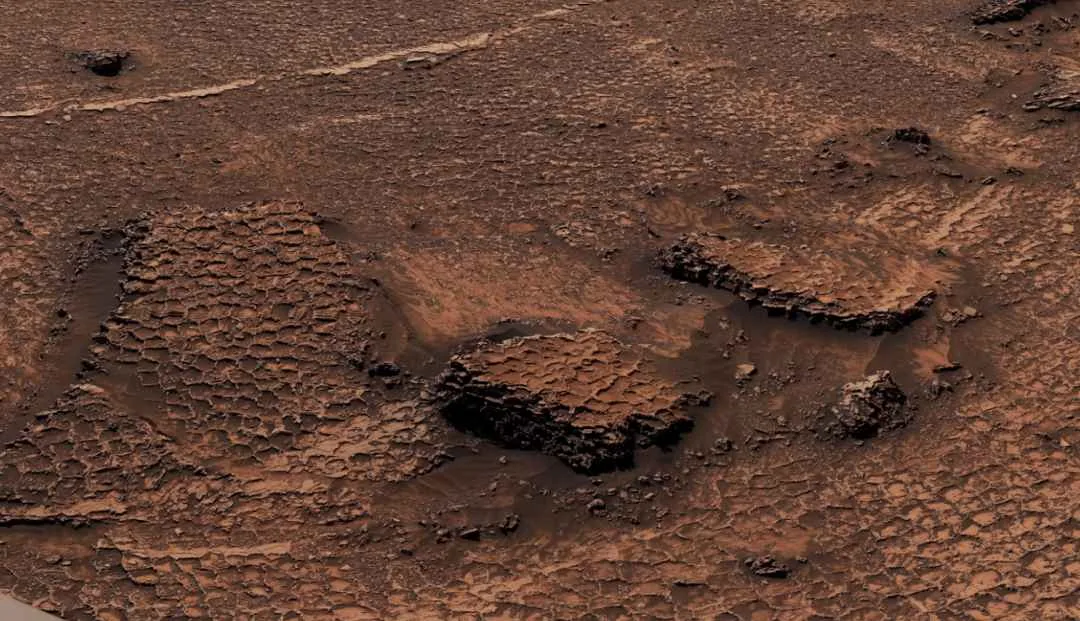
NASA's Curiosity rover has encountered an expansive field of polygonal, honeycomb-textured rocks in an area of Mars dubbed "Valle Grande." This remarkable discovery, revealed in a 360-degree panorama captured on June 19-20, 2026, marks the largest such formation observed by the rover to date, extending as far as the eye can see and even wrapping around a 20-foot tall butte named "Miraflores." The rover has detected smaller instances of these fractured patterns before, but never on this unprecedented scale.
"We've seen a lot of fascinating landscapes through Curiosity's eyes, but this sea of polygons took our breath away," said Ashwin Vasavada, project scientist at NASA's Jet Propulsion Laboratory (JPL). Researchers are meticulously analyzing the shapes and chemistry of these formations, hoping to uncover details about their origins. Potential explanations for the polygonal structures include the ancient cracking of mud as it dried, cycles of freezing and thawing, or immense pressure squeezing water from the rock.
Unraveling Mars' Wet Past
These polygonal fractures serve as a geological record, offering insights into Mars' ancient history when liquid water was prevalent. For over a decade, Curiosity has been ascending Mount Sharp, a monumental mountain on Mars, and has previously documented evidence of past lakes and streams in the region. Astrobiologists are particularly keen on the chemical composition of these rocks, seeking biosignatures that could indicate past life. This interest is amplified by the rover's previous detection of the largest organic molecules found on Mars to date, announced last year. These carbon-based molecules are considered potential precursors to RNA and DNA, the building blocks of genetic material on Earth.
While scientists cannot definitively determine whether these organic molecules originated from biological processes or geological activity, their presence confirms that ancient Mars possessed the necessary chemical ingredients to potentially support life. The discovery of these complex organic molecules, alongside the vast polygonal fields, underscores the scientific value of the Curiosity rover's ongoing mission. Each new finding adds a piece to the intricate puzzle of Mars' environmental evolution and its potential for habitability.
In 2023, the rover provided another significant surprise, revealing hexagonal patterns for the first time and extracting pure sulfur crystals from a rock – a first for the Martian surface. The continued exploration by NASA missions like Curiosity is crucial for understanding planetary formation and the conditions under which life might arise elsewhere in the universe.