
4.1 Billion-Year-Old Mars Meteorite Discovered in Sahara Desert
A rare meteorite found in the Sahara Desert has been confirmed as a 4.1-billion-year-old fragment of Mars. Scientists believe this ancient Martian rock could hold clues to early planetary conditions and the potential for life.

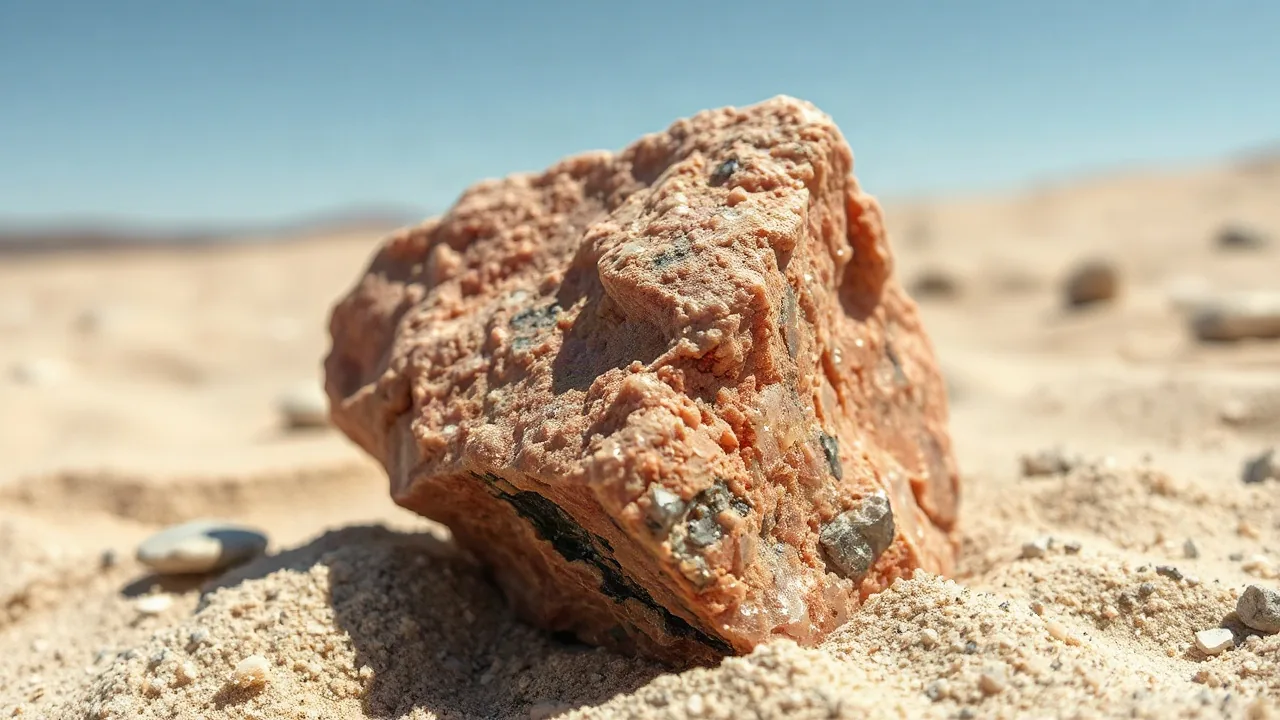
An exceptionally rare meteorite, distinguished by its rose-colored hue, has been unearthed in the Sahara Desert and scientifically verified as a 4.1-billion-year-old piece of Mars. The discovery, made in late 2023, offers scientists an unprecedented glimpse into the early history of the Red Planet and potentially the origins of life itself.
The specimen, designated Teghaza 001, was initially identified by local nomads in a remote region of the Sahara. Its unusual coloration, a result of iron oxidation, set it apart from typical meteorites. Subsequent analysis by researchers at the Muséum national d'histoire naturelle in Paris and NASA's Johnson Space Center in Houston confirmed its Martian origin and remarkable age.
At 4.1 billion years old, Teghaza 001 predates most known Martian meteorites, providing valuable insights into the planet's formative period. Scientists are particularly interested in the meteorite's mineral composition and the potential presence of trapped gases or organic molecules that could shed light on Mars's ancient atmosphere and geological evolution. "This meteorite is a time capsule from a very early epoch of Mars," stated Dr. Anya Sharma, a planetary scientist involved in the analysis. "Its composition could tell us a lot about the conditions on Mars when the planet was much younger and possibly more habitable."
Unlocking Secrets of Early Mars
The significance of this find lies in its potential to answer fundamental questions about planetary science. Understanding the early conditions of Mars, including its atmospheric pressure, temperature, and the presence of water, is crucial for tracing the development of its geology and the potential emergence of life. Teghaza 001's age suggests it originated from a period when Mars may have possessed a thicker atmosphere and surface water, conditions more conducive to life as we know it.
The study of Martian meteorites is one of the primary ways scientists can analyze Martian material without the immense cost and logistical challenges of sample return missions. Each meteorite is a fragment of a larger body, ejected into space by asteroid impacts and eventually finding its way to Earth. The vastness of the Sahara Desert provides an ideal environment for preserving these extraterrestrial visitors.
Researchers are meticulously examining the meteorite for isotopes, trapped volatiles, and signs of biological or pre-biological activity. The data gathered from Teghaza 001 could help refine models of planetary formation and evolution, offering comparative insights into Earth's own history. The findings are expected to be published in a leading scientific journal later this year, with preliminary reports already generating excitement within the scientific community.
The discovery of Teghaza 001 underscores the importance of continued exploration and analysis of meteorites. Each new find has the potential to rewrite our understanding of the solar system's history and our place within it. This particular Mars fragment, with its unique age and composition, is poised to be one of the most significant discoveries in planetary science in recent years.