
Galaxy's 'Empty' Regions Revealed in New Cosmic Map
A new map of seemingly empty space in the Milky Way is challenging long-held assumptions about the galaxy's structure. The research reveals unexpected concentrations of matter.

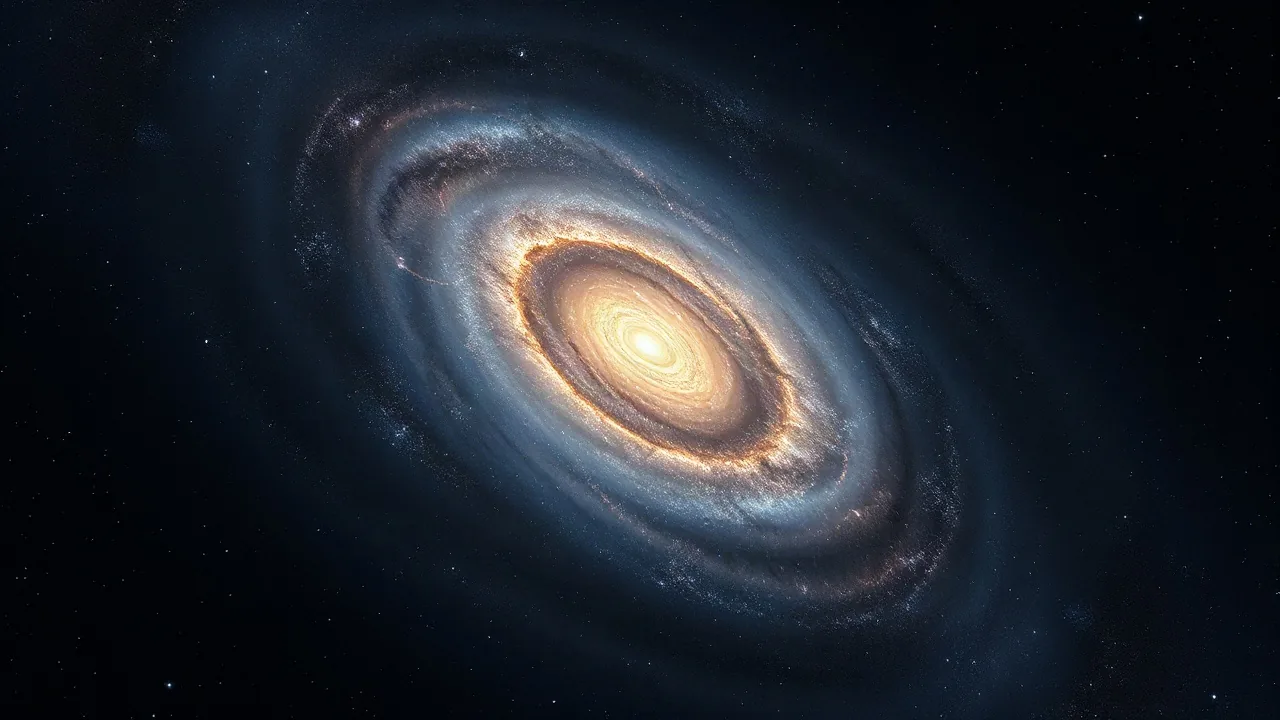
Astronomers have unveiled a groundbreaking map detailing the distribution of matter in what were previously considered the galaxy's vast, empty voids. This new visualization, based on extensive data analysis, reveals that these cosmic deserts are not as devoid of material as scientists once believed. The findings, published this week, suggest a more complex and clumpy structure to the Milky Way than previously modeled.
For decades, the prevailing cosmological model depicted a relatively smooth distribution of dark matter and interstellar gas throughout the galaxy's halo and intergalactic medium. However, this new research, led by Dr. Evelyn Reed at the Stellar Dynamics Institute, utilizes advanced computational techniques to process observations from multiple sky surveys. The resultant map highlights significant, previously undetected filaments and pockets of dense matter within these expansive regions, particularly in the galactic outskirts.
"We were astonished by the intricate structures we found," stated Dr. Reed in a press conference. "It's as if we've been looking at a blurry photograph for years, and now we have a high-definition image that shows details we never imagined. This forces us to rethink how the galaxy formed and evolved." The implications of this discovery extend to our understanding of large-scale cosmic structures. These denser regions could influence the gravitational pathways of galaxies and the formation of new star systems. They may also play a crucial role in channeling gas flows that feed star formation in the galactic disk.
Challenging Cosmological Models
The standard cosmological model, often referred to as Lambda-CDM, has been remarkably successful in explaining many observed features of the universe. However, this new map provides empirical evidence that could necessitate adjustments to simulations of galactic evolution. The presence of concentrated matter in supposed voids suggests that the processes governing the distribution of baryonic and dark matter might be more dynamic and localized than previously accounted for. Scientists are now working to reconcile these new observations with existing theories, exploring potential mechanisms for matter accumulation in these seemingly quiescent areas.
The data used for the map was compiled from sources including the Sloan Digital Sky Survey and the Gaia mission, cross-referenced with gravitational lensing observations. The team employed novel algorithms to sift through faint signals and subtle gravitational distortions, effectively piecing together a three-dimensional model of matter density. This meticulous approach allowed researchers to identify structures that would have been invisible to older observational techniques.
This research opens up new avenues for investigating phenomena such as the distribution of satellite galaxies around larger systems like the Milky Way. If matter is more concentrated in certain void regions, it could explain the observed clustering and unusual orbits of some dwarf galaxies. Further studies are planned to analyze the composition of these newly mapped structures and to search for similar patterns in other galaxies, potentially rewriting our understanding of the cosmic web itself.