
Distant Galaxy's Millisecond Signal Traced by Webb Telescope
The James Webb Space Telescope has pinpointed the origin of a millisecond-long signal from a galaxy 10 billion light-years away, revealing a unique cosmic event.

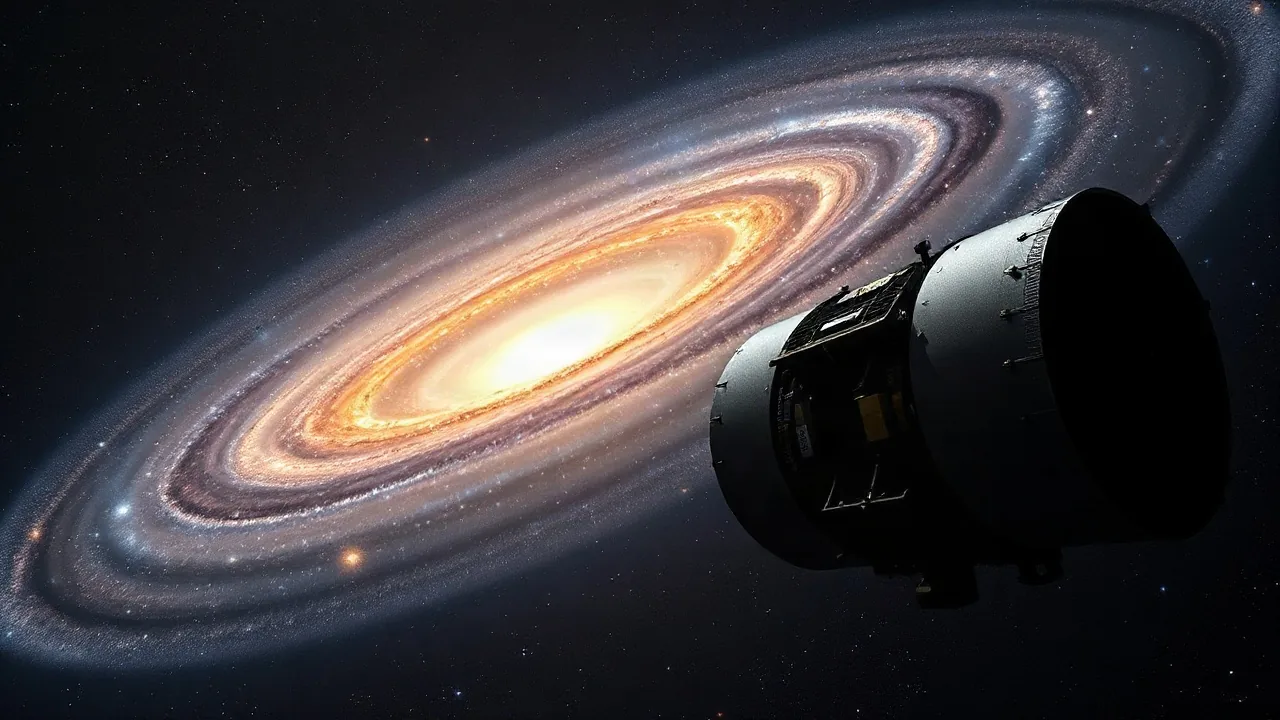
Astronomers utilizing the powerful capabilities of the James Webb Space Telescope (JWST) have successfully identified the source of a faint, millisecond-duration signal originating from a galaxy approximately 10 billion light-years from Earth. This marks the most distant Fast Radio Burst (FRB) ever detected, providing unprecedented insights into the extreme conditions of the early universe.
The signal, designated FRB 20220610A, was first detected by the CHIME/FRB project in 2022 and later observed by the JWST. The telescope's advanced infrared vision allowed researchers to determine the precise location of the FRB within a star-forming region of a distant galaxy. This finding is particularly surprising because it suggests that the energetic events capable of producing FRBs were occurring even in the universe's infancy, a period previously thought to be less conducive to such phenomena.
Cosmic Conundrum: Early Universe Energetics
Fast Radio Bursts are intense, millisecond-long pulses of radio waves that emanate from deep space. While hundreds have been detected since their discovery in 2007, pinpointing their exact origins has been a significant challenge due to their brief duration and immense distances. Many FRBs are thought to be associated with magnetars, a type of neutron star with an extremely powerful magnetic field, but the conditions in the very early universe might have differed significantly from those in nearby galaxies.
The discovery that such powerful events could occur in galaxies as ancient as the one emitting FRB 20220610A challenges existing models of cosmic evolution. Dr. Ryan Chornock, an astronomer at Ohio State University and a lead author on the study published in The Astrophysical Journal Letters, stated, "The universe was much younger at the time the light we observe was emitted, and that's a significant aspect of this finding." The detection implies that the necessary ingredients and extreme environments for FRB generation were present much earlier in cosmic history than previously assumed.
The JWST's ability to observe at infrared wavelengths was crucial for this breakthrough. It allowed the telescope to peer through dust and gas that would obscure the view for instruments operating at shorter wavelengths. By analyzing the light from the host galaxy, scientists were able to confirm its immense distance and characterize its properties, including its star formation rate. The galaxy hosting FRB 20220610A is a vigorous producer of stars, hinting that active, energetic phenomena are not exclusive to more mature cosmic structures.
This research opens new avenues for studying the early cosmos. By analyzing more distant FRBs, astronomers hope to use them as cosmic probes, similar to how supernovae have been used to map the expansion of the universe. Each detected fast radio bursts provides a unique data point about the conditions and composition of galaxies billions of years ago. Future observations with JWST and other advanced telescopes will likely uncover more of these ancient signals, further refining our understanding of the universe's formative epochs.
The precise mechanism behind FRBs remains an active area of research, but this latest detection pushes the boundaries of our knowledge, suggesting that the universe has been a place of intense energetic events for far longer than previously understood. The study, involving an international team of researchers, highlights the transformative power of James Webb Space Telescope in unraveling cosmic mysteries.