
Early Universe 'Little Red Dots' May Be Earliest Supermassive Black Holes
A new study published in Nature Astronomy suggests that the mysterious 'little red dots' observed by the James Webb Space Telescope could be the universe's earliest supermassive black holes, offering clues to galaxy formation.

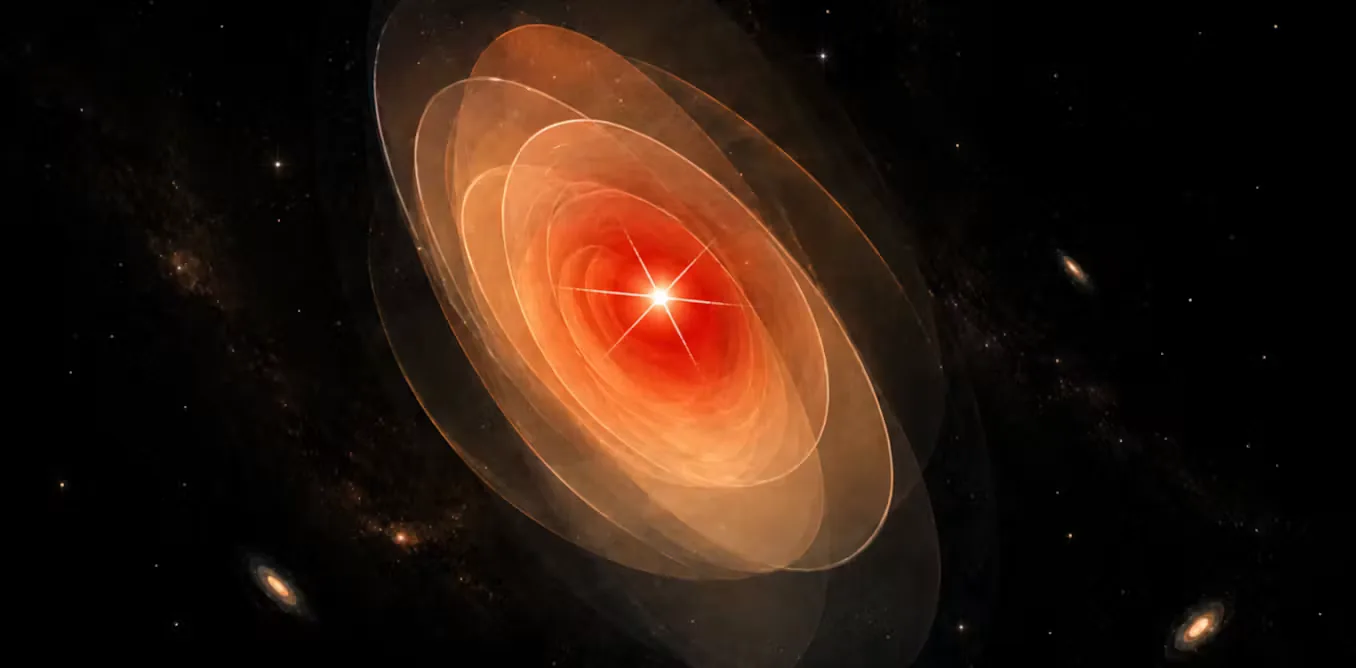
Astronomers using the powerful James Webb Space Telescope (JWST) have identified enigmatic celestial objects dubbed 'little red dots' in the distant universe. A new study, published today in the journal Nature Astronomy, proposes that these objects may represent some of the earliest supermassive black holes, shedding light on how stars and galaxies began to form in the universe's infancy, approximately one billion years after the Big Bang.
The JWST, renowned for its unprecedented infrared vision, has revealed these distant entities as compact, reddish points of light. Their extreme distance means the light observed has traveled for over 13 billion years to reach Earth. Consequently, these 'little red dots' appear to originate from regions smaller than 2% of the Milky Way's diameter, making their host galaxies challenging to analyze.
For some time, scientists have debated the true nature of these phenomena. The prevailing theory suggests they are nascent supermassive black holes, some so actively consuming matter that their observable surfaces mimic those of stars, a concept known as "black hole stars." An alternative hypothesis posits that these could be sites of intense star formation, giving rise to the most massive galaxies in the early cosmos. To resolve this, researchers have focused on the characteristics of the galaxies hosting these dots, seeking to understand the co-evolution of galaxies and their central black holes.
Unveiling the Host Galaxies
A significant breakthrough comes from a new paper co-authored by researchers, including Yiyang Zhang of Wuhan University. The team analyzed imaging data from the COSMOS-Web region, a vast area of the sky observed by JWST, which contains over 400 identified 'little red dots.' This substantial sample size allowed for detailed analysis of their host galaxies.
Deciphering the faint light from these host galaxies proved difficult due to the overwhelming glare from the central objects. The research employed sophisticated modeling techniques to account for JWST's optical properties, effectively filtering out the bright central emissions to reveal the dimmer galactic light. By combining data from 217 distinct 'little red dot' observations, the study determined that the host galaxies contributed only about 10% of the total light observed at red wavelengths. This suggests the central supermassive black hole is the dominant light source.
Furthermore, the host galaxies themselves were found to be exceptionally small, measuring only about 40% the size of typical galaxies from that early cosmic epoch. This equates to roughly 4% of the Milky Way's current size, indicating that 'little red dots' likely emerge under very specific, and not universally common, conditions.
The study also estimated the stellar populations within these host galaxies. While most stars formed in the early universe are smaller and cooler than our Sun—emitting more red light—the intense radiation from central black holes complicated measurements. After accounting for this central glare, the researchers concluded that these host galaxies contain approximately 1 billion stars. For context, the Milky Way harbors hundreds of billions of stars.
The estimated mass of the supermassive black holes at the centers of these 'little red dots' ranges from 10 million to 1 billion solar masses. This finding implies that these colossal black holes accumulated a significant portion of their mass before their host galaxies could mature and form the majority of their stars. This supports the idea that supermassive black holes play a critical role in the early stages of galaxy formation and evolution, a process known as galaxy formation.
While this research provides crucial insights into the nature of 'little red dots' and their peculiar host galaxies, the precise mechanisms behind their formation and subsequent development remain an active area of investigation for astronomers studying the early universe and the cosmic origins of black holes.