
Eclipse and Perseid Meteor Shower Delight Stargazers
Europeans witnessed a spectacular celestial event as a significant solar eclipse coincided with the peak of the Perseid meteor shower. Millions gathered to observe the rare astronomical alignment.

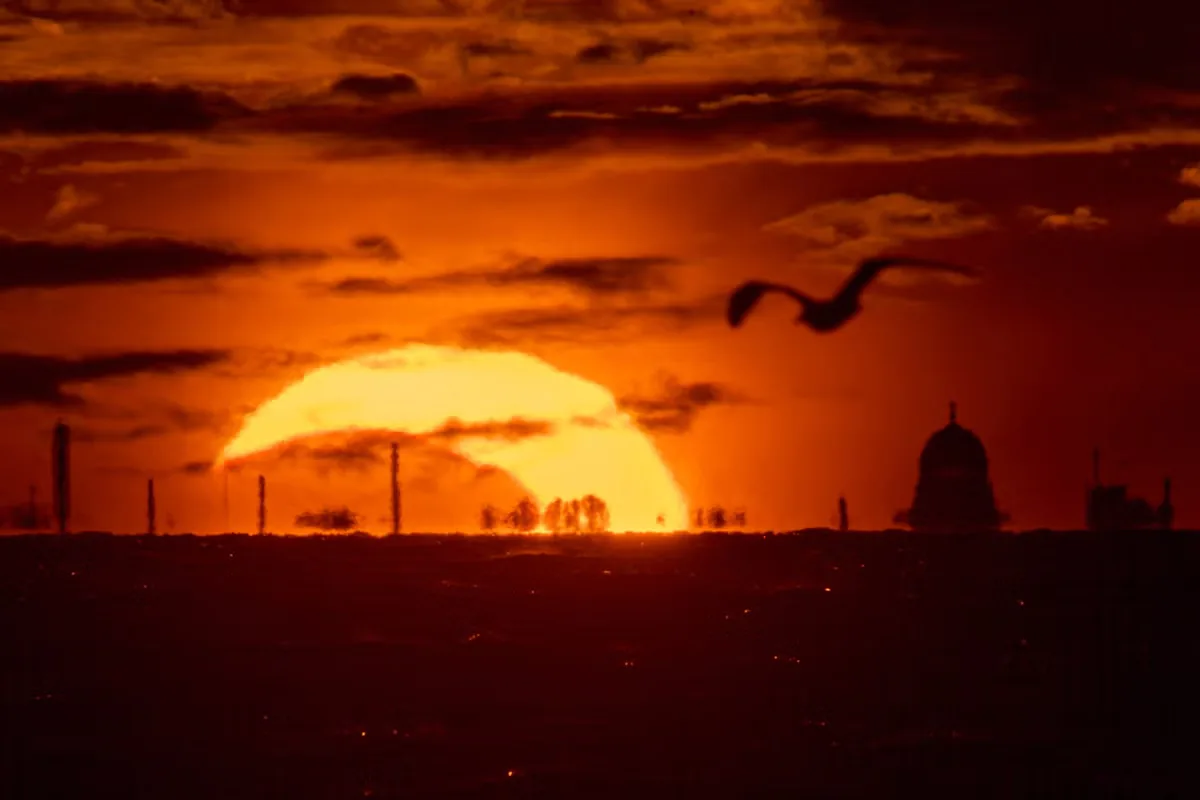
Stargazers across Europe were treated to a remarkable night of astronomical phenomena on August 12, 2026, as the peak of the annual Perseid meteor shower coincided with a significant solar eclipse. The Moon obscured over 90 percent of the Sun, marking the most substantial solar eclipse visible over the United Kingdom in decades, surpassing the extent seen in 1999.
Crowds converged at popular viewing sites nationwide, including the Royal Observatory Greenwich in London, the ancient monument of Stonehenge in Wiltshire, Calton Hill in Edinburgh, and outside Queen’s University in Belfast. Enthusiasts utilized specialized eclipse glasses and even improvised viewers crafted from everyday items like cereal boxes and colanders, following NASA's suggestion to project shadows. Many brought portable seating, while photographers positioned themselves with professional camera equipment to capture the event.
Social media platforms buzzed with images and videos, with one notable clip showing a lengthy queue in Goring, West Sussex, as people awaited the distribution of viewing glasses. Following the eclipse, Google searches for terms like "sore eyes" reportedly surged by 650% in the UK compared to the previous day, highlighting public concern over eye safety. Experts had strongly advised using only ISO 12312-2 certified solar eclipse glasses, warning that standard sunglasses offered insufficient protection.
The English Heritage charity confirmed that the solar eclipse reached its peak over Stonehenge around 7 p.m. on Wednesday evening. At Greenwich Park in southeast London, skywatchers expressed awe with exclamations of "wow," "oh my god," and "this is so cool" as the celestial spectacle unfolded. Thousands gathered on Crosby beach in Merseyside, where a DJ stationed atop a bus at The Bus Yard venue played The Beatles' "Here Comes The Sun" as the eclipse climaxed. Heavy traffic was reported in the Penarth area as individuals attempted to reach Cardiff Bay barrage in time for the event's peak.
A Night of Cosmic Wonders
The astronomical alignment even played a role in personal milestones. Jerry and Jamie Bone, aged 30 and 25, deliberately scheduled their wedding in Alpheton, Suffolk, over a year in advance to coincide with the eclipse, providing guests with special glasses and filters. This rare convergence of celestial events offered an unforgettable experience for millions.
Adding to the night's spectacle, British stargazers were treated to an additional cosmic display hours after the eclipse subsided. The Perseid meteor shower illuminated the night sky across the UK, peaking in the early hours of Thursday, August 13, 2026. Optimal viewing conditions were found in rural areas away from light pollution, offering clearer glimpses of the shower's brilliance.
The Perseid shower, an annual event, occurs as Earth passes through a trail of debris left by Comet Swift–Tuttle. Each minute particle entering Earth's atmosphere at approximately 60 kilometers per second burns up, creating the visual effect of a shooting star. The Royal Greenwich Observatory reported selling approximately 15,000 pairs of certified eclipse glasses in the month preceding the event, a complete sell-out. Convenience stores, national parks, and the observatory itself saw their supplies of eclipse glasses depleted ahead of the highly anticipated event, which was the most significant solar eclipse visible in the UK for the next 54 years.
Following the 1999 total solar eclipse, the Royal College of Ophthalmologists recorded around 70 cases of vision-related issues among individuals who viewed the event improperly. Approximately 40% of those affected had looked at the Sun for less than a minute without adequate protection. This serves as a crucial reminder of the importance of following safety guidelines during such astronomical observations.