
Fastest Star Observed Racing Sagittarius A* Black Hole in Milky Way
Astronomers have identified the fastest star ever recorded, S301, orbiting the supermassive black hole Sagittarius A* at the Milky Way's center. Its extreme speed and proximity offer new insights into gravity.

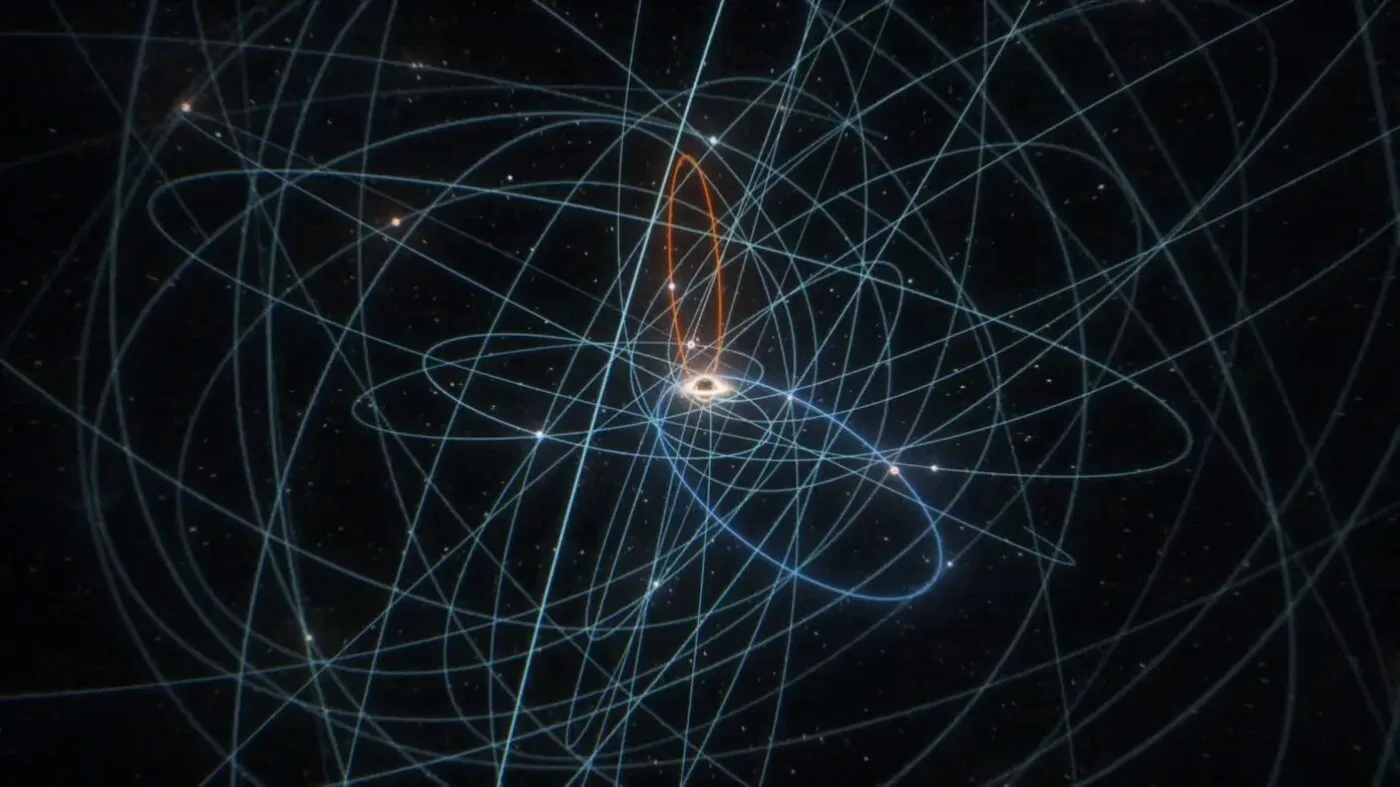
Scientists have identified the fastest star ever observed, a celestial object designated S301, as it performs an incredibly rapid orbit around Sagittarius A*, the supermassive black hole at the heart of our Milky Way galaxy. The discovery, detailed in the journal Nature on Wednesday, utilizes the star's extreme velocity and proximity to the black hole to offer unprecedented insights into gravity's effects on space and time.
Stefan Gillessen, an astronomer at the Max Planck Institute for Extraterrestrial Physics in Germany, explained that the star's speed itself isn't the most significant aspect of the finding. Instead, he noted, "what's important about the discovery isn't the star's speed — but rather its proximity to the black hole." He added, "Thereby we can use the star [as a probe] to visualize how gravity is acting on space and time." The supermassive black hole, estimated to be four million times the mass of our Sun, presents a unique laboratory for studying cosmic phenomena that are otherwise nearly impossible to observe.
Probing Gravity's Limits Near Galactic Center
The center of the Milky Way, while harboring the galaxy's largest black hole, is obscured by vast amounts of cosmic dust and gas. To overcome this, Gillessen and his team employed infrared light, using four telescopes at the European Southern Observatory's Very Large Telescope site in Chile. This allowed them to peer through the obscuring material. Felix Mang, a Ph.D. student also at the Max Planck Institute for Extraterrestrial Physics, first spotted the star in the collected data. "A small flicker of light, a very faint star came to our attention, which moved with a very high velocity," Mang recalled, marking the initial observation of what would become S301.
Tracking S301's position over several years and analyzing past data revealed its orbital path. Using a combination of Newtonian gravity and corrections from general relativity, researchers determined that the star completes an extremely elongated elliptical orbit, with the black hole situated at one focal point. The star experiences its highest velocity during its closest approach to Sagittarius A*, reaching speeds exceeding 15,000 miles per second, which is nearly 8% of the speed of light. This makes S301 the fastest known star within our galaxy. After its closest pass, the star decelerates as it moves away from the black hole.
This precise and predictable orbit, likened by Gillessen to "the Swiss railway system," allows scientists to study the gravitational influence of the black hole. "The star, it feels how space and time are distorted by the black hole. And thereby we can use the star to visualize how gravity is acting on space and time," he stated. This could help answer fundamental questions about how black holes function and how they shape their galactic environments.
Erin Kara, an astrophysicist at MIT not involved in the study, described the finding as "a really exciting result." She believes it "sets the stage in the next decade to make these kind of unprecedented measurements of black holes." A key future application is to measure the spin of Sagittarius A*, a property that can warp the fabric of space-time around it. While the rotation of actively growing black holes in other galaxies has been measured, S301 offers a potential method for calculating the spin of a quiescent black hole like the one in our own galaxy. Such a measurement could provide critical clues about the black hole's formation and, by extension, the evolution of the Milky Way itself.
Kara highlighted the dual nature of black holes, noting, "they're both exotic and where our understanding of physics breaks down. And at the same time, they're really fundamental for explaining why our galaxy looks the way that it does." The observations of S301 push the boundaries of astronomical observation, offering a unique window into the extreme physics governing the galactic center and reinforcing the importance of studying these enigmatic objects.